Wartime Rations – Day 9

No photos today as everything I’ve eaten, apart from my morning porridge and toast, has been ‘leftovers’ – cauliflower soup and casserole. In fact, when my husband heard that dinner would be a choice between leftovers or fish pie, he very suddenly remembered he had an evening business dinner that he ‘had’ to attend.

So, I’ll go to straight to Anne’s memories. Staying on the cinema theme, I asked her the following: What do you remember of the cinema in those times?  Did the ushers always wear uniforms?

anne2013They were a world I wanted to live in.  Remember I was alone by now with my mum and dad, the others busy with babies or fighting, so home life was for me a bit dull – until *Clydebank, when the countryside and its freedom hit me like a nice kind of bombshell. Until then, the cinema was my escape and it was easy (if I had enough pennies) because of the Grosvenor and the little ‘Hillhead‘ cinema just around the corner near the top of Byres Road – it was 1/3d, 3d more expensive than the Grosvenor, but if I managed to save 5/- I could buy a book of 6 tickets which worked out at 10d a time.

Yes, the ushers did wear uniforms: a self-colour shirt-type dress or a skirt and white blouse; in the interval an apron was added if there was any ice-cream or drinks to sell.  And torches of course to guide you to a seat – not welcomed in the back row!

*Clydebank refers to the Clydebank Blitz, after which Anne, my mother and brother were evacuated into the countryside.

In searching – unsuccessfully – for some video footage of Glasgow cinemas during the 1940s, I came upon this homemade video showing modern day Byres Road, a popular street in the West End of Glasgow.  If you check the footage at 0.28 you’ll see the Hillhead Cinema Anne refers to above, at 1.14 the flat where Anne and my grandparents lived during the war and at 1.30 the bar where my mum used to go and buy a jug of beer for my grandfather.

http://www.youtube.com/watch?v=hVDkS-4TbuU

Wartime Rations – Day 8

It’s hard work being a wartime housewife. ‘All’ I’ve done this morning is go to the supermarket (where I didn’t have to queue) to pick up my ‘rations’, come home, divide them out for the week, prepare some cauliflower soup for lunch, homemade beef casserole for this evening’s meal, wash up the mountain of dishes that prepping all these vegetables takes and it’s already 12.30pm. How did married women, who worked during the war, manage their time? Seriously, between working, shopping, cooking, cleaning up, looking after the kids and doing laundry, they must have been exhausted. My respect for them grows daily!

syrupOnce again, I shopped the perimeter of the store, picking up fresh produce, but I did dip down into the centre aisles to make one major decision. As well as rationed and unrationed foods, there were also foods only available on ‘points’ – each person got 16 points per month. What you could buy with these points varied depending on supplies. So what to spend my valuable 16 points on today?  Having gone back and forth through the recipe books, I’ve found a lot of puddings that call for golden syrup, so that was my final decision.  And doesn’t it look wonderful?

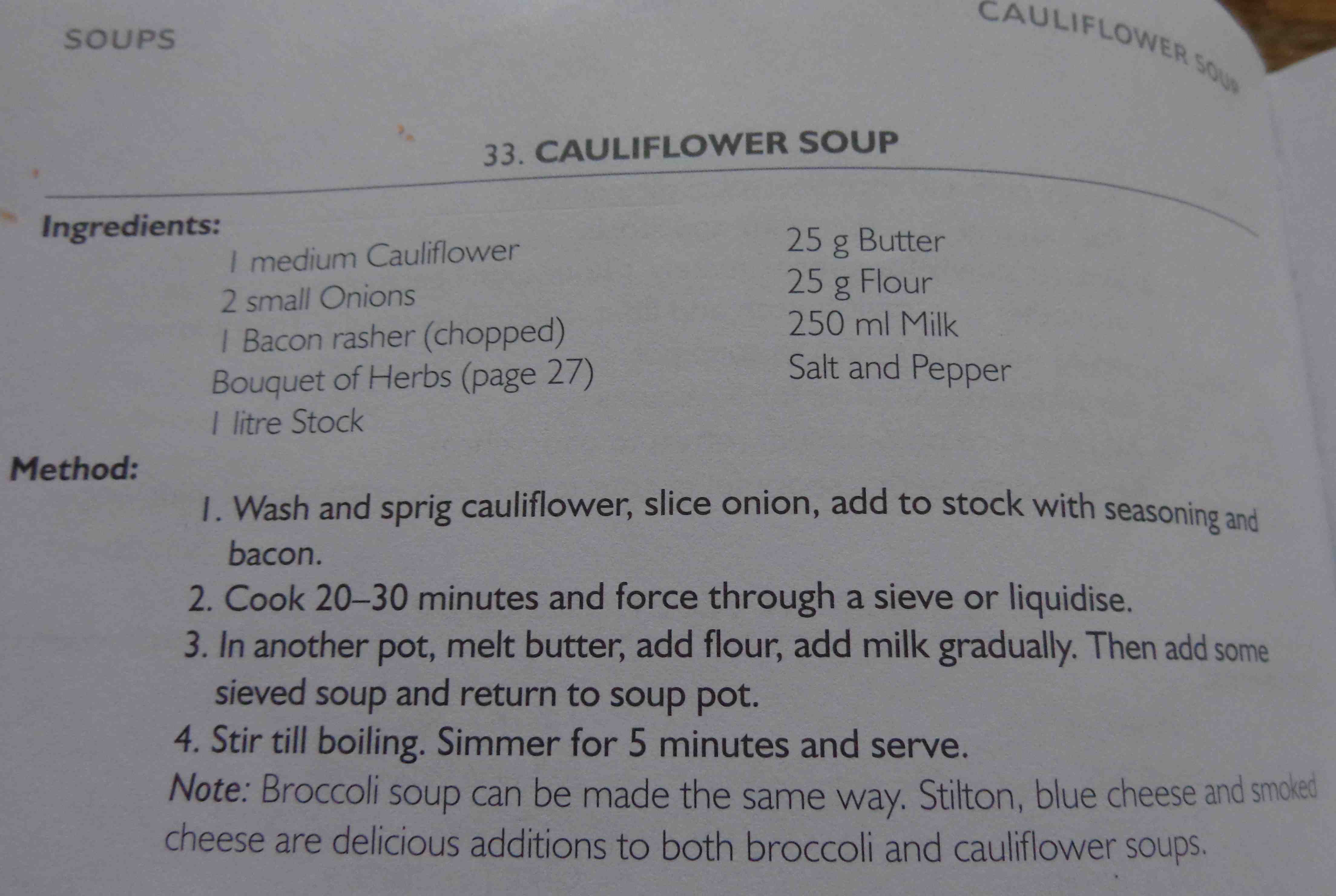
bookIt’s snowing really heavily here, so for lunch I made myself a hot bowl of cauliflower soup from The Glasgow Cookery Book with a bacon sandwich on the side. I have to say, the bacon ration is the saving grace of this whole process. Wartime food can seem so bland, but just adding a rasher of bacon to the soup or sandwich is great on the taste buds! I did adjust the soup recipe a little – I didn’t have a bouquet garni, so I just used a bay leaf, and used one leek instead of the second onion – but it tasted great.

recipe

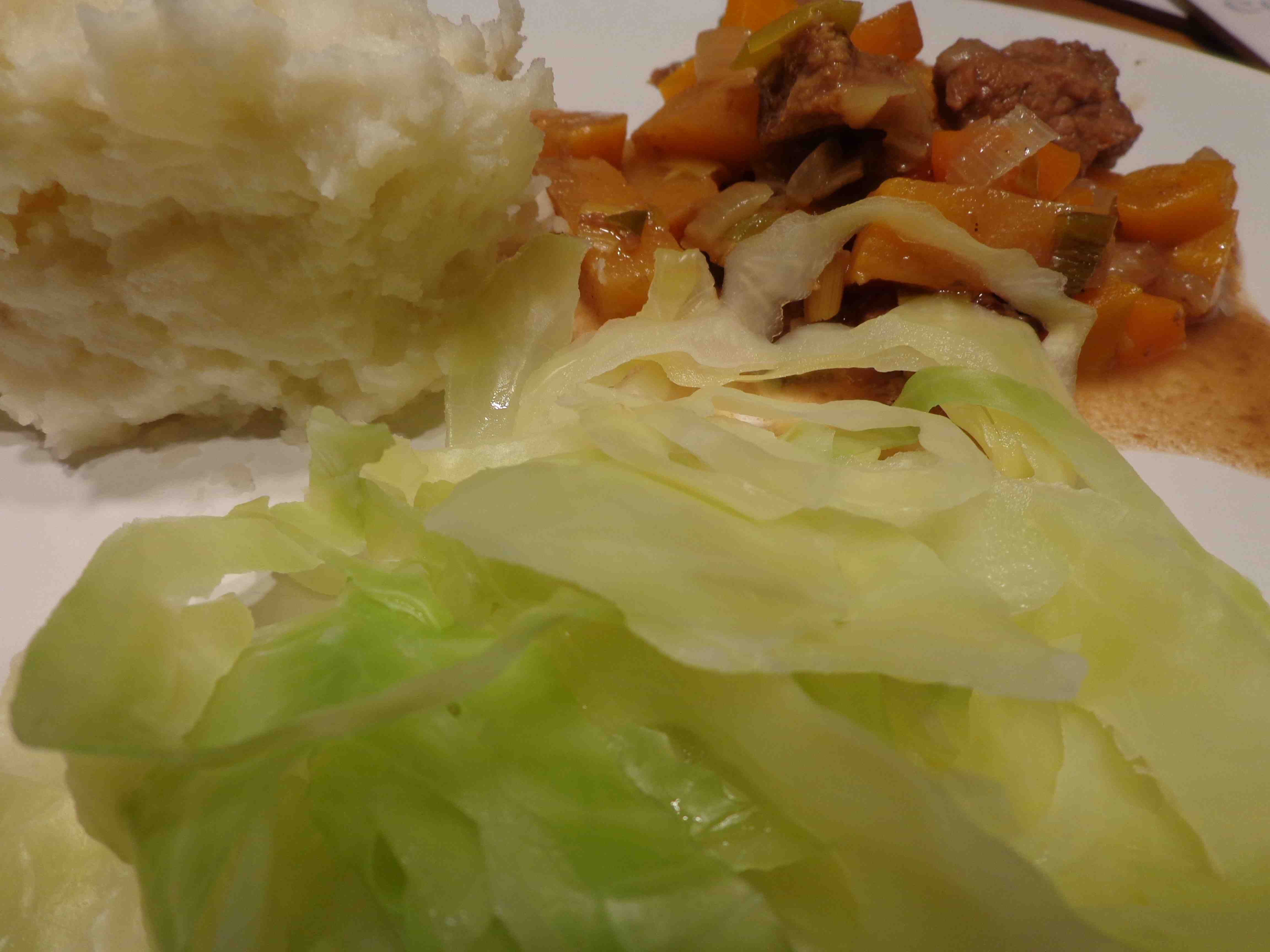
Another three course meal for dinner tonight.  We started with cauliflower soup.  (I’ve made rather a lot of it, so we’re going to be eating it for a couple of days!)  That was followed by a beef casserole, cooked in the slow cooker, served with mashed potatoes and cabbage. It was the first cabbage, other than raw, that I’ve eaten voluntarily since I was a child. You know what? If you cook it in barely any water and add some butter – as instructed on the wartime video, 2 Cooks and a Cabbage, I posted a couple of days ago –  it isn’t bad at all. And then pudding – yay!  I made baked apples, as per The Glasgow Cookery Book, stuffing them with a mix of sultanas and the delicious golden syrup I bought this morning. Am I full?  You bet!

cabbgeapple

I love going to the cinema, so I asked Anne some questions about going to the ‘pictures’ during the war. This week, I’ll be showcasing her answers.

anne2013Clark Gable was top box office, but then so were James Steward, Gary Cooper, Ronald Colman, Spencer Tracy et al. In Britain it was Leslie Howard who was the biggest name with films like ‘Pimpernel Smith’ and, indeed, ‘The Scarlet Pimpernel’ himself. Bing Crosby was the big singing star and had been for many years, but Frank Sinatra was knocking on the door by 1940 – the rest is history. Crosby teamed up with Bob Hope and Dorothy Lamour around 1940 with the first of their one-a-year ‘Road to…’ films which were tremendously popular. Maybe the biggest change was in musicals: as well as Astaire/Rogers there had been years of Jeanette MacDonald/Nelson Eddy films in Viennese-type or ‘Rose Marie’- type stories. Suddenly the US produced a few films set in Latin America -‘South American Way’ comes to mind; the main star was usually Don Ameche joined by someone like Alice Faye, and later Betty Grable the first pin-up girl, and moved on to the ‘poor glamour girl makes good on Broadway’ genre, until ‘Oklahoma’ changed everything again later on.

Wartime Rations – Day 7

Having completed one week of eating wartime rations, this evening is an opportunity to work out what I’ve done right, what I’ve done wrong, and plan for the upcoming week.

What I’ve done right? Despite many temptations, I’ve stuck to my rations. (We went to the cinema today and nary a piece of popcorn passed my lips!) I’ve eaten more healthily in the past week than I have for a while, and although I slipped a bit vegetable-wise today – it’s been a bit bread/potato heavy –  one day out of seven isn’t bad. This evening I got a bit of a ‘fat’ craving, so finished up my meat ration with a side order of chips. Making chips at home during the war became more difficult as fat rations were limited, but fish and chip suppers were still available at the local chippie or restaurant.

chips

What I’ve done wrong? Because I wasn’t sure how to make the rations stretch for the week, I ended up not actually eating them all.  I’ve been left with 2 pints milk, one powdered egg, about 5 ozs fat and most of my sugar.  Good news in a way because it means I can add those rations to next week, but bad because the rations were carefully designed for health, so I really should get that milk, egg and butter in to me!

The plan for the upcoming week? I had underestimated just how much time cooking everything from scratch would take –  even though I’ve cheated a couple of times, microwaving a baked potato for example – so I’ve been a bit sparse adding Anne’s comments and what was going on in the war to my daily postings.  As from tomorrow, that will change!

One observation about something we take for granted that must have been so different during the war. Driving home from the other side of Calgary this evening, we crested a hill and saw the city spread out in front of us, thousands upon thousands of lights glittering in the dark. Sky scrapers sparkled and traffic lights blinked red and green in the night. It was stunningly beautiful. And as I sit here writing this in my study, I have my blinds open and can watch car headlights swing around corners, enjoy the Christmas lights still twinkling across the road, and marvel at the misty waxing moon rising in the sky. If this had been wartime, I would have had to go outside to look at the moon, and beautiful though the moon is, I find there’s something magical about city lights and the thousands of lives they reflect.

In the British wartime blackout, all that life would have been hidden. And frightened, waiting for the bombs to fall.

How fortunate I am.

Wartime Rations – Day 6

Although I’ve been eating wartime rations this week, apart from experimenting with some soup recipes, most of the meals have been family dishes my mother cooked when I was growing up.  Mum and Dad married in 1938, so with rationing introduced in 1940 and not ending completely in the UK until 1954, she spent 14 out of the first 16 years of her married life feeding her family under rationing conditions.  I was born l-o-n-g after the war ended (although not so long after rationing finished), so perhaps that’s why the meals I’ve cooked this week have felt ‘familiar’ and reminded me of my childhood.

cookbook

But at least all those evening meals –  so far – have contained meat.  Today – apart from treating myself to a toasted bacon sandwich from my rations for breakfast – our evening meal had to be meat free as I’m just about out of our meat ration for the week.  I turned to Marguerite Patten’s book for inspiration. With so many ingredients not available during the war, the index revealed a lot of ideas for ‘mock’ meals; mock apricot flan, mock cream, mock crab, mock marzipan, mock chocolate.  I decided I would give ‘mock goose’ a try – even though I’ve never actually eaten real goose in my life.

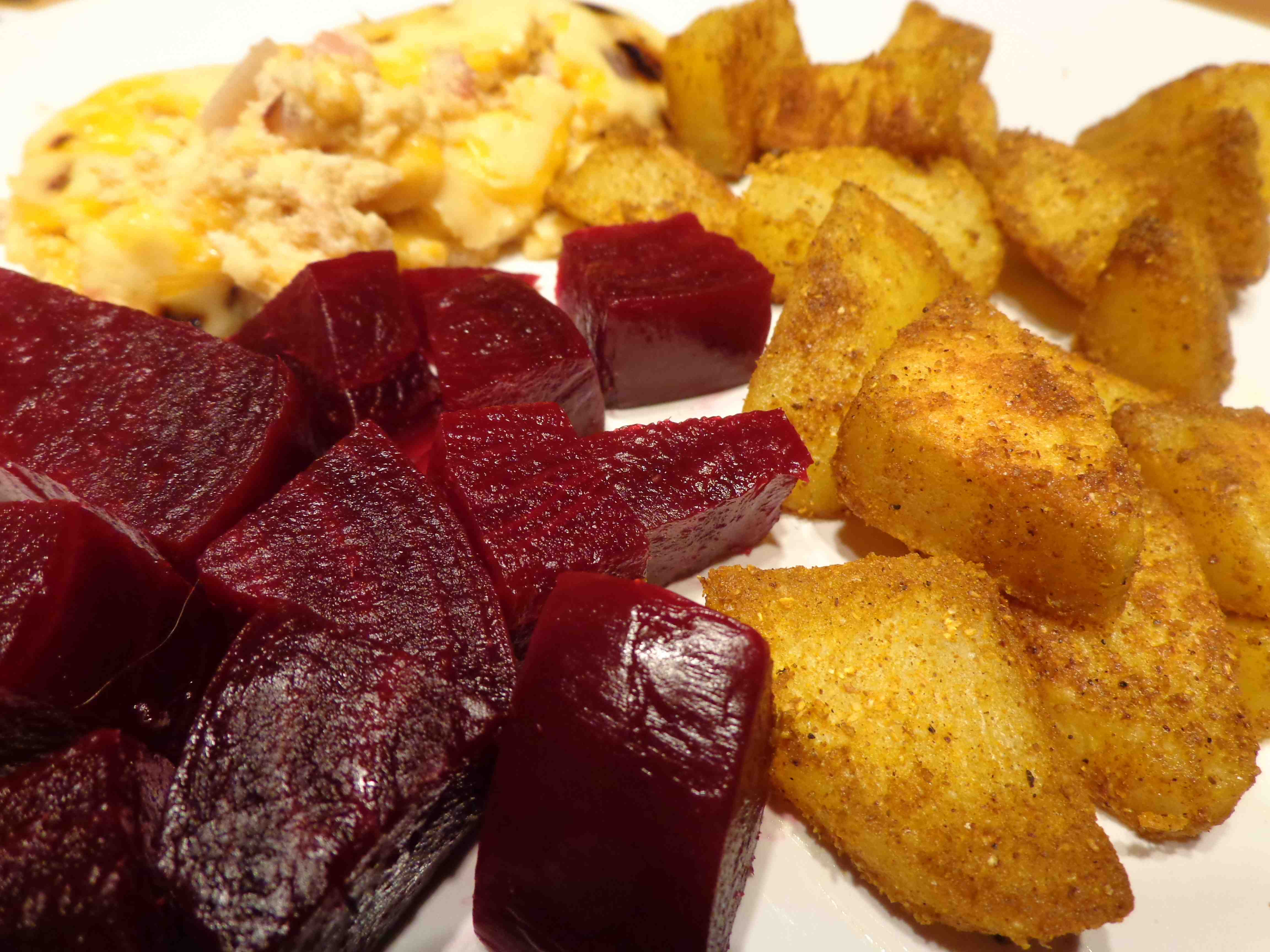
mock goose

Consisting of apples, potatoes, cheese, stock and sage, it resembled – and tasted – more like scalloped potatoes than anything else.  And it tasted fine – for a side dish. I can’t believe I actually found myself craving a juicy steak, lamb chop or chicken leg this evening. And that’s after only 5 days. I’m eating wartime rations out of curiosity, to try to learn a little about what it must have been like on the home front, but in many ways I’m kidding myself. If I’d really wanted to, I could have nipped down to the supermarket and easily bought a steak to put on the BBQ this evening. But imagine 14 years of wartime rations.  Four-teen years.  How did they do it? Of course they did it because they had to, but for the regular person who couldn’t afford to go to a fancy hotel for dinner, it must have been so drab.

Wartime Rations – Day 5

Another very brief blog this evening.

Today has been ‘leftover’ day – soup and coleslaw salad at lunchtime, mince and tatties for dinner – so I haven’t added any photos. What I am quite pleased about is that I still have quite a lot of butter, milk and cheese left for the weekend, so I’m hoping to get some baking done on Sunday.

Given how important the role of the housewife was in the war effort, I’m really surprised there are very few archival films out there depicting the challenges they faced. I’ve been very fortunate in being able to buy all my ‘rations’ at my once weekly shopping and store meat for later use in the freezer.  I can’t imagine how hard it must have been to have to queue almost daily at the shops, not even knowing if there would be any food to buy to make an evening meal for the family. And can you imagine how miserable it must have been in the winter when it was cold, wet or snowy?

Anyway, here is one video I did manage to find – about how to cook cabbage correctly. Anyone else annoyed that the girls have to do all the work while the boys stay outside playing??

Wartime Rations – Day 4

Yesterday evening I pressed the ‘publish’ button by mistake when I was only halfway through my blog, so tonight I’ll be more careful not to make the same mistake.

Conscious that most of the vegetables I’ve eaten in the past few days have been cooked, I decided to follow my lunchtime leftover Brussels Sprouts soup with a big bowl of red cabbage, carrot and sultana coleslaw. It tasted just as delicious as it looks and, with no citrus fruits available in Wartime Britain in January, I felt very virtuous having boosted my Vitamin C intake!

colesalw

For dinner, I tried out a couple of recipes from The 1940s Experiment. The first was Oatmeal Soup – only I forgot to add the milk at the end and used a leek instead of onion. My husband was more than a little suspicious of the idea of ‘oatmeal’ in soup, but I have to confess, this was the best soup ev-ah! Dead simple: pint of broth, one leek chopped, two carrots grated, three tablespoons of oatmeal, and a smidgen of butter for frying the leek before adding it to the stock.  It couldn’t have been more simple and I honestly think it’s the best soup I’ve ever made.

soup

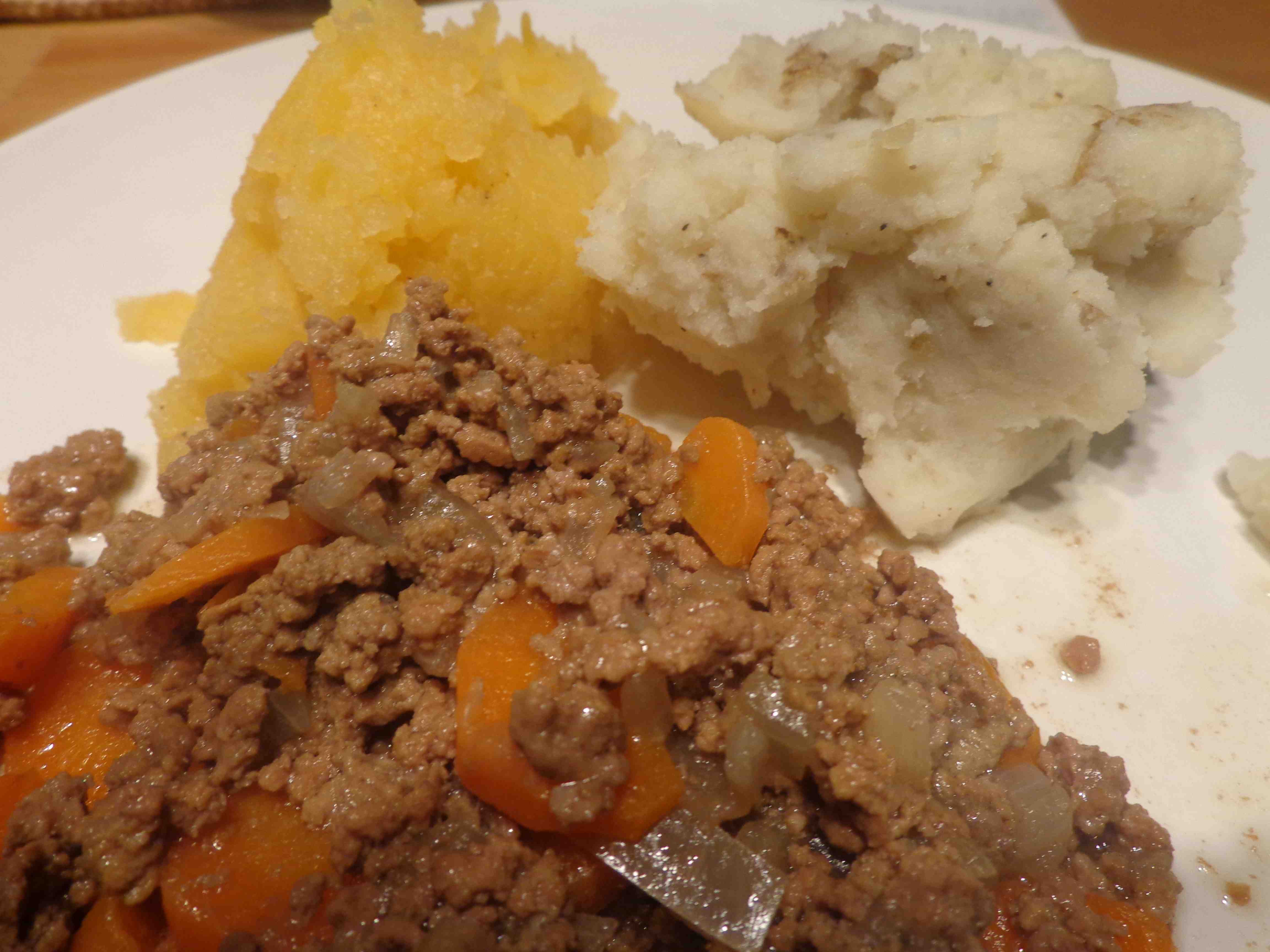
mince

Main course – a real Scottish dinner of mince, tatties and turnip – doesn’t look very appetizing here, but tasted good. Real comfort food.  And I was a good wartime wife tonight because I didn’t peel the potatoes, only scrubbed them before boiling them. I wondered about mashing the skins in with the potatoes, but it didn’t make any difference to the taste.

And then… dessert.  I rarely ever make puddings, or a three course meal for that matter – maybe once a week if you’re really lucky – so ending our wartime meals with a sweet every night is a real treat. Tonight it was Bread Pudding, and the recipe again taken from The 1940s Experiment website.  Deee-lish! Given we’re eating so well, I did rather dread standing on the scales this morning, but if anything, I’ve lost a little weight over the past few days.  Great food, never hungry and losing weight?  Bring it on! The only downside is the amount of time it takes to prepare and cook the meals. (And clean up afterwards.)

puddin

Getting back to the war… I was surprised that the blackout started so early in the afternoon in Glasgow and finished so late next morning. I asked Anne how that affected her, especially going to school in the pitch dark. Was she allowed to use a flashlight to see the pavement? Did the classroom windows have to keep the blackout blinds down until 9.17am – or whatever time the blackout ended?

anne2013Memory is very hazy on this, but what there is tells me that hand torches were forbidden unless they gave only a tiny slit of light or else had the clear glass painted or covered in blue – like the lights in railway carriages and, I suppose in buses and trams, but I have no memory of them.  I don’t remember any difficulty with light when climbing up George St to get to Hillhead Junior School – I know Mother used to come down to ‘see me across Byres Road’ – blackout or no – after that I was on my own. Perhaps there was just enough light even though the official blackout hadn’t ended.  It was when I went to Kippen after the Clydebank Blitz that I discovered that my secondary school in Balfron was really Hyndland School shifted en bloc – pupils and teachers.  Their teaching suited me better, but I was unfortunately still sent back to Hillhead when I returned to Glasgow.

Wartime Rations – Day 3

I’ve had a really busy day, so I’m afraid this is going to be a short post talking only about today’s rations. The one thing I’ve discovered about eating fresh wartime food is that cooking it takes up quite a bit of time.  Especially when I’m trying out new recipes.

Breakfast and lunch were the usual – toast for breakfast, then soup, a sandwich and fruit for lunch.

Soup

I experimented with dinner tonight. With not a huge variety of vegetables available at this time of year during wartime, I decided to try out a recipe for Brussels Sprouts soup which I found in The Glasgow Cookery Book. My first reaction was Ewwww.  But you know what?  It was absolutely delicious.  (Apologies for the blurred photo.) I only made enough for three small servings (one each tonight and one for my lunch tomorrow) but I wish I’d made more and will definitely ‘supersize’ it next time!

I’ve never cooked with powdered eggs before, so tonight I thought I would make a bacon/onion/cheese frittata as I didn’t have time (or the egginclination) to make a quiche pastry from scratch. To be honest, it didn’t look great, but tasted okay.  Not great, just okay. Thank goodness for the onion and bacon to give it flavour.  However the Curried Potatoes that I took from The 1940s Experiment website were a great hit and very simple – although I did miss out the oatmeal.  (Oops! I just pressed the publish button by mistake and don’t know how to undo it, so some people reading this might only get half the blog!!)

For dessert we had individual apple crumbles again.

As I said above, preparing and cooking all this homemade food from scratch is very time consuming… but the smell in the house is fabulous.  A visitor has just walked in the door – my husband and I finished eating about 30 minutes ago – and her first comment was, “Wow, something smells good.”

Even more important, it tastes good!

Wartime Rations – Day 2

It might only be my second day of rations but I couldn’t quite face porridge for breakfast again. After the recent excesses of the holiday season, my mindset saw it as shades of Oliver Twist in the workhouse begging for more gruel.  Give me a couple more days and I’ll be back in the swing of it. Instead, I enjoyed some toast with a meagre scraping of butter and precious jam with my morning cuppa.

For lunch I finished off the homemade soup and leftovers from last night’s dinner, so I’m not going to bore you with those repeated photos.

We’re probably going to have to eat at least one – maybe two – meatless evening meals per week, so I tried to ease ourselves gradually into it this evening with baked potatoes, with a bacon and cheese topping, and carrots on the side. For pudding, I made individual apple crumbles, using one (large) apple and half the crumble mix.  I was still left with 1/2 apple and plenty of topping, so guess what we’re having for pudding tomorrow!

Potatocrumble

Because I’m such a modern day TV addict,  I wondered what radio programmes – and the actual radio set itself – were like during wartime.  Also, I’d heard the newsreaders were supposed identify themselves – something to do with ensuring accurate news during an invasion, I think. I asked Anne, and here’s her reply.

anne2013Radio?  No. no – WIRELESS SET.  It sat on top of the coal bunker, was about 16″ across, 10-12″ high and 9-10″ deep.  Yes, it took a while for the valves to warm up, so you switched THE WIRELESS on a little before your programme was due to start.
Don’t know what it was made of – it wasn’t wood, though many wireless sets were.  It looked like a mottled brown plastic case but of course it couldn’t have been.  The speaker was behind a gold piece of cloth, and there were two knobs:  one for volume and one which changed the station, arrayed in a narrow arc at the bottom.  The foreign station names fascinated me and I used to switch from one to another whenever I could, to listen to the strange languages.  It arrived about 1937 as a gift from Alex to Mum, but of course everyone had use of it, and woe betide anyone who wanted to use it – or made any noise – if Dad was glued to it for a cricket match or a special football match.  It was treated by Mother as if it were sentient – no-one could talk if the wireless was on.  It was as rude as interrupting a person talking, Mum said.   Don’t remember a smell. 

Mary had a wireless in Kippen, but there was no power there and it needed two batteries to work, a solid one about 10x5x3″ deep, and a liquid one in a heavy glass container with a handle so you could carry it to a petrol station or other place to get it re-charged. Which reminds me that we lived by the light of oil lamps. 

The wireless was on most of the day – except during the frequent power cuts. Yes the newsreaders gave their names John Snagge, Bruce Belfridge, Alvar Liddell etc . Lots of b-i-g dance bands with half-hour programmes: Henry Hall, Geraldo, Jack Jackson (my favourite) et al. The biggest ones of around 25-30 instruments called themselves dance orchestras – but it still wasn’t as loud as today’s pop. One of Mother’s favourite wireless programmes was Sandy McPherson on a cinema organ.

Anne mentioning my Uncle Alex above made me decided to check out The Glasgow Herald to see what other programmes were on the WIRELESS on January 7th, 1942.  (Uncle Alex was a reporter with the newspaper before he joined the RAF.)  Here’s a selection.

7.30am: Exercises. 8.15: The Kitchen Front. 10.30: Music While You Work. 2.30: Billy Cotton and his Band. 9.20pm: Tamburlaine, a play by Christopher Marlowe.

What else was in the paper that day?

The blackout in Glasgow started at 5.32pm in the afternoon and ended at 9.15pm next morning.

The New Year Sales were coming to an end.  You could buy a pair of ladies’ shoes for 30 shillings, a nightdress for 8/11,  or a ‘Hampster’ fur coat  (Really?? I hope I read that wrong!) for 19 Guineas.  Even though you could afford the purchase, I think the points system was operating by this time, so I’d love to know how many points you needed for a fur coat.

It was still pantomime season in Glasgow, with Aladdin playing at the Pavilion Theatre and Dick Whittington at the Alhambra.The afore-mentioned Geraldo and his Orchestra were performing at the Glasgow Empire.

An enraged letter to the editor discussed a particular Glasgwegian’s fury at the proposal to plough up golf courses for agriculture while so much untilled land was still available in the countryside.

Women born in 1921, whether married or single, were to register for war-work on Saturday morning at their local Labour Exchange.

In the Situations Vacant, there was a call for a butcher – weekly wage of 6 pounds .  Also a hairdresser – wage not mentioned. And there was another advertisement inviting women – not liable for National Service – to apply for clerical positions in engineering works in the Glasgow Area.

A worker in Paisley was charged with failing to participate in his works fire duties and was fined 4 pounds – to be paid within 8 weeks – or face 6 weeks imprisonment.  His excuse was that he’d gone to a dance and ‘forgotten about the matter’.

But there was some tragic news in there, too. On January 6th, 6 miners were killed in a gas explosion in Lancashire. But that wasn’t the only catastrophic accident in the first week of the New Year. On New Year’s Day, there was an explosion at the Sneyd Colliery near Stoke-on-Trent where 57 miners lost their lives.

mine screen shot


Wartime Rations – Day 1

What was it Robert Burns said about the best laid plans…? I decided over a month ago to start eating ‘wartime rations’ today, so you’d think I’d have been a bit more organised about it. Wrong! Having cleaned out my fridge yesterday of all the non-rationed foods and eating porridge for breakfast this morning (milk and a wee bit of sugar)…

Porridge

… lunchtime found me racing down to Safeway to buy my rations for the week.  Healthy ‘perimeter’ shopping which cost a fraction of my usual bill. (The carton of eggs you see is three weeks supply of shell eggs – I still have to pick up powdered eggs.)

safeway

Last time I ate wartime rations it was spring/summer, so I could enjoy lettuce, tomato and cucumbers in my  ‘Oslo meal’ sandwich. (Oslo meal = sandwich, piece of fruit and glass of milk).  But with no salad available in January – and little advance prep on my part – I had to make do with a carrot sandwich.  It looks a bit odd, but actually tasted okay. Fortunately, I had made some homemade soup yesterday evening, so that was nice and warming on a cold day!

Oslo Meal

While discussing dinner with my husband last night. I told him I would be making vegetable curry for our first evening meal. (I want to keep the bulk of my meat ration until later on in the week.) However, when I came downstairs this morning to discover he’d really got into the spirit of things and made himself porridge for breakfast I relented. Sausages were available during the war off ration, but were hard to get and the quality was not always the best.  Tonight they were available and, along with more homemade vegetable soup, we enjoyed a Stewed Sausage recipe of my mother’s  – probably my grandmother’s too – made with apples, leeks and carrots with beetroot and mashed potato on the side.

dinner

Okay, on to some historical stuff.

As this is the first day back at school for most children after the holidays, what was discipline like in wartime schools? During those years, Anne went to school in Glasgow and was also evacuated into the countryside, so here are her recollections.

At Hillhead, very strict. All of us had to sit with arms folded or hands clasped behind our backs, according to a particular teacher’s whim, unless we were actually writing. A whistle was much used in the playground to stop unladylike behaviour. At Hyndland/Balfron it was a bit looser: my history teacher for instance didn’t mind that I listened to his lectures with my head resting on my arms on the desk – he took it that I was listening, which I was. But that would never have been countenanced at Hillhead. 

As for what was going on in the war on this day… although it wasn’t voted in until March, on January 6th, 1941, FDR asked Congress to support Lend Lease, offering the allies money and supplies in the war effort. According to Wikipedia, the vote was split down party lines with the Republicans against, seeing it as a step to war. Through Lend Lease, the US supplied the Allies with  $50.1 billion ($659b in today’s money) worth of goods.  Repayment of the British debt started in January 1951 – although the annual payments were deferred for 5 years.  Britain submitted its final installment of $83.3million to the US on January 29th, 2006.

WW2 Month of Rations – Research

As with last time, I will be including the images of the wartime food I eat each day with a little history of the war.

What I personally enjoyed most about my previous ration challenge was hearing the stories my Aunt Anne, who was a child during the war, contributed to my blog, as well as her advice on what I was doing right… or wrong.  (No rice pudding!)  I’m thrilled she’s given me some more stories this time around.

anne2013

For research,  I’m using The Chronicle of the 20th Century, which describes the events of each day of the century.  There are all kinds of WW2 sites available online, but I recently found a link to Real Time’ WW2 Tweets.  It’s absolutely fabulous and I can’t recommend it highly enough.

history book

When it comes to the food, I’ll be mostly using three books of Marguerite Patten’s wartime recipes published by the Imperial War Museum –  We’ll Eat Again, The Victory Cookbook and Post-War Kitchen.

cookbook

There are also some great wartime ration websites out there, my favourite being The 1940s Experiment.  She has some great recipes and information, so please check it out!

And of course, there’s always Youtube.  Here’s an excerpt from an informative (and funny!) documentary series the BBC released a few years ago.