St Andrew’s Day

In keeping this blog, I’m learning all kinds of things I really should have known before.  Take St Andrew’s Day on November 30th.  Of course I knew he was the patron saint of Scotland and one of Christ’s 12 apostles, but I didn’t realise he was the brother of St Peter and also the patron saint of Russia, Ukraine, Romania, Greece and… Barbados, where it is also Independence Day!

In addition, St Andrew is the patron of fishermen, singers and unmarried women.  And if you suffer from gout, St Andrew is the saint to pray to. Traditionally, St Andrew’s Day marks the opening of the Christmas markets in Europe.

Scottish flag

St Andrew is believed to have been executed on a transverse cross on November 30th by the Romans.  This became known as the Saint Andrew’s Cross and was adopted as Scotland’s national flag – the Saltire. (The saltire was reputed to have been seen above the fields of Bannockburn in 1314 when the Robert the Bruce beat the English during the wars for Scottish independence.)

Happy St Andrew’s Day!


November 25th. On this day…

10 things that happened on this day in history.

2348 BC:  According to Biblical scholars, this was The Day of The Flood.

1491: The Siege of Granada, the last Moorish stronghold in Spain, began.

1703: The Great Storm in the UK. Lasting for 2 days, and bringing with it winds of 120mph, it killed over 9,000 people.

1835: Andrew Carnegie was born in Scotland.  By the time he died, he’d given away $350million.

1867: Alfred Nobel patented dynamite.

1885: Banff Park in Canada opened to tourists.

1897: Helen Duncan, the last person in the UK to be tried, convicted and imprisoned under the Witchcraft Act, was born.

1949: ‘Rudolph the Red Nose Reindeer’ appeared on the music charts.

1963: The body of JFK was buried.

1990: Lech Walesa won Poland’s first popular election.

Research

I still haven’t managed to make too much progress on finding out more information on the Canadian Native soldier who apparently died in Glasgow in 1916/17.  However, while researching information about him and his unit, I’ve discovered some great tidbits from The Glasgow Herald newspaper’s archive.

These were all taken from the paper’s December 7-10th, 1916 editions.  When it comes to ideas for stories, they’re an absolute gift for historical fiction writers.

Penpals wanted for Irish POWs imprisoned in Germany.

1,000 maids wanted in Canada.  Travel and personal costs all paid for. (Why did Canada need 1,000 maids in the middle of a war??)

An ex-soldier, who married at the beginning of the war in 1914, was discharged a year later for medical reasons.  His wife then ‘refused to take up house’ with him, so he ‘married’ another woman.  He was found guilty of bigamy and jailed for 2 months and the woman he ‘married’ jailed for 30 days!

A psychic, who told a woman her husband would die in France, was jailed for causing emotional distress and lowering morale.

An angry letter from a woman whose husband was a POW. She was required to donate over 2 pounds sterling a month to insure he received care parcels while only receiving 3/4 of that per month to house, feed and clothe her family. Imagine the physical and mental hardships she must have suffered caring for her family while worrying about her husband.


London versus Alberta

Here’s the challenge.  If you’ve read my blog, you know how much I love London.  My husband and I were supposed to spend three weeks there this December, with a side trip to Belgium (Brussels/Bruges, two hours on the Eurostar) thrown in.  We’ve had to cancel our visit, so is there any way we can replicate what we were hoping to see in Europe in Calgary/Alberta without visiting places we’ve already been?

LONDON: Marks and Spencer Xmas shopping. Jude Law in Henry V. Dennis Severs House. Geffrye Museum. Hamley’s Toy Shop in Regent Street. Carol Service at St Martin’s in the Fields. Ice skating and Xmas markets on The South Bank. National Army Museum. Making of Harry Potter, Warner Brothers’ Tour.

BRUSSELS/BRUGES:  Tour of WW1 battlefields. Belgian Beer. Belgian Chocolate! Belgian food! Walk along the canals in Bruges. Traditional Xmas markets. Herge/Tintin  Museum.

Can we do it?

Watch this space!


History Mystery – Part Two.

So much for my three scheduled posts a week! There are times I get a wee bit carried away with myself… and today has been one of those days. I just couldn’t get the mystery of the Native Soldier who died in Scotland out of my head, so instead of editing the manuscript I’m currently working on, I spent most of the day surfing. I still don’t have the answers I’m looking for, but I’ve e-mailed several institutions which I hope can help me. If they respond with information, I will let you know.

What I have learned is that the Govan Military Hospital was the old Govan Workhouse, built in the 1850s. The building is still in use as The Southern General Hospital and its speciality is neurology. If you’ve ever had a head injury and been tested on the Glasgow Coma Scale, this is where that scale was invented.

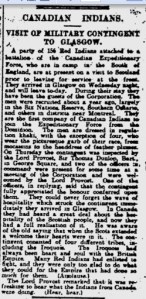
I also managed to rustle up an account from the archives of The Glasgow Herald which reported the unit’s visit to Glasgow, and I’ve contacted Glasgow City Council in the hope they have some photos of the visit.
HERALD

I’ve typed the article below, but in your reading please be aware that these were different times with different attitudes.

Glasgow Herald, December 9th 1916,  Page 8

CANADIAN INDIANS 

 Visit of Military Contingent to Glasgow

 A party of 156 Red Indians attached to a battalion of the Canadian Expeditionary Force, who are in camp in the South of England, are at present on a visit to Scotland prior to leaving for service at the front. They arrived in Glasgow on Wednesday night and will leave today. During their stay they have been the guests of the Corporation.

 The men were recruited about a year ago, largely in the Six Nations Reserve, Southern Ontario and others in districts near Montreal. They are the first company of Canadian Indians to join the Expeditionary Force from the Dominion. The men are dressed in regulation khaki, with the exception of four, who wore the picturesque garb of their race, from moccasins to the headdress of feather plumes.

 On Thursday the contingent was inspected by the Lord Provost, Sir Thomas Dunlop Bart, in George Square, and two of the officers in command were present for some time at a meeting of the Corporation and were welcomed by the Lord Provost. One of the officers, in replying, said that the contingent fully appreciated the honour conferred upon them. They could never forget the wave of hospitality which struck the contingent immediately they arrived in Glasgow. In Canada they had heard a great deal about the hospitality of the Scottish people, and now they had a full realisation of it. He was aware of the old saying that when the Scots extended a welcome their hearts were in it.

 The Contingent consisted of four different tribes, including the Iroquois. The Iroquois had always been heart and soul with the British Empire. Many Red Indians had enlisted to fight, and they were only too glad to do what they could for the Empire that had done so much for them. (Applause.)

 The Lord Provost remarked that it was refreshing to hear what the Indians from Canada were doing. (Hear, hear.)

History Mystery

Although I’ve chosen to make Canada my home, I still love my country of birth. So when I find a historical story that connects the two I get really excited!  But sometimes that excitement can lead to ‘historical’ frustration.

The book,  TEA AT MISS CRANSTON’S, (not related – at least, I don’t think so) recounts the memories of Glaswegians growing up in the city in the first half of the 20th Century. Inside its pages I found this fascinating nugget.

Chapter 15 – Their Weans Would Never Be. P127

Another fleeting recollection of 1915 was the swift passage through wartime Glasgow in a bleak week of smirring drizzle and gloom, of an exotic party of Canadian Indian troops commanded by Chief Clear Sky.  They were on their way to the war and sampled Glasgow hospitality enjoying a first, and no doubt last, taste of black pudding.

But they left one young Indian behind.  His name was Gay Flier.  He was very very ill with flu and died in Govan Military Hospital.  My grandpa had been seeing to Chief Clear Sky’s men when they were in Glasgow and so’s not to let the boy get buried in an unmarked grave he claimed the body and saw to it that there was a right funeral in Glasgow with magistrates there, a gun carriage and a party to fire a salute at the grave.  It wasnae among his own open-air folk, but it was better than being not heeded at all.

Absolutely incredible! I had to find out more, so the last time I was in Glasgow I headed to The Mitchell Library to undertake some research on this young native Canadian soldier. Although I came up with plenty of newspaper coverage of the regiment landing in Glasgow and going through to Edinburgh (click on this link) there was nothing about the soldier himself.

I’m determined to solve this mystery. If anyone out there has any ideas how to go about this, I would love to hear from you!

Outlander

The first book in the Outlander series definitely ranks in my top ten list of favourite reads. If what you want is to lose yourself in a blockbuster story, it’s got it all; great characters, a love story, adventure, history and a little fantasy to boot. Best of all, it’s set in Scotland!

It’s taken a long time to get this to the screen. There was talk of a movie at one time, but it’s too big a story for a two-hour film. Now, probably partly due to the success of Game of Thrones, it’s just started filming in Scotland with a 2014 TV air date.

I’m excited yet nervous at the prospect, and can only hope the producers manage to realise Diana Gabaldon’s vision in the same way David Benioff and D.B. Weiss managed with G.R.R. Martin’s epic.

We’ll have to wait and see, but until then you might want to check out this website to keep up to date on the series’ progress.

http://outlandertvnews.com/2013/10/photos-of-outlander-filming-1940s-claire-and-frank

The Great Canadian Bucket List.

My daughter has travelled the world and one of her favourite travel writers is Robin Esrock.  He was here in town a few weeks ago promoting his new book The Great Canadian Bucket List so I went along to hear his talk.

We all know Canada has the most amazing scenery and fabulous history.  Living here in Calgary, I’m fortunate enough to have the Rockies in my backyard. But I didn’t know Canada has its own Dead Sea.  Or its own Da Vinci Code? Did you?

I’ve always fancied a cycling holiday in France – all that great scenery, food and wine  – but it turns out I don’t have to cross the ocean to savour the experience. Quebec has its own 230 km bike trail Le P’tit Train Du Nord (ski trail in winter) that sweeps through forests and villages, past rivers and golf courses and – best of all – is mostly FLAT!

Yesss!

Dame Margot Turner

Of the four women I’ve presented in this run up to Remembrance Day, Dame Margot Turner is my personal favourite. While we bandy around the word ‘hero’ rather easily these days, I’ve found that the mark of a true hero(ine) is that you often don’t realise you’re in their presence. 

As a young Lieutenant in the QAs (British Army Nurse), part of my training in Aldershot included a visit to the QA Museum. It was a fascinating place and when the tour was complete, I duly went into the bookshop to buy a book on the regiment’s history from the older, grey-haired woman, dressed in a yellow sweater and beige trousers, serving behind the counter. Our instructor nudged my arm. “That’s Dame Margot Turner,” she said. “You should ask her to sign your book.” I had no idea who Dame Margot might be, but my army instructor had told me to ask for a signature, so I asked for a signature.

What a revelation.

Born in 1910, Margot Turner joined the QAs in the 1930s.  Her first overseas posting was to the Far East and she was serving in Malaya when the Japanese invaded in 1941.  Ultimately the only survivor after her ship was torpedoed, she kept herself alive on a makeshift raft, under the blazing sun, by condensing water in her powder compact until she was picked up by a Japanese ship.

Margot Turner then survived the following three and-a-half years in various brutal prison camps. After the war was over, she continued serving in the Queen Alexandra Royal Army Nursing Corps rising to the rank of Colonel Commandant before retiring. She was awarded the MBE and DBE for her service.  This video shows her accompanying Princess Margaret on a tour of the QARANC Centre in Aldershot.

Dame Margot Turner’s story was told on the British Television Show This is Your Life, where she was reunited with some of her former camp colleagues.  The show ended with them singing The Captive’s Hymnwritten by one of their own, which they had sung in the camps.  A young producer watching the show, was so inspired by Dame Margot’s story that she went on to create one of the BBC’s most loved series of the 1980s Tenko, which told of the horrors these brave women experienced.

Dame Margot Turner.  1910-1993.  True Heroine.

Remembrance Sunday

My Dad, who served in WW2, was one of the 350,000 soldiers rescued from the beaches of Dunkirk in May 1940. Thereafter, he attended church for only one of 4 reasons;  Baptisms, Weddings, Funerals and Remembrance Sunday.

The Saturday evening before Remembrance Sunday, we’d gather around the TV as a family to watch the Festival of Remembrance from The Royal Alberta Hall in London.

Then, as now, the two minute silence and falling of the poppies, each one representing a soldier (male or female) who perished in a British War, remains one of THE most profound ceremonies I have ever witnessed.