Wartime Rations – Day 10

Breakfast and lunch were the usual.  Although I’m using quick oats for breakfast, I’m still finding that soaking them overnight – as in the ‘olden’ days – really helps make the porridge much thicker and creamier.

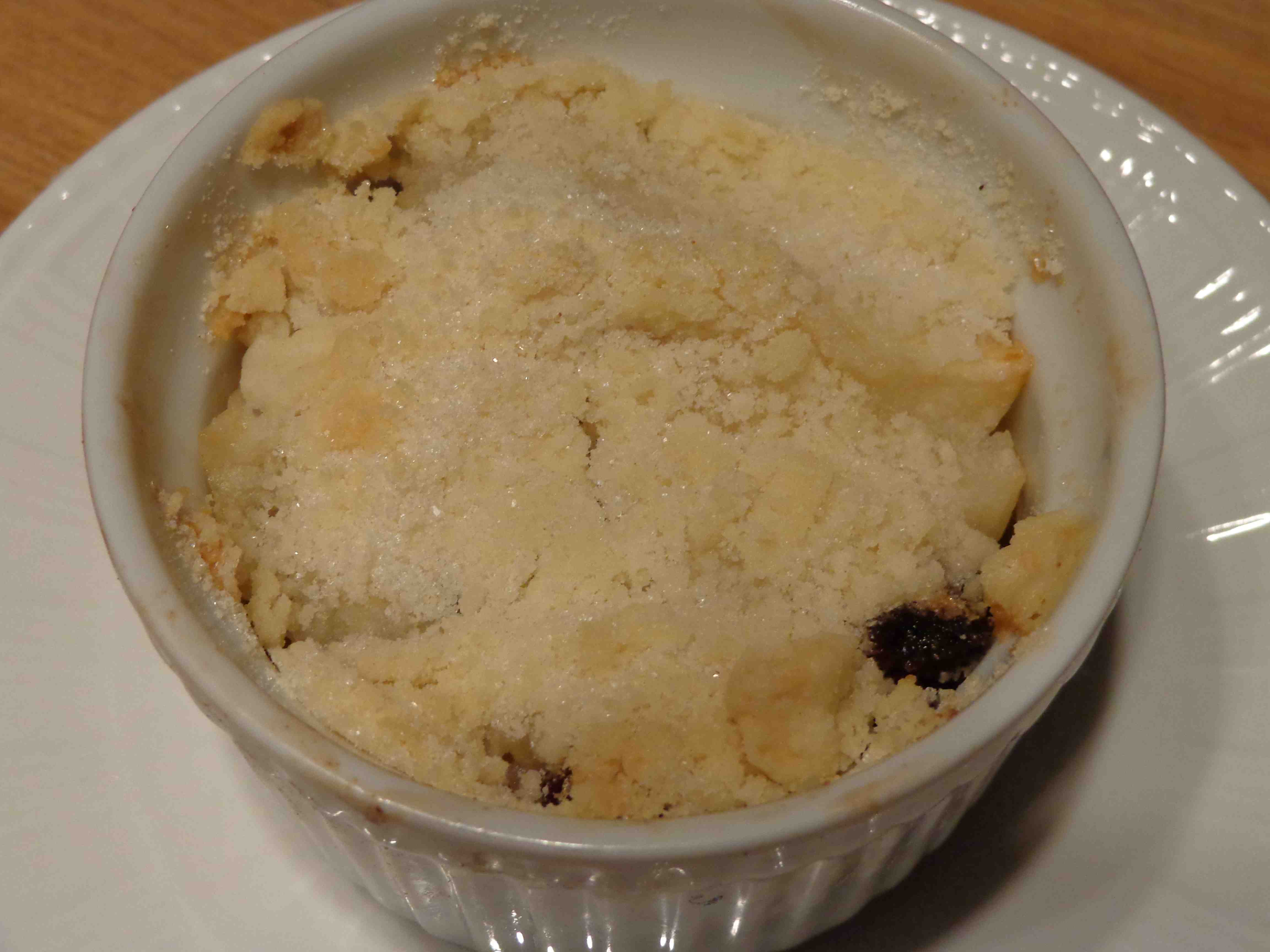
Dinner was ‘only’ two courses this evening; fish pie, with pear and sultana crumble to follow. (My husband, who hates fish, had the leftover casserole.) I’m loving these wee pudding ramekins. I made a full measure of crumble (stored the rest in fridge for the next few evenings) and shared one pear between us. Having something sweet at the end of the meal is such a treat and I’m finally starting to lose my craving for chocolate.  Long may it continue.

fish piepear crumble

Getting back to Anne’s memories of wartime cinemas… When war was first declared, all public places – theatres, cinemas etc – were closed for fear of mass casualties in bombing raids. But the ban didn’t last long and they were quickly re-opened. So I wondered if they continued to have Saturday morning films for the children and, if so, what kinds of treats were available to eat?

anne2013Yes, there were Saturday morning films at the Grosvenor but I only went a couple of times I think – not particularly to my taste. There were a few cartoons, not very good though I loved Donald Duck, and Goofy too but saw nothing funny in Mickey himself. There was often a cowboy film (Cowboys and Indians was the main game of boys still) and some slapstick of the Laurel and Hardy type – Charlie Chaplin was disappearing from screens, again not my type – even as a child I couldn’t bear the humiliation he, or Laurel and Hardy were suffering before my eyes, even if they finally came out on top.

As for treats… Not a lot if you hadn’t any sweetie coupons. Fruit and other foods were not forbidden but they were discouraged. I was OK – I went on to the Black Market and sold my sweet coupons so I could buy a cold scotch pie* or sausage roll munch through – disgusting, I was.

*’Scotch’ pies were originally called ‘mutton’ pies; minced mutton was the filling – though what they put in any wartime ones (few and far between) goodness only knows. It was only when lamb and not mutton was offered by butchers and lamb became much more expensive that ‘Scotch’ pies were filled with minced beef.  You’ll never know what a real Scotch pie tasted like!

Wartime Rations – Day 9

No photos today as everything I’ve eaten, apart from my morning porridge and toast, has been ‘leftovers’ – cauliflower soup and casserole. In fact, when my husband heard that dinner would be a choice between leftovers or fish pie, he very suddenly remembered he had an evening business dinner that he ‘had’ to attend.

So, I’ll go to straight to Anne’s memories. Staying on the cinema theme, I asked her the following: What do you remember of the cinema in those times?  Did the ushers always wear uniforms?

anne2013They were a world I wanted to live in.  Remember I was alone by now with my mum and dad, the others busy with babies or fighting, so home life was for me a bit dull – until *Clydebank, when the countryside and its freedom hit me like a nice kind of bombshell. Until then, the cinema was my escape and it was easy (if I had enough pennies) because of the Grosvenor and the little ‘Hillhead‘ cinema just around the corner near the top of Byres Road – it was 1/3d, 3d more expensive than the Grosvenor, but if I managed to save 5/- I could buy a book of 6 tickets which worked out at 10d a time.

Yes, the ushers did wear uniforms: a self-colour shirt-type dress or a skirt and white blouse; in the interval an apron was added if there was any ice-cream or drinks to sell.  And torches of course to guide you to a seat – not welcomed in the back row!

*Clydebank refers to the Clydebank Blitz, after which Anne, my mother and brother were evacuated into the countryside.

In searching – unsuccessfully – for some video footage of Glasgow cinemas during the 1940s, I came upon this homemade video showing modern day Byres Road, a popular street in the West End of Glasgow.  If you check the footage at 0.28 you’ll see the Hillhead Cinema Anne refers to above, at 1.14 the flat where Anne and my grandparents lived during the war and at 1.30 the bar where my mum used to go and buy a jug of beer for my grandfather.

http://www.youtube.com/watch?v=hVDkS-4TbuU

Wartime Rations – Day 4

Yesterday evening I pressed the ‘publish’ button by mistake when I was only halfway through my blog, so tonight I’ll be more careful not to make the same mistake.

Conscious that most of the vegetables I’ve eaten in the past few days have been cooked, I decided to follow my lunchtime leftover Brussels Sprouts soup with a big bowl of red cabbage, carrot and sultana coleslaw. It tasted just as delicious as it looks and, with no citrus fruits available in Wartime Britain in January, I felt very virtuous having boosted my Vitamin C intake!

colesalw

For dinner, I tried out a couple of recipes from The 1940s Experiment. The first was Oatmeal Soup – only I forgot to add the milk at the end and used a leek instead of onion. My husband was more than a little suspicious of the idea of ‘oatmeal’ in soup, but I have to confess, this was the best soup ev-ah! Dead simple: pint of broth, one leek chopped, two carrots grated, three tablespoons of oatmeal, and a smidgen of butter for frying the leek before adding it to the stock.  It couldn’t have been more simple and I honestly think it’s the best soup I’ve ever made.

soup

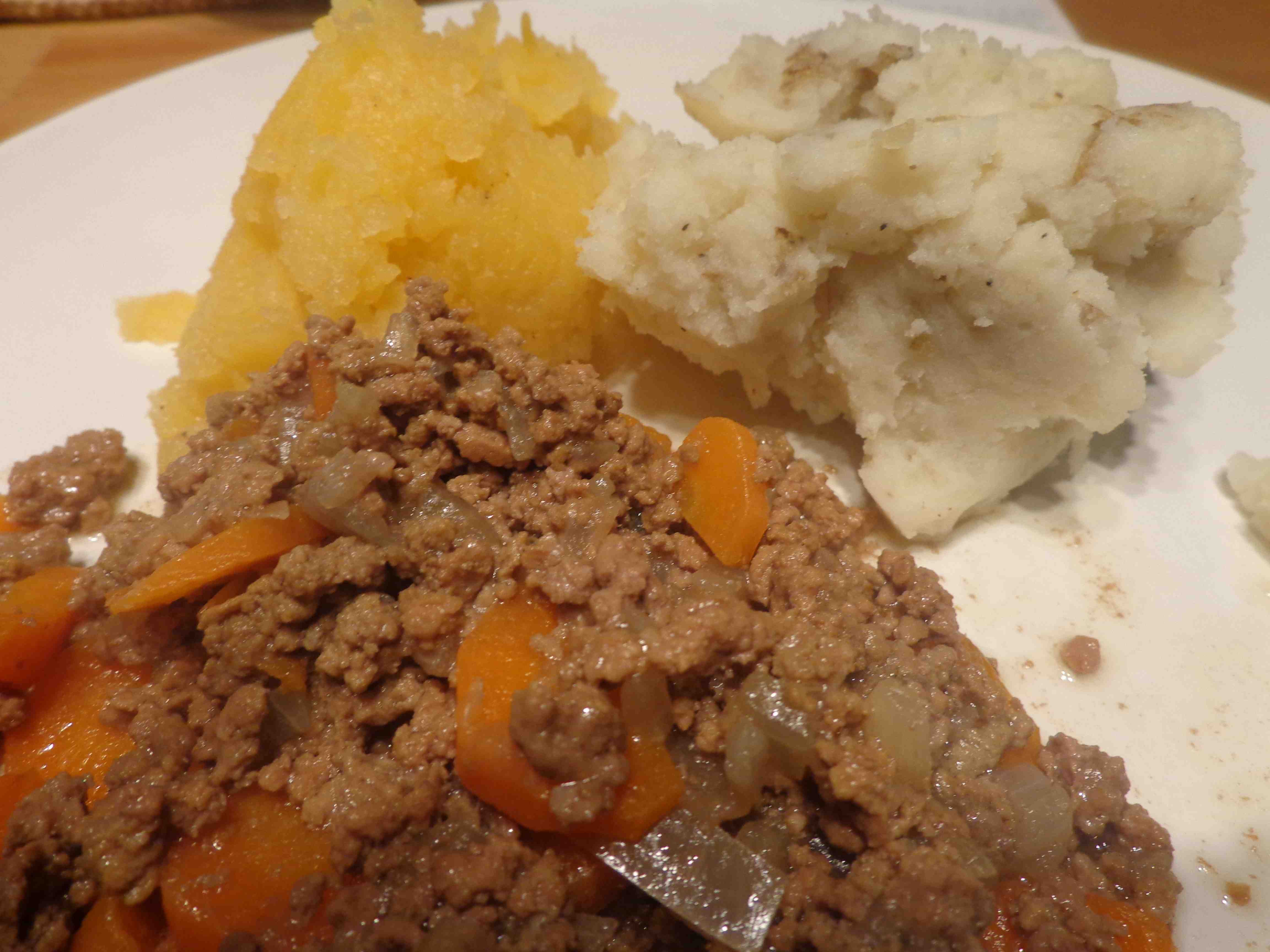
mince

Main course – a real Scottish dinner of mince, tatties and turnip – doesn’t look very appetizing here, but tasted good. Real comfort food.  And I was a good wartime wife tonight because I didn’t peel the potatoes, only scrubbed them before boiling them. I wondered about mashing the skins in with the potatoes, but it didn’t make any difference to the taste.

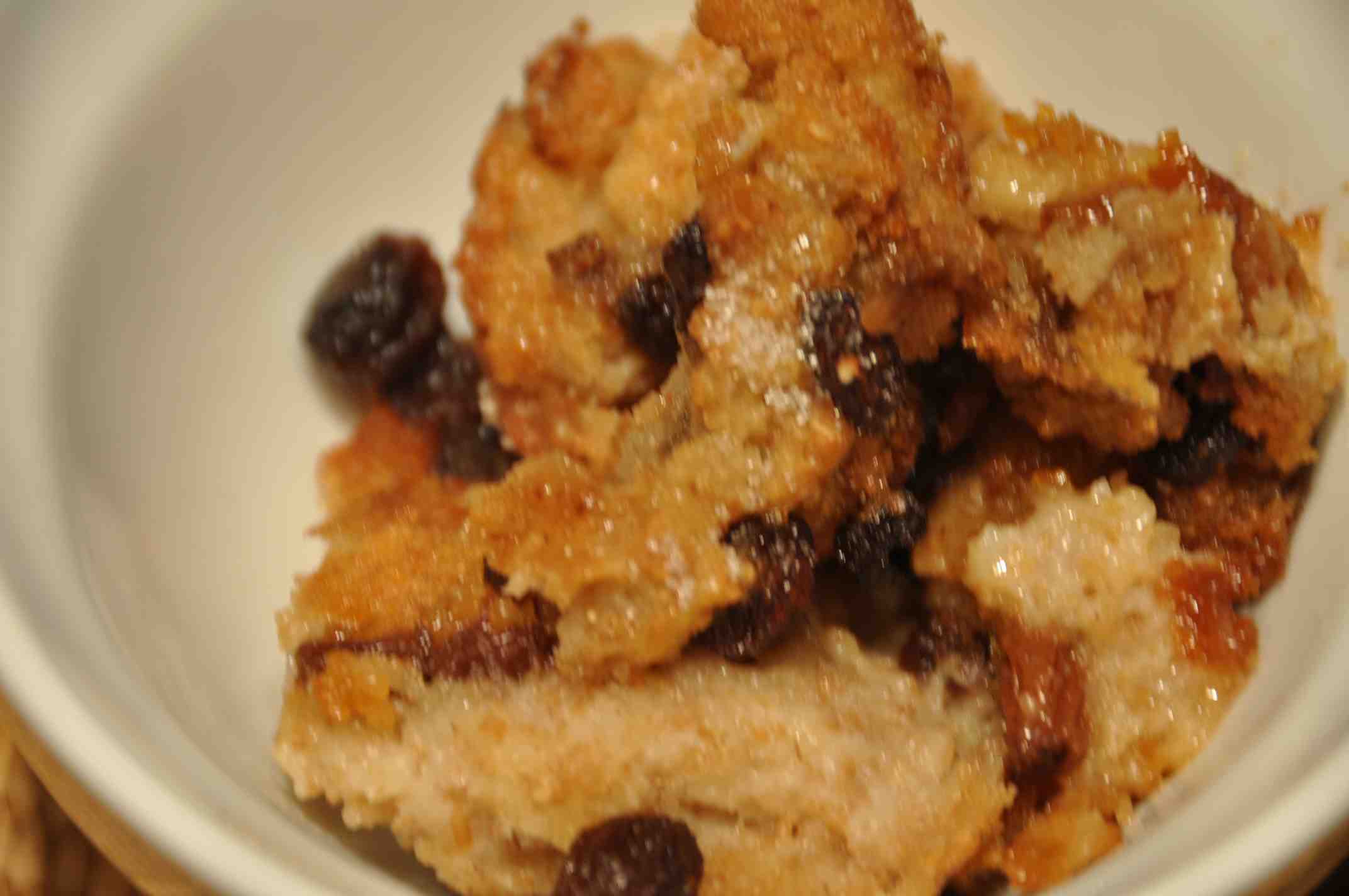
And then… dessert.  I rarely ever make puddings, or a three course meal for that matter – maybe once a week if you’re really lucky – so ending our wartime meals with a sweet every night is a real treat. Tonight it was Bread Pudding, and the recipe again taken from The 1940s Experiment website.  Deee-lish! Given we’re eating so well, I did rather dread standing on the scales this morning, but if anything, I’ve lost a little weight over the past few days.  Great food, never hungry and losing weight?  Bring it on! The only downside is the amount of time it takes to prepare and cook the meals. (And clean up afterwards.)

puddin

Getting back to the war… I was surprised that the blackout started so early in the afternoon in Glasgow and finished so late next morning. I asked Anne how that affected her, especially going to school in the pitch dark. Was she allowed to use a flashlight to see the pavement? Did the classroom windows have to keep the blackout blinds down until 9.17am – or whatever time the blackout ended?

anne2013Memory is very hazy on this, but what there is tells me that hand torches were forbidden unless they gave only a tiny slit of light or else had the clear glass painted or covered in blue – like the lights in railway carriages and, I suppose in buses and trams, but I have no memory of them.  I don’t remember any difficulty with light when climbing up George St to get to Hillhead Junior School – I know Mother used to come down to ‘see me across Byres Road’ – blackout or no – after that I was on my own. Perhaps there was just enough light even though the official blackout hadn’t ended.  It was when I went to Kippen after the Clydebank Blitz that I discovered that my secondary school in Balfron was really Hyndland School shifted en bloc – pupils and teachers.  Their teaching suited me better, but I was unfortunately still sent back to Hillhead when I returned to Glasgow.

Wartime Rations – Day 2

It might only be my second day of rations but I couldn’t quite face porridge for breakfast again. After the recent excesses of the holiday season, my mindset saw it as shades of Oliver Twist in the workhouse begging for more gruel.  Give me a couple more days and I’ll be back in the swing of it. Instead, I enjoyed some toast with a meagre scraping of butter and precious jam with my morning cuppa.

For lunch I finished off the homemade soup and leftovers from last night’s dinner, so I’m not going to bore you with those repeated photos.

We’re probably going to have to eat at least one – maybe two – meatless evening meals per week, so I tried to ease ourselves gradually into it this evening with baked potatoes, with a bacon and cheese topping, and carrots on the side. For pudding, I made individual apple crumbles, using one (large) apple and half the crumble mix.  I was still left with 1/2 apple and plenty of topping, so guess what we’re having for pudding tomorrow!

Potatocrumble

Because I’m such a modern day TV addict,  I wondered what radio programmes – and the actual radio set itself – were like during wartime.  Also, I’d heard the newsreaders were supposed identify themselves – something to do with ensuring accurate news during an invasion, I think. I asked Anne, and here’s her reply.

anne2013Radio?  No. no – WIRELESS SET.  It sat on top of the coal bunker, was about 16″ across, 10-12″ high and 9-10″ deep.  Yes, it took a while for the valves to warm up, so you switched THE WIRELESS on a little before your programme was due to start.
Don’t know what it was made of – it wasn’t wood, though many wireless sets were.  It looked like a mottled brown plastic case but of course it couldn’t have been.  The speaker was behind a gold piece of cloth, and there were two knobs:  one for volume and one which changed the station, arrayed in a narrow arc at the bottom.  The foreign station names fascinated me and I used to switch from one to another whenever I could, to listen to the strange languages.  It arrived about 1937 as a gift from Alex to Mum, but of course everyone had use of it, and woe betide anyone who wanted to use it – or made any noise – if Dad was glued to it for a cricket match or a special football match.  It was treated by Mother as if it were sentient – no-one could talk if the wireless was on.  It was as rude as interrupting a person talking, Mum said.   Don’t remember a smell. 

Mary had a wireless in Kippen, but there was no power there and it needed two batteries to work, a solid one about 10x5x3″ deep, and a liquid one in a heavy glass container with a handle so you could carry it to a petrol station or other place to get it re-charged. Which reminds me that we lived by the light of oil lamps. 

The wireless was on most of the day – except during the frequent power cuts. Yes the newsreaders gave their names John Snagge, Bruce Belfridge, Alvar Liddell etc . Lots of b-i-g dance bands with half-hour programmes: Henry Hall, Geraldo, Jack Jackson (my favourite) et al. The biggest ones of around 25-30 instruments called themselves dance orchestras – but it still wasn’t as loud as today’s pop. One of Mother’s favourite wireless programmes was Sandy McPherson on a cinema organ.

Anne mentioning my Uncle Alex above made me decided to check out The Glasgow Herald to see what other programmes were on the WIRELESS on January 7th, 1942.  (Uncle Alex was a reporter with the newspaper before he joined the RAF.)  Here’s a selection.

7.30am: Exercises. 8.15: The Kitchen Front. 10.30: Music While You Work. 2.30: Billy Cotton and his Band. 9.20pm: Tamburlaine, a play by Christopher Marlowe.

What else was in the paper that day?

The blackout in Glasgow started at 5.32pm in the afternoon and ended at 9.15pm next morning.

The New Year Sales were coming to an end.  You could buy a pair of ladies’ shoes for 30 shillings, a nightdress for 8/11,  or a ‘Hampster’ fur coat  (Really?? I hope I read that wrong!) for 19 Guineas.  Even though you could afford the purchase, I think the points system was operating by this time, so I’d love to know how many points you needed for a fur coat.

It was still pantomime season in Glasgow, with Aladdin playing at the Pavilion Theatre and Dick Whittington at the Alhambra.The afore-mentioned Geraldo and his Orchestra were performing at the Glasgow Empire.

An enraged letter to the editor discussed a particular Glasgwegian’s fury at the proposal to plough up golf courses for agriculture while so much untilled land was still available in the countryside.

Women born in 1921, whether married or single, were to register for war-work on Saturday morning at their local Labour Exchange.

In the Situations Vacant, there was a call for a butcher – weekly wage of 6 pounds .  Also a hairdresser – wage not mentioned. And there was another advertisement inviting women – not liable for National Service – to apply for clerical positions in engineering works in the Glasgow Area.

A worker in Paisley was charged with failing to participate in his works fire duties and was fined 4 pounds – to be paid within 8 weeks – or face 6 weeks imprisonment.  His excuse was that he’d gone to a dance and ‘forgotten about the matter’.

But there was some tragic news in there, too. On January 6th, 6 miners were killed in a gas explosion in Lancashire. But that wasn’t the only catastrophic accident in the first week of the New Year. On New Year’s Day, there was an explosion at the Sneyd Colliery near Stoke-on-Trent where 57 miners lost their lives.

mine screen shot


History Mystery – Part Three

I’m still on the search for the Canadian Native soldier who supposedly died in Glasgow, Scotland in 1916.  His name – Gay Flier – appears to be wrong, so it’s going to be a challenge.  However, The Commonwealth War Graves Commission responded with a very informative e-mail giving me the names of 42 Canadian soldiers who died and were buried in 7 different cemeteries in the Glasgow vicinity from 1915-1919.  Unfortunately for my particular search, there is no native sounding name among them.

The list makes for sober reading. The youngest victim was 17, a seaman from Newfoundland, the oldest a 45 year-old American from Florida who joined the Canadian military.  Most died of ‘wounds’ or pneumonia – one was ‘accidentally killed’ – and you can’t help but wonder about the stories behind these men.  One, a member of the Canadian Forestry Corps, had a Glaswegian wife. Was theirs a wartime romance that ended in tragedy?

But the name that really caught my attention was that of Private James Crawford Begg, 31st Brigade, Canadian Infantry.  Died of pneumonia following wounds (gas) 5th of February 1919. Age 22.  Son of William and Janet Napier Crawford Begg of 219-14th Ave West, Calgary, Alberta.  Born at Govan, Glasgow.  A young man who emigrated to Canada for a better life and then died in the city of his birth. And the fact that he died more than three months after the war ended… So sad.

Doctor Who

As a child growing up in Glasgow, late Saturday afternoon found me in front of the TV watching Doctor Who. I have to admit, I was one of those cliches – the kid hiding behind the sofa, terrified yet enthralled by these strange characters and even stranger worlds.  And don’t get me started on the Daleks.  As far as I’m concerned, they are the most frightening aliens ever invented!

I stopped watching the show around the time Jon Pertwee became the third doctor, but last weekend I plonked myself ON the sofa (rather than behind it) to enjoy the full day of celebrations for Doctor Who’s 50th anniversary.

And I had a blast. The special episode, broadcast live around the world to over 94 countries, was great, but I particularly enjoyed the interviews with cast members, past and present, as well as the drama An Adventure in Space and Time which documented the making of the show back in 1963.  Interesting that the Head Of Drama, who came up with the concept, the producer and director were all ‘outsiders’ –  a Canadian, the first female producer, and first Indian director, employed by the BBC.

Episode One – An Unearthly Child –  was broadcast the day after JFK’s assassination in Dallas. No-one expected the show to last more than one series, but here we are, 50 years later.

(An interesting tidbit for you Outlander fans out there –  Diana Gabaldon has said that Jamie Fraser was inspired by one of the Doctor’s early assistants.)

Watching that very first episode once again took me right back to my childhood.  Then, as now, the music still sends shivers up my spine.

Here are the opening scenes of that very first show.  Enjoy!

History Mystery – Part Two.

So much for my three scheduled posts a week! There are times I get a wee bit carried away with myself… and today has been one of those days. I just couldn’t get the mystery of the Native Soldier who died in Scotland out of my head, so instead of editing the manuscript I’m currently working on, I spent most of the day surfing. I still don’t have the answers I’m looking for, but I’ve e-mailed several institutions which I hope can help me. If they respond with information, I will let you know.

What I have learned is that the Govan Military Hospital was the old Govan Workhouse, built in the 1850s. The building is still in use as The Southern General Hospital and its speciality is neurology. If you’ve ever had a head injury and been tested on the Glasgow Coma Scale, this is where that scale was invented.

I also managed to rustle up an account from the archives of The Glasgow Herald which reported the unit’s visit to Glasgow, and I’ve contacted Glasgow City Council in the hope they have some photos of the visit.

HERALD

I’ve typed the article below, but in your reading please be aware that these were different times with different attitudes.

Glasgow Herald, December 9th 1916,  Page 8

CANADIAN INDIANS 

 Visit of Military Contingent to Glasgow

 A party of 156 Red Indians attached to a battalion of the Canadian Expeditionary Force, who are in camp in the South of England, are at present on a visit to Scotland prior to leaving for service at the front. They arrived in Glasgow on Wednesday night and will leave today. During their stay they have been the guests of the Corporation.

 The men were recruited about a year ago, largely in the Six Nations Reserve, Southern Ontario and others in districts near Montreal. They are the first company of Canadian Indians to join the Expeditionary Force from the Dominion. The men are dressed in regulation khaki, with the exception of four, who wore the picturesque garb of their race, from moccasins to the headdress of feather plumes.

 On Thursday the contingent was inspected by the Lord Provost, Sir Thomas Dunlop Bart, in George Square, and two of the officers in command were present for some time at a meeting of the Corporation and were welcomed by the Lord Provost. One of the officers, in replying, said that the contingent fully appreciated the honour conferred upon them. They could never forget the wave of hospitality which struck the contingent immediately they arrived in Glasgow. In Canada they had heard a great deal about the hospitality of the Scottish people, and now they had a full realisation of it. He was aware of the old saying that when the Scots extended a welcome their hearts were in it.

 The Contingent consisted of four different tribes, including the Iroquois. The Iroquois had always been heart and soul with the British Empire. Many Red Indians had enlisted to fight, and they were only too glad to do what they could for the Empire that had done so much for them. (Applause.)

 The Lord Provost remarked that it was refreshing to hear what the Indians from Canada were doing. (Hear, hear.)

History Mystery

Although I’ve chosen to make Canada my home, I still love my country of birth. So when I find a historical story that connects the two I get really excited!  But sometimes that excitement can lead to ‘historical’ frustration.

The book,  TEA AT MISS CRANSTON’S, (not related – at least, I don’t think so) recounts the memories of Glaswegians growing up in the city in the first half of the 20th Century. Inside its pages I found this fascinating nugget.

Chapter 15 – Their Weans Would Never Be. P127

Another fleeting recollection of 1915 was the swift passage through wartime Glasgow in a bleak week of smirring drizzle and gloom, of an exotic party of Canadian Indian troops commanded by Chief Clear Sky.  They were on their way to the war and sampled Glasgow hospitality enjoying a first, and no doubt last, taste of black pudding.

But they left one young Indian behind.  His name was Gay Flier.  He was very very ill with flu and died in Govan Military Hospital.  My grandpa had been seeing to Chief Clear Sky’s men when they were in Glasgow and so’s not to let the boy get buried in an unmarked grave he claimed the body and saw to it that there was a right funeral in Glasgow with magistrates there, a gun carriage and a party to fire a salute at the grave.  It wasnae among his own open-air folk, but it was better than being not heeded at all.

Absolutely incredible! I had to find out more, so the last time I was in Glasgow I headed to The Mitchell Library to undertake some research on this young native Canadian soldier. Although I came up with plenty of newspaper coverage of the regiment landing in Glasgow and going through to Edinburgh (click on this link) there was nothing about the soldier himself.

I’m determined to solve this mystery. If anyone out there has any ideas how to go about this, I would love to hear from you!

Wartime Rations – Day Twelve

Had the usual – porridge – for breakfast, with soup and the last of the meat pie for lunch.

Dinner was macaroni – again – but now that I’m getting the hang of how to tease out the rations, I added fried bacon and onions to the sauce. A real guilty pleasure.

Macaroni2

Anne’s memories today are in response to two questions I posed yesterday about storing and reheating food (thank heavens for fridges and microwaves) and also treats at the cinema.

Over to Anne:

As far as I remember, it was a case of Bring your Own treats (at the cinema).  I think the ‘ice cream girls’ who paraded the aisles during the intervals had probably disappeared to the Services or factories.  For myself, it was something from Colquhoun’s (the bakery beneath the flat in Byres Road) with cash I’d swapped my sweet coupons for! or perhaps an apple  or a scrubbed carrot.  From Colquhoun’s it would depend on the state of my purse – most likely a sausage roll or (the best treat for me) a mutton pie   You don’t seem to be suffering from feeling hungry, but I did – but then I was a growing girl!

Without a fridge, especially in the summer, it was difficult to keep meat fresh – cooked or uncooked.  All I had as a young wife was a ‘meat safe’ which was just a ‘box’ of wire to keep flies off.  I kept it in the coolest room, in the shade, and where it might catch any draught going.  I had been well warned by Mother that I should not re-heat cooked meat after it had cooled unless it was a stew or something that I could bring back to the boil again – I’d run a strong risk of its containing bacteria.  

Wartime Rations – Day Nine

Another winner! My son didn’t have time to go home for dinner tonight between work and going to his night class, so I invited him over to share our rations. “It’ll be okay,” I assured him, but I’m not sure he was convinced.  Fortunately the three course dinner was a hit.

Pea soupWe started with vegetable soup made with dried peas instead of my usual lentils, followed by sausages, baked potato with butter, carrot/parsnip mash and raw broccoli. (My husband won’t eat green vegetables if they’ve been cooked.)

Bangers and mash

Sausages weren’t rationed during the war, but their meat content was very low with most of the filler being bread.

bread pudding

For pudding I decided on Bread Pudding and it was delicious.  I got the recipe from The 1940s  Experiment.com website.  If you haven’t checked it out yet, please do. There is so much fascinating content to be found there.

I haven’t been at all hungry on my rations.  In fact, I forgot to eat lunch today because I was still full from a late-ish breakfast of porridge and toast. But I can’t pretend I’m really experiencing what it must have been like during the war. Even though a food might be on the ration – eg eggs – if there weren’t any to be had, you did without. Sometimes the shortage lasted one week, often more. In that case it was make do and mend, and in that case, as Anne comments below, mothers usually denied themselves for their families.

From Anne:

Mothers, I am sure, became thinner before anyone else, though children and expectant mums got extra milk, vitamins and some rather horrid concentrated orange juice; sometimes there were eggs for ‘blue books only’. (Blue covers denoted children’s ration books.)

Soap and washing powders were rationed too. That wasn’t a problem to us in Glasgow. With its wonderfully soft water the ration was more than enough; in fact Mother used to send unused soap coupons to her family in the hard water areas of the Midlands who were finding the allocation too small.