Lamlash Cemetery

Given my fascination with graveyards and the fact that I discussed my visit to a Russian cemetery in my blog post last week, I thought I’d talk about one of my favourite Scottish ones today – Lamlash Cemetery on the Isle of Arran.

Arran is an island off the West Coast of Scotland, two hours from Glasgow by car/train and ferry. It’s known as Scotland in Miniature because anything you can find in Scotland – apart from a major city – can be found on the island. Four thousand year-old standing stones? Check. Iron Age Forts? Check. Mediaeval Castle? Check. Victorian Castle? Check. Palm trees. Palm trees?? Yes, palm trees. Check.

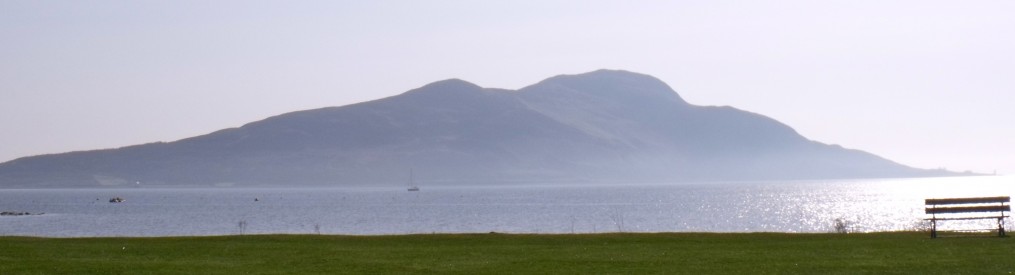
Lamlash Cemetery commands a stunning view. Situated on a softly rising hillside, it overlooks a golf course in one direction and the Holy Isle in Lamlash Bay in the other.

bay

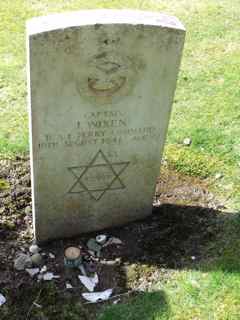
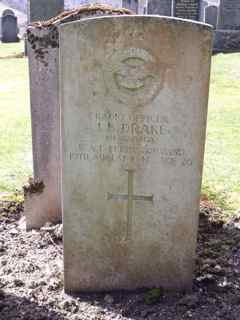
But as someone who loves reading about history of World War Two, what I find most fascinating about the place is a row of war graves. They commemorate the men of RAF Ferry Command whose plane crashed into a foggy mountainside on the island in 1941, shortly after taking off from the mainland. I’ve visited Arran every year since the age of seven, and on each trip I make a pilgrimage to the cemetery to wonder about the stories of the men buried there.

ROW

These were men of all ages, nationalities and religion. As well as the two Canadians whose graves are shown here, there was a third Canadian, two Americans and an Australian amongst the Brits. It was their job to ‘ferry’ planes from the factories in North America to Britain. They were returning to North America from one such flight when their plane went down.
DSCF1093DSCF1092DSCF1091

I don’t know if it’s true or not, but I ‘remember’ hearing a tale that, following the war, the family of one of the men wanted their son’s remains returned to his home. However, when they visited the cemetery and saw him buried by his comrades in such a peaceful location, they decided to leave him where he lay.

Kirsty Wark, a highly respected TV journalist and fellow Arran-ite, has written a novel which features the plane crash. Entitled The Legacy of Elizabeth Pringle, it is scheduled for publication on March 13th, so please check it out.

If you would like more information on the events of that crash, please click here and scroll half way down the page.

Wartime Rations – Day Twenty-Two

Week Four – I’m in the homestretch.

The disadvantage of words like ‘rations’ or ‘diet’ is the assumption it immediately creates of privation and hunger. Rationing in Britain was introduced to prevent both those circumstances. It was essential to the war effort that the civilian population was well fed so they could work in the factories and take on extra duties (eg. Air Raid Wardens) if Britain was going to win the war. And it was so successful that by the end of the war people were consuming approximately 3,000 calories per day!

But – I have to confess – when I weighed myself this morning, I discovered I’ve lost a total of 7 lbs in the 3 weeks I’ve been eating wartime rations! Seven pound weight-loss eating pudding every night and never feeling hungry!

Another confession.  I wobbled on my rations this afternoon. I was out for lunch and had a ham/lettuce/tomato and cucumber sandwich, even though the last three ingredients weren’t available in wartime Scotland in January. Next Monday – I can’t believe I’m saying this! – I’m looking forward to enjoying a tomato, cucumber, red pepper, celery and broccoli salad.  With a fresh orange to finish!

But for tonight, dinner was genuine January wartime rations: homemade vegetable soup, cheese dumplings with coleslaw and brussels sprouts, and apple crumble.

dinner

* * *

Anne, my mother and brother moved to Kippen from Glasgow to avoid the bombing and this week she’ll be answering my questions on her experiences as an evacuee.

anne2013When were you evacuated and how long did you stay in Kippen? Shortly after Clydebank*, and I was there for about 2 years 6 months. To begin with I was in the village school for a few months until the ‘Qualifying Exam’ (like the later ’11+’); a nice overstretched headmaster  had to cope with all these extra pupils because Glasgow’s Hyndland School was moved ‘en bloc’ (teachers as well) to the village around Balfron, which was the secondary school centre.

What was the village like? Kippen was isolated on a loop road off the main Glasgow-Stirling road, so it was quiet with no passing traffic. It formed a cross with houses along three of the roads, and there was a stone cross at the centre. No side-roads – the fields began behind the little houses. I was surprised when I went back, out of nostalgia, in the early 1990s to see that little had changed – in fact the only change in the centre was that the Post Office had moved from one side of the main street to the other, and that was all except for a sort row of houses which had been built since I’d last seen it in the 40s.

*Clydebank Blitz – March 13/14 1941

Kippen – A village 20 miles north-west of Glasgow. Scotland.

Christmas in Wartime

Starting one week today (Monday, January 6th 2014) I plan to return to eating World War Two British rations for one month. As before I’ll be adding in tidbits about the war, while Anne (my aunt) will once again add her own recollections of living in Scotland during that conflict.

To get my mind in the right headspace, I’ve recently been watching a few WW2 documentaries and dramas. A Wartime Farm Christmas, a documentary which can be found on Youtube, is a wonderful antidote to the excesses of our 21st Century festive season and a great tribute to the resilience of those wartime civilians.

Enjoy!

History Mystery – Part Three

I’m still on the search for the Canadian Native soldier who supposedly died in Glasgow, Scotland in 1916.  His name – Gay Flier – appears to be wrong, so it’s going to be a challenge.  However, The Commonwealth War Graves Commission responded with a very informative e-mail giving me the names of 42 Canadian soldiers who died and were buried in 7 different cemeteries in the Glasgow vicinity from 1915-1919.  Unfortunately for my particular search, there is no native sounding name among them.

The list makes for sober reading. The youngest victim was 17, a seaman from Newfoundland, the oldest a 45 year-old American from Florida who joined the Canadian military.  Most died of ‘wounds’ or pneumonia – one was ‘accidentally killed’ – and you can’t help but wonder about the stories behind these men.  One, a member of the Canadian Forestry Corps, had a Glaswegian wife. Was theirs a wartime romance that ended in tragedy?

But the name that really caught my attention was that of Private James Crawford Begg, 31st Brigade, Canadian Infantry.  Died of pneumonia following wounds (gas) 5th of February 1919. Age 22.  Son of William and Janet Napier Crawford Begg of 219-14th Ave West, Calgary, Alberta.  Born at Govan, Glasgow.  A young man who emigrated to Canada for a better life and then died in the city of his birth. And the fact that he died more than three months after the war ended… So sad.

St Andrew’s Day

In keeping this blog, I’m learning all kinds of things I really should have known before.  Take St Andrew’s Day on November 30th.  Of course I knew he was the patron saint of Scotland and one of Christ’s 12 apostles, but I didn’t realise he was the brother of St Peter and also the patron saint of Russia, Ukraine, Romania, Greece and… Barbados, where it is also Independence Day!

In addition, St Andrew is the patron of fishermen, singers and unmarried women.  And if you suffer from gout, St Andrew is the saint to pray to. Traditionally, St Andrew’s Day marks the opening of the Christmas markets in Europe.

Scottish flag

St Andrew is believed to have been executed on a transverse cross on November 30th by the Romans.  This became known as the Saint Andrew’s Cross and was adopted as Scotland’s national flag – the Saltire. (The saltire was reputed to have been seen above the fields of Bannockburn in 1314 when the Robert the Bruce beat the English during the wars for Scottish independence.)

Happy St Andrew’s Day!


Outlander

The first book in the Outlander series definitely ranks in my top ten list of favourite reads. If what you want is to lose yourself in a blockbuster story, it’s got it all; great characters, a love story, adventure, history and a little fantasy to boot. Best of all, it’s set in Scotland!

It’s taken a long time to get this to the screen. There was talk of a movie at one time, but it’s too big a story for a two-hour film. Now, probably partly due to the success of Game of Thrones, it’s just started filming in Scotland with a 2014 TV air date.

I’m excited yet nervous at the prospect, and can only hope the producers manage to realise Diana Gabaldon’s vision in the same way David Benioff and D.B. Weiss managed with G.R.R. Martin’s epic.

We’ll have to wait and see, but until then you might want to check out this website to keep up to date on the series’ progress.

http://outlandertvnews.com/2013/10/photos-of-outlander-filming-1940s-claire-and-frank

Happy Hallowe’en

Growing up in Scotland, Hallowe’en was the most magical of nights. First would come the carving of the turnip; two triangles for its eyes, a twisted slash for a grin, a candle perched inside, and string worked through the sides to create a handle.

turnip

Party pieces perfected, we’d get dressed up in weird and wonderful homemade costumes and go out guisin’, the glow from our turnip lamps lighting our way down streets glittering with frost, to visit friends and neighbours.  (No knocking on strangers doors and definitely no calls of Trick or Treat back then.) Invited inside, we’d then have to perform our poem or song, and if our audience was pleased with the recitation, we’d be rewarded with an apple, orange, peanuts, or best of all, a silver coin… or two!

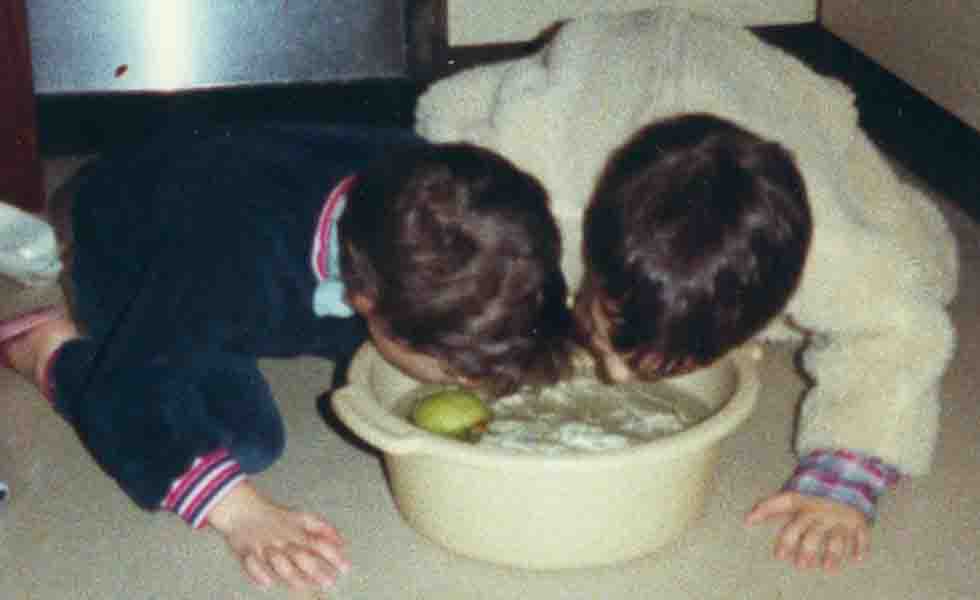
Back home, Mum would have slathered crumpets in treacle and attached them to the pulley in the kitchen.  With our hands behind our backs, the game was to see who could be first to eat them.  That would be followed – fortunately – by dookin’ for apples.  If you didn’t manage to grab an apple with your teeth, at least the treacle was washed from your face.

dookin

According to some historical accounts, it was Scottish and Irish immigrants who brought these traditions to North America. They developed over the years to the Hallowe’en celebrations kids enjoy now.

And talking of the Scots, it turns out that Robert Burns wrote a poem capturing the Hallowe’en rituals of 18th Century Scotland.  No, I’m not talking about Tam O’Shanter, but another entitled, simply, Hallowe’en, which describes the lingering pagan traditions in the Scotland of his time. Even I found myself struggling with the Scots version, so here’s an English translation.

Whatever your traditions, have a Happy Hallowe’en everyone!

Bothered and Bewildered

You know that horrible feeling when you sleep through your alarm and spend the next few hours trying to play catch up?  Welcome to my day.

Here’s the thing… I’ve been planning on starting a blog for a while.  I’m going to be publishing  a series of books this autumn, and with that comes the requirement for a website.  A friend recommended it might be better to get the whole website/blog thing figured out beforehand so I can then concentrate on my writing.

Flash forward to today.  The perfect time, I decide, to start pulling my website together.  I’ll put in a few photos, a little bit of text, and then over the next week I can pull together a couple of blog topics before I push the ‘live’ button.

How was I supposed to know it went live as soon as you sign up?  They only had three TV channels when I was growing up!

So here I am, scrambling to introduce myself and this blog.  What’s it going to be about?  Three of my passions; the craft of writing, travelling and the history of the Second World War.  If you enjoy these topics, I hope you will join in the conversation.

Thanks for stopping by.

(Hmmm.  Maybe I’d better double check my alarm clock tonight.)