Wartime Rations – The Rules

Earlier this year I spent one month eating World War Two British style food; the basics provided on rations, plus fruit and vegetables in season. My aunt collaborated with me, providing her recollections of her childhood during those six years of war. I had such a great time with the experiment, and learned so much, that I decided it would be a good idea to repeat it four times in the year (April/July/October) using the fruits and vegetables specific to that season.

What was it Robert Burns said?  ‘The best laid schemes o’ mice an’ men gang aft a-gley’. I’m not sure what happened to my good intentions for April and July, but as we’re only ‘just’ into October I’m going to try to get back on track and start again on Monday, October 6th and continue through until Sunday, November 2nd.

Diana’s Wartime Rations Rule Number One:
A little background to rationing in the UK during WW2 for those of you who are unfamiliar with its history.

Even though people received ration cards entitling them to certain essential foods, and those foods were ‘theoretically’ available, it didn’t mean that they always received them. There were constant shortages. If eggs weren’t available one week, you didn’t get two the following week to make up, but I’m going to assume all the foods that were on ration ‘are’ available.

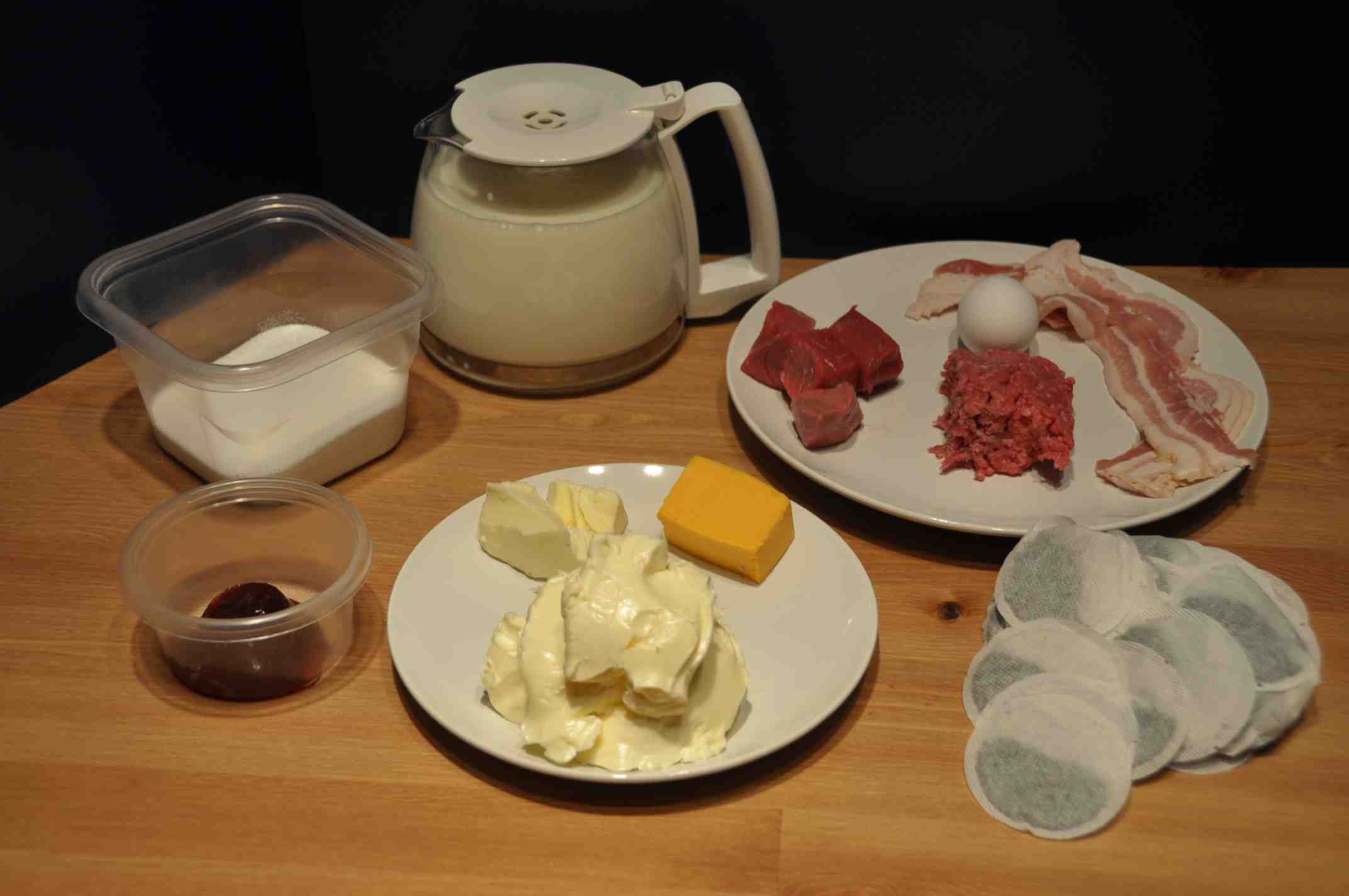
This is what one week’s rations look like.
ratiions

One week’s worth of rations – Britain WW2

Bacon – 4 oz
Meat – 8oz
Sausages – when available
Fats – 8oz (2 oz butter, 4 oz margarine, 2oz lard).  I’m going to substitute that with 8 oz of butter.
Cheese – 2 ozs
Milk  – 3 pints
Sugar – 8oz
Jam – 2oz
Tea – 2oz (15 tea bags)
Eggs – 1 shell and 3 dried.  (I will substitute with 4 shell eggs)
Sweets – 3oz

As for the fruits and vegetables in season, I will be using those suggested on this website. For October that means: Apples, Blackberries, Sweetcorn, Savoy Cabbage, Kale, Red Cabbage, Squash, White Cabbage, Runner Beans, Potatoes, Brussel Sprouts, Spring Cabbage, Carrots, Maron, Spinach, Leeks, Celery, Cauliflower.

Certain other foods weren’t rationed – eg flour, oatmeal – and others were to be found on a points system, eg tinned vegetables.  No-one went into the war with empty cupboards, and I’m sure there were times people swapped – I’ll give you some extra sugar for a tin of peas – so I’m starting tomorrow with the following in my pantry cupboard; flour, raising agents, certain spices, raisins, a small tin of golden syrup and jar of mayonnaise.

Diana’s War Time Rations Rule Number Two:
I call this my ‘Dining at the Savoy’ rule.

Rationing was probably hardest on the housewife who remained in the home and was limited to eating only rationed food – unless she went out for a cup of tea and a bun, or the occasional fish and chips. People who worked in factories were provided with a daily hot meal at the works canteen. And of course, those who could afford it could always eat out, and eat out well –  at places like The Savoy Hotel in London! – thus augmenting their rations.

This month sees Canadian Thanksgiving and a Wedding Anniversary in our family. On those two occasions I’m going to adopt my Dining at the Savoy rule and not inflict my wartime rations on my relations!

I’ve also decided to follow what happened in the newspapers between October 6th 1944 – November 2nd 1944, so will be adding information about that at the end of each post.  And I still have a few questions I’d like to ask Anne who was a child growing up in Glasgow during that time.

(If you have any wartime questions you think Anne might be able to answer, please e-mail them to me at dianacranstoun@gmail.com and I will pass them on.)

Here goes!
 

Harold and Emma McGill – A WW1 Love Story

IS picture

Photo – Diana Cranstoun

Harold McGill and Emma Griffis, a doctor and nurse from Calgary, made an unlikely pair – he was shy and reserved while she was outgoing – but when Harold signed up to serve on The Western Front in 1915, he asked Emma to write to him. Emma also joined the Canadian army as a Nursing Sister in 1917 and was stationed in England. The couple married in December 1917, returning to Calgary after the war.

Sadly, Emma’s letters no longer exist, but Harold’s are safe in the archives at the Glenbow Museum in Calgary and can be viewed online. They tell a fascinating story;  aspects of war you rarely find in the history books blended with a tenderly unfolding love story.

Some of Harold’s descriptions of the battlefield – the guns growling, a shower of shells, night as dark as a wolf’s mouth – are chillingly evocative. And when he talks about standing in a trench at midnight on New Year’s Eve 1915 to watch the old year out and witness the blast of artillery fire from all the batteries announcing the birth of 1916… well it makes the hairs on the back of your neck prickle.

He talks about their rotation through the trenches; 6 days in the trenches – where they must sleep in their clothes and only remove their boots to change their socks – followed by 6 days in the brigade reserve, followed by another 6 days in the trenches, then 6 welcome days in divisional reserve billets where they have the opportunity to rest up before the whole process starts over again.

The gas alerts when the wind blows in from the east.

How ‘one smokes a lot at this game’.

A regimental dinner held in a convent.

The daily rum ration when in the trenches.

Having to go for 15 days without changing his clothes followed by the sheer joy of a hot bath and clean bed.

But it’s the love story that is the most touching. He starts off addressing Emma as Dear Miss Griffis and signs off Sincerely yours. Following his proposal of marriage in July 1917, that changes to My dear Emma and ends Yours truly. And after their marriage in December that year, it’s My Dear Wife from Your loving husband.

His concern when he discovers she’s assigned to the ‘lungers‘ ward at Bramshott Military Hospital in England, and his ‘mortal terror of TB which is more deadly than Fritz’s trench mortars’.

He makes an interesting comment about how men approach married life. ‘Usually when a man asks a woman for the privilege of making her everlastingly happy,” he writes, “what he really wants is for her to make him happy and worship him as a tin God.”

Only after they became engaged, when he was on leave in England in July 1917, do they really start learning about each other. He tells her he has an older brother and two younger sisters (one of whom, Margaret, is also serving in France) and that his parents died within 10 days of each other when Margaret was only 15.

There is so much more. I can only offer a sliver of the richness of his letters here and encourage you to click on the link at the top of the page and check them out yourself. As to why her letters didn’t survive… Harold offers the intriguing hint that he would ‘love to keep them’ but it is ‘difficult on active service’ and he must ‘burn them’.


Research

My main area of historical interest is World War Two. I’m fascinated by it – perhaps because there were still air raid shelters around to play in when I was growing up in Glasgow. And I can still clearly remember my Dad pulling on his old army overalls and beret before climbing underneath Mum’s car when it needed fixed.

So when I heard about a two-day symposium on The Great War being offered at the Military Museum here in Calgary, I hummed and hawed before deciding to sign up. It’s not ‘my’ time period.

But I’m glad I did.

Here’s what I learned.

1) Two days and 25 papers later, I probably know more about Alberta in WWI than most of my native-born Albertan/Canadian friends.

2) As a writer, ANYTHING you learn is invaluable. Everything can be adapted to add depth, texture and veracity to your writing.

3) More importantly, if you write anything inaccurate in your novel, someone somewhere will pick up on it. And when they do, it will pull them out of the story. From then on they will question everything else you say. Pull a reader out of your story and you’ve lost them.

No matter what you’re writing about, please – please – make sure your facts are sound.


Alberta In The Great War

Although I learned about The First World War in secondary school, I don’t remember much about it beyond the Schlieffen Plan and trench warfare. Somehow it never captured my imagination in the same way as The Second World War.

However, I’ve recently been soaking up all the recent TV programmes and documentaries which have been made to mark the 100th anniversary since the The Great War’s outbreak. And the more I learn, the more I want to learn. So when I discovered the Military Museum here in Calgary was offering a lecture to introduce their temporary exhibition, Albertans in The Great War, I was in there like a dirty shirt.

Here are a few tidbits I learned.

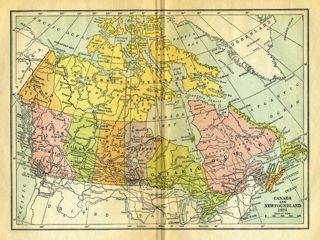
alberta map for blogIn 1914, Alberta, as a province in Canadian Confederation, was only 9 years old with a population of 470,000. (Canada’s total population was 7.9million.) During the war, Alberta sent 49,000 men, between the ages of 18-34, to serve overseas. Only Ontario and Manitoba sent more in sheer numbers, but the proportion of men Alberta sent was the highest in Canada.

The majority of Albertan men served in the infantry on The Western Front, but a few joined the navy or the RFC serving at sea (obviously!) or in Palestine, Siberia and at Gallipoli. Supporting units included Artillery Batteries, Cyclist(!), Tunnelling and Railways companies. Medical, engineering, veterinary, supply, forestry and machine gun personnel. (The aim of the bicycle units had been to get the infantry up to the front fast, but were essentially useless in the chewed up battlefields of The Western Front. They did come into their own at the end of 1918 when the front line moved to areas where the roads remained intact.)

During the war, Alberta became the largest exporter of wheat and timber, the 3rd largest exporter of beef, and sent over ½ million horses overseas. The province also raised $42million ($1 billion in 2014 dollars) to war relief efforts such as The Red Cross, The Canadian Patriotic Fund, The Belgium Relief Fund and the YMCA amongst others.

Sam Steele, a hero of The March West, The Riel Rebellion and The Boer War, volunteered to serve, but was officially too old for the armed forces.  However he received special dispensation to help train the men here in Alberta and accompany them to Britain. Once there, the men received further training under Steele, but Steele then had to relinquish command when the troops were sent to the Western Front. His forage cap is part of the current exhibition.

The lecturer told a great story of pilots in the RFC who, after they had destroyed a target (eg ammunition dump/ train) would then land their planes beside the target, collect a souvenir (eg empty shell casing/letter from the engine) then take off again. Apparently one pilot returned with a sack full of mementoes.

And what do you do if you’re caught in a chlorine gas attack and have no gas mask to hand? Urinate into your handkerchief and hold it against your face.

These are just a fraction of the stories told during the current exhibition. It’s on until December 15th.  If you live in Alberta and have an interest in our province’s role during the conflict, I highly recommend you check it out.


Scottish Referendum – The Morning After

The morning after

Scotland, 19th September 2014

by Christine de Luca

Let none wake despondent: one way
or another we have talked plainly,
tested ourselves, weighed up the sum
of our knowing, ta’en tent o scholars,
checked the balance sheet of risk and
fearlessness, of wisdom and of folly.

Was it about the powers we gain or how
we use them? We aim for more equality;
and for tomorrow to be more peaceful
than today; for fairness, opportunity,
the common weal; a hand stretched out
in ready hospitality.         

It’s those unseen things that bind us,
not flag or battle-weary turf or tartan.
There are dragons to slay whatever happens:
poverty, false pride, snobbery, sectarian
schisms still hovering. But there’s
nothing broken that’s not repairable.

We’re a citizenry of bonnie fighters,
a gathered folk; a culture that imparts,
inspires, demands a rare devotion,
no back-tracking; that each should work
and play our several parts to bring about
the best in Scotland, an open heart.

Scottish Women’s Hospitals

Given that Scotland will – or will not – vote for independence from the rest of the UK on Thursday, September 18th, I thought I would focus this week’s blog posts on Scottish history and writing.

With 2014 being the one hundredth anniversary of the outbreak of World War One, I was fascinated to read about the Scottish Women’s Hospitals which treated allied soldiers during The Great War.

Formed to provide medical assistance to the injured, the Scottish Women’s Hospitals also worked to promote the cause of women’s rights.

Elsie Inglis, who I talked about in a previous blog, was one of its founders. A doctor, she approached the War Office with the intention of setting up a hospital in Edinburgh to care for injured soldiers, or co-operating with the RAMC to treat soldiers on the Western Front. The War Office’s response? “My good woman, go home and sit still!”

Following this rebuff, the Scottish Women’s Hospital approached the French and by November 1914 they were in business, setting up a hospital in Calais. This was followed in December with a hospital in the Abbey of Royaumont. They went on to set up hospitals in Belgium, Serbia, Malta, Corsica and Russia.

The hospitals were staffed entirely by women. Many, but not all, came from Scotland, with others coming from other countries such as America, England and Ceylon. Doctors, nurses and other medical personnel received a salary, but ancillary staff, including orderlies, drivers and cooks, did not. These jobs were filled by women from the upper classes who could afford to work for free, wanted to help the war effort and had a sense of adventure.

If you are interested in reading more, please check out this wonderful website which not only goes into the history of the hospitals, but contains the biographies of many the women who worked there.


Union Cemetery – Calgary: Part Four

I know, I know.  I can just imagine you looking at the blog post title, throwing up your arms in despair and saying, “She’s talking about graves. Again!’  But this is the last time, I promise. At least from Union Cemetery. (I still have to take the tours of Burnsland and St Mary’s cemeteries.)

VIEWAlthough not all of the people buried in Union Cemetery have grave markers, they all have a story. As a writer, here are a few of the stories I learned on the cemetery tour which – while not about the great and the good – really piqued my interest.

The first I found really touching – because I pass by this place every day when I walk my dog – was the story of a young engaged couple who were killed on the corner of Prospect Ave and 10th Street SW. Apparently he went to pick up his fiancée, who lived in a rooming house on Prospect Ave, to go for a walk one day. Mount Royal is – not surprisingly given its name – on a hill. When they were caught in a thunderstorm, a bolt of lightning ended their lives. Their grave is unmarked and their story leaves me with so many unanswered questions. What were their names? Where did they come from? What ages were they? What were their dreams? How soon did they plan to marry? What were their occupations? Such a tragic loss.

SMITHI love the story of Jimmy Smith who emigrated to Calgary from China. Determined to become ‘Canadian’, he dressed in western clothes and was known only by his ‘English’ name. A cook at the Grand Hotel in Calgary, he died of TB but left $1,500 to go towards the building of Calgary’s first hospital, the Calgary General Hospital. His marker was provided by both the Nurses Union of Alberta and the Chinese Community of Calgary. What was his ‘real Chinese name?’ someone on the tour asked. A couple who spoke Chinese looked at the  Chinese characters and smiled.  ‘Jimmy Smith,’ they  replied.

I’ve talked about Peter Prince – a lumber merchant from Quebec – before in my blog. His house can be found at Heritage Park and his office still serves as a restaurant – 1886 Cafe – in Eau Claire. After Prince’s first wife Marguerite died of diabetes (he is buried alongside her in St Mary’s Cemetery) he married three more times. Hmmm, I can hear you thinking. Sounds a bit dodgy. But remember, those were different times. You could not have a single woman in your home unless you were married to her. He married Emma – who had been a invalid for some time – who died in 1902. His third wife, Rosa, died of cancer in 1907. Emily, his fourth wife, outlived him by 19 years. Her grave is unmarked, but she is buried with Rosa and Emily in Union Cemetery.

There are so many other graves and so many stories: Sam Livingstone who brought fruit trees to Alberta and fed the NWMP through their first hard winter in Calgary; Maude Riley, who made a pact with God after she almost died in childbirth, brought in laws to protect children and is commemorated by Riley Park; Fred Collings, a runner for the telegraph office, who died when he and another boy were cleaning their revolvers. Thinking the chambers empty, they fought a ‘duel’.

What a rich and colourful tapestry.

TREEI learned other things about the symbols to be found in graveyards. We know that children are often represented by lambs or little shoes, but a grave marked by a tree stump also represents a life cut short.

What about an anchor? – The symbol of faith.

Or what about this grave? Given the name and lack of dates… what story does it conceal?

SHERLOCK

Union Cemetery – Calgary: Part Three

I first moved to Calgary when the city was little more than one hundred years old. Coming from a country where a ‘new’ bridge built to replace an ‘old’ one could still be 500 years old, it didn’t seem to me that a place like Calgary could have much history.

What an arrogant attitude!

In the first place, the peoples of the First Nations had lived here for thousands of years with a history and traditions as old – if not older – than that of my home country.

Secondly.. we might think of history as being the realm of kings and queens, dukes and earls, generals and admirals, after all, they’re the ones who get their names in the history books. But REAL history is made by ordinary people doing extraordinary things. And when you see a city transformed from a simple wooden fort to a shining metropolis in less than four generations… well that’s purely down to the ambition, hard work and vision of those ‘ordinary’ people.

Here are two of those people whose graves can be found in Union Cemetery.

MACLOEDCOLONEL JAMES FARQUHARSON MACLEOD: Born in Scotland in 1836, he trained in Ontario as a lawyer, before joining the NWMP. Macleod was part of the famous March West in 1874, its remit being to establish law and order, stop the illegal whiskey trade, protect Canada’s border from encroachment by the Americans, and open up preliminary negotiations with the First Nations. He founded the fort, named in his honour – Fort Macleod – in what is now Alberta on the US/Canada border.

In 1875, he ordered Inspector Brisbois and 50 men from ‘F’ tropp to establish a post on the Bow River. Initially called Fort Brisbois, the name was changed to Calgary (after a village in Scotland) on the suggestion of Colonel Macleod.

Trusted by the First Nations as an honourable man, he was one of the signatories to Treaty Number 7 with the mainly Blackfoot First Nations.

Despite being Commissioner of the NWMP and working as a magistrate and judge, he died in 1894 a poor man, leaving a wife, five children and just $8.

WAREJOHN WARE: Born into slavery in South Carolina in 1845, he moved west at the end of the American Civil War, finding work on a ranch in Texas where he became a skilled horseman. In 1882 he came to Canada on one of the great cattle drives north. He worked on various ranches (including the famous Bar U) before buying his own homestead in 1890 and then creating a ranch east of Brooks. Over time, he owned 1,000 head of cattle and 100 horses under his 9999 (The Four Nine) brand.

Tragically, for a man of whom it was said, “The horse is not running on the prairie that John Ware can’t ride,” he died on September 12th, 1905 when his horse stumbled on a gopher hole and fell on him. He was killed instantly.

John Ware‘s name is remembered in Calgary by John Ware Junior High School and the John Ware Building at the Southern Alberta Insititute of Technology. He is also commemorated in Mount Ware and Ware Creek.


Union Cemetery – Calgary: Part Two

With 50,000 people buried in Union Cemetery (not all in marked graves) there are literally thousands of stories to be told. Continuing on from my previous post on Monday, I’m going to look at a couple of memorials which are related to two famous nautical disasters.

STEENROBERT ALEXANDER STEEN.  Forty-seven years of age, a private in the Canadian Army Medical Corps, Steen was one of the 234 personnel murdered by the Germans on the Hospital Ship Llandovery Castle in World War One. The ship was returning to England from Halifax NS, carrying 164 men, 14 nurses, and 80 officers and men of the Canadian Army Medical Corps.

Under the Hague Convention, hospital ships are prohibited from carrying arms, must be clearly marked with the Red Cross, and sail with all lights burning. The enemy are allowed to stop and search the ships, but must not fire on them. However, on June 27th, 1918, a German submarine fired on the Llandovery Castle.

It sank within 10 minutes. Three lifeboats got away. The German captain – Patzig – interrogated those on the boats to find ‘proof’ of misuse of the ship (ie that it was carrying arms). Unable to find any, he then ordered his crew to prepare to dive. With only himself and a few other sailors on board, they attempted to hide their war crime by ramming and machine gunning the boats and survivors in the water. Twenty-four men in one of the lifeboats survived and were rescued 36 hours later. All 14 nurses were murdered. The sinking became a rallying cry for the Canadian forces in the last few months of the war. Captain Patzig was never found or prosecuted for war crimes.

Please click HERE to find a link to a brief report of the tragedy on the front page of The Calgary Daily Herald on July 2nd, 1918.

dickALBERT and VERA DICK were two of the 795 survivors of the sinking of the Titanic on April 10th, 1912 which killed more than 1,500 men, women and children.  Albert, who made his early fortune in Calgary’s land boom,  married his seventeen year-old wife Vera in the fall of 1911. They travelled to Italy, Palestine,  Egypt and France on an extended honeymoon, picking up the Titanic in Cherbourg. Their first-class tickets cost 57 GBP each. They both escaped in lifeboat #3.

In an era when the custom was, ‘Women and children first,’ Albert’s survival caused controversy. He claimed that, while trying to calm his hysterical wife who was clinging to him, he was pushed into the lifeboat. Some speculated that he dressed himself as a woman (not true) to escape. However, it must be remembered that men were needed to row the lifeboats far enough away from the ship to prevent them being drawn down into the vortex  as the ship went down. Whatever the reason, Albert’s survival meant that he carried a stigma for the rest of his life. In some places he was even considered not ‘socially respectable’ for having survived.


Union Cemetery – Calgary. Part 1

ENTRANCEIf you ever find yourself at a loss for something to do on a Sunday afternoon (May-October) and fancy learning more about Calgary’s history, pull on a pair of walking shoes, grab a bottle of water and a can of bug spray, and head down to Union Cemetery, established in 1891 (just off Macleod Trail and Spiller Road SE) to enjoy a volunteer-led tour of the cemetery.

Here you’ll learn about the great, the good, the characters, philanthropists, mounties, soldiers, ex-slave, politicians, ex-husband of a mistress of The Prince of Wales, survivors of the Titanic disaster – and many more – who have added to the richness of this beautiful city.

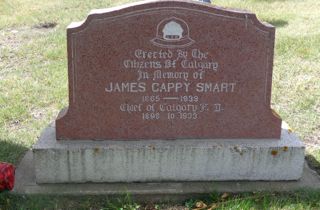
CAPPYFirst up is JAMES ‘CAPPY’ SMITH, a Scot who arrived in Calgary on October 19th, 1883 to a city of ‘nothing but a village of tents’. He worked in a sawmill before signing up with Calgary’s young fire department. He was appointed chief in 1898 and remained in that position until 1933. He was a blunt spoken man who led by example and should the crowds get too close to a fire and refuse to listen to his orders to get back, he would simply turn that fire hose on them! He led the Stampede Parade for many years, owned 3 bears, an alligator, a monkey and a parrot!

DENNYNext is SIR CECIL EDWARD DENNY. Born in England, Denny emigrated to the US when he was nineteen, before moving north to Canada. He joined the North West Mounted Police for the famous March West in 1874, traveling north from Fort Macleod in the fall of 1875 to build Fort Calgary. He was one of the signatories at Treaty Number 7 but forced to resign from the NWMP when he had an affair with a colleague’s wife. Denny then became an Indian Agent and archivist and can truly be called one of Calgary’s founding fathers.

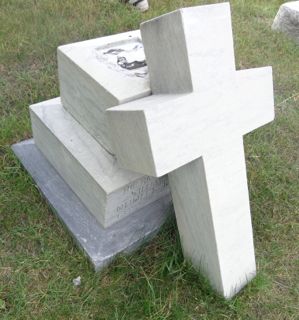
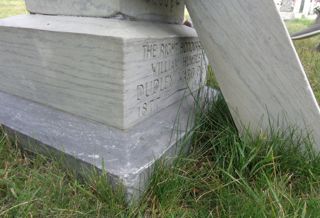
Now comes my personal favourite. WILLIAM DUDLEY WARD. If you’re a Downton Abbey fan and watched the 2013 Christmas Special, or if you know anything of the goings-on of the Prince of Wales at the beginning of the 20th century, you should recognize the name, because his wife Freda Dudley-Ward was the long-time mistress of Edward Prince of Wales before Wallis Simpson came into the picture.

WARD1    WARD2

WARD3 I have to admit, finding his grave raised more questions than answers. Why did a man, born into great wealth and privilege, educated at Eton and Cambridge, a possible spy and British MP who divorced his wife in 1931, end up in Calgary where he died at aged 69 following an operation? Hmmmm.  I’m going to be down at the library this week checking that out!

BETNLEYBut perhaps one of the most moving memorials in the cemetery is that of the Bentley family. An ordinary young couple, it is a sobering reminder that life is fragile and to be treasured. On May 7, 1918, Orlie Bentley gave birth to a daughter, Helena. Four days later, the infant died of exhaustion due to an inability to ‘latch on’ and feed. Within three weeks, Orlie herself was dead from ‘childbed fever’, all-too-common amongst women before the mid-20th century. Tragically, only six months later, James died from the Spanish flu which struck Calgary in October 1918.  He was only twenty-eight.

I’ll continue with more stories from Union Cemetery in my Wednesday post.