My Top Ten Scottish Films

Perhaps not technically a travel blog but, sticking with this week’s Scottish theme, lots of lovely Scottish scenery!

I’d love to hear your top ten favourite Scottish films.  Here, in no particular order – except for the first two – are mine.

1) LOCAL HERO

2) DEAR FRANKIE

3) WHISKY GALORE

4) THE PRIME OF MISS JEAN BRODIE

5) TUNES OF GLORY

6) SMALL FACES

7) I KNOW WHERE I’M GOING

8) TRAINSPOTTING

9) GREGORY’S GIRL

10) THE WINTER GUEST

Scottish Women’s Hospitals

Given that Scotland will – or will not – vote for independence from the rest of the UK on Thursday, September 18th, I thought I would focus this week’s blog posts on Scottish history and writing.

With 2014 being the one hundredth anniversary of the outbreak of World War One, I was fascinated to read about the Scottish Women’s Hospitals which treated allied soldiers during The Great War.

Formed to provide medical assistance to the injured, the Scottish Women’s Hospitals also worked to promote the cause of women’s rights.

Elsie Inglis, who I talked about in a previous blog, was one of its founders. A doctor, she approached the War Office with the intention of setting up a hospital in Edinburgh to care for injured soldiers, or co-operating with the RAMC to treat soldiers on the Western Front. The War Office’s response? “My good woman, go home and sit still!”

Following this rebuff, the Scottish Women’s Hospital approached the French and by November 1914 they were in business, setting up a hospital in Calais. This was followed in December with a hospital in the Abbey of Royaumont. They went on to set up hospitals in Belgium, Serbia, Malta, Corsica and Russia.

The hospitals were staffed entirely by women. Many, but not all, came from Scotland, with others coming from other countries such as America, England and Ceylon. Doctors, nurses and other medical personnel received a salary, but ancillary staff, including orderlies, drivers and cooks, did not. These jobs were filled by women from the upper classes who could afford to work for free, wanted to help the war effort and had a sense of adventure.

If you are interested in reading more, please check out this wonderful website which not only goes into the history of the hospitals, but contains the biographies of many the women who worked there.


The Virgin’s Promise – Kim Hudson: Part Three

In this third and final blog installment – The Thirteen Steps of the Virgin’s Promise – taken from Kim Hudson’s book The Virgin’s Promise, I can only offer you a hint – a flavour – of her concepts and ideas.

The thirteen steps Hudson describes are fascinating, all the more so because she compares them with the twelve steps of The Hero’s Journey. And if you read her book (which I highly recommend!) she takes several movies, which follow the Hero’s Journey and others which follow the Virgin’s, and points out each step.

Plus, you know she’s on to something important when Christopher Vogler himself (The Writer’s Journey) says in the forward: This book repeatedly pounds me how much I didn’t know… Many of the terms she uses are compatible with those of the Hero’s Journey and simply emphasize a different shade of meaning in some common signposts. But other elements of her grammar of storytelling are unique, recognizing turning points that don’t have equivalents in the Hero’s Journey language, that are uniquely feminine, or at least reflective of a more inward and emotionally based approach to drama and life.

 THE THIRTEEN STEPS

By Kim Hudson

 ACT ONE:

1) DEPENDENT WORLD: This is often the domestic realm. The people around the virgin are dependent on her or vice-versa. There remains a force within her kingdom – and within her – that keeps her attached to this world.
Material Survival
Social Convention
Protection
Need for Love.

2) PRICE OF CONFORMITY: This is about the suppression of the true self. Even if the virgin knows what she wants, she might not see a way of getting it because she may be:
Sleeping through life.
Living with restrictive boundaries
Living a life of servitude.
Facing psychological danger.

3) OPPORTUNITY TO SHINE: Something happens here that allows the Virgin to reveal her talent, dream or true nature. It can be:
Directed by fate.
Actively pursued.
A wish fulfilled.
A response to someone in need.
The result of a push from the crone.

4) DRESSES THE PART: This can be a fun moment for the audience or reader, but it is NOT a frivolous moment.
She becomes beautiful.
Receives a physical object she begins to use.
Participates in a fashion show and knows her potential.
Undresses (not necessarily physically) to reveal her full potential.

ACT TWO:

5) SECRET WORLD: Once the virgin has had a taste of living her dream and made it a tangible reality, she creates a Secret World in which to experiment and practice in her journey to realize that dream.
Creates her world: This can be a physical place or a state of mind.
Fear of Discovery: What if she’s found out?

6) NO LONGER FITS HER WORLD: She starts to see her dream as a possible reality but it becomes clear she can’t keep juggling the two worlds forever. At this point she may become:
Reckless.
Attract attention.
Declare her task too hard.

7) CAUGHT SHINING: Her two worlds collide and the consequences she feared come to pass.
She grows too big.
Circumstances change.
She is recognized by the dependent world while she’s in her secret world.
Betrayed.

8) GIVES UP WHAT KEPT HER STUCK: This is a MAJOR turning point. As Hudson says so beautifully: ‘Just as a butterfly sheds a drop of blood as it emerges from it cocoon and experiences a period of vulnerability, the virgin must sacrifice some of her past to move into her future.”  

In her Price of Conformity, she had an experience that developed into a complex, burying her pain and creating a belief or pattern of behaviour that keeps her from taking action and claiming her life.

In this major turning point, she brings that belief or behavior to a conscious level and challenges it. She has lost her dream life and must take the steps necessary to make it reality. This begins with letting something go or of allowing it to die. The usual reasons to remain in the dependent world are:
Fear of Being Hurt.
Fear of Loss of Love.

ACT THREE:

9) KINGDOM IN CHAOS:
The world becomes uncomfortable.
The Kingdom uses its power to bring the virgin back into line.

10) WANDERS IN THE WILDERNESS: It was easy to follow her dream when the dependent world still existed as a fallback position, but it’s a different matter following the dream no matter what the consequences. She finds herself faced with:
Test of Conviction.
Moment of Doubt.

11) CHOOSES HER LIGHT: She trusts herself and pursues her dream whatever happens.
Last stage of transformation.
Introduces her true form to the kingdom.

12) RE-ORDERING/RESCUE: This is when her shadow side is truly banished.
She – and others – see her value.
Reconnects with her kingdom.
The false rescue. (In a false rescue, the Hero will fight for the virgin but only to prove he is brave or to assert his will over another.)
The Test: When the hero fails to value her true nature, the virgin must reject him.
Multiple rescues. There can be multiple rescues, each one testing the virgin.

(In writing a compelling romance, the rescue provides the CRUCIAL obstacle to love. The hero fails to value the virgin in her authentic form due to his:
Immaturity – Ever After
Fear of Commitment – Pretty Woman
Fear of Embarrassment – About a Boy)

13) THE KINGDOM IS BRIGHTER: The virgin has challenged the kingdom and thrown it into chaos. They have accepted her back and made adjustments to accommodate her AUTHENTIC nature or dream and realize the Kingdom is better off for having gone through this experience as it needed change.
Evil has been uncovered and removed.
New life has been injected into the kingdom.
Unconditional love binds the kingdom.

So there you have it – The Virgin’s Promise in thirteen steps. But as I said above, this is just a taste of Kim Hudson’s book. Please check it out, examine the films she talks about and you will see the important differences between the journey of the Hero and that of the Virgin. You won’t be disappointed.

Union Cemetery – Calgary: Part Four

I know, I know.  I can just imagine you looking at the blog post title, throwing up your arms in despair and saying, “She’s talking about graves. Again!’  But this is the last time, I promise. At least from Union Cemetery. (I still have to take the tours of Burnsland and St Mary’s cemeteries.)

VIEWAlthough not all of the people buried in Union Cemetery have grave markers, they all have a story. As a writer, here are a few of the stories I learned on the cemetery tour which – while not about the great and the good – really piqued my interest.

The first I found really touching – because I pass by this place every day when I walk my dog – was the story of a young engaged couple who were killed on the corner of Prospect Ave and 10th Street SW. Apparently he went to pick up his fiancée, who lived in a rooming house on Prospect Ave, to go for a walk one day. Mount Royal is – not surprisingly given its name – on a hill. When they were caught in a thunderstorm, a bolt of lightning ended their lives. Their grave is unmarked and their story leaves me with so many unanswered questions. What were their names? Where did they come from? What ages were they? What were their dreams? How soon did they plan to marry? What were their occupations? Such a tragic loss.

SMITHI love the story of Jimmy Smith who emigrated to Calgary from China. Determined to become ‘Canadian’, he dressed in western clothes and was known only by his ‘English’ name. A cook at the Grand Hotel in Calgary, he died of TB but left $1,500 to go towards the building of Calgary’s first hospital, the Calgary General Hospital. His marker was provided by both the Nurses Union of Alberta and the Chinese Community of Calgary. What was his ‘real Chinese name?’ someone on the tour asked. A couple who spoke Chinese looked at the  Chinese characters and smiled.  ‘Jimmy Smith,’ they  replied.

I’ve talked about Peter Prince – a lumber merchant from Quebec – before in my blog. His house can be found at Heritage Park and his office still serves as a restaurant – 1886 Cafe – in Eau Claire. After Prince’s first wife Marguerite died of diabetes (he is buried alongside her in St Mary’s Cemetery) he married three more times. Hmmm, I can hear you thinking. Sounds a bit dodgy. But remember, those were different times. You could not have a single woman in your home unless you were married to her. He married Emma – who had been a invalid for some time – who died in 1902. His third wife, Rosa, died of cancer in 1907. Emily, his fourth wife, outlived him by 19 years. Her grave is unmarked, but she is buried with Rosa and Emily in Union Cemetery.

There are so many other graves and so many stories: Sam Livingstone who brought fruit trees to Alberta and fed the NWMP through their first hard winter in Calgary; Maude Riley, who made a pact with God after she almost died in childbirth, brought in laws to protect children and is commemorated by Riley Park; Fred Collings, a runner for the telegraph office, who died when he and another boy were cleaning their revolvers. Thinking the chambers empty, they fought a ‘duel’.

What a rich and colourful tapestry.

TREEI learned other things about the symbols to be found in graveyards. We know that children are often represented by lambs or little shoes, but a grave marked by a tree stump also represents a life cut short.

What about an anchor? – The symbol of faith.

Or what about this grave? Given the name and lack of dates… what story does it conceal?

SHERLOCK

Union Cemetery – Calgary: Part Three

I first moved to Calgary when the city was little more than one hundred years old. Coming from a country where a ‘new’ bridge built to replace an ‘old’ one could still be 500 years old, it didn’t seem to me that a place like Calgary could have much history.

What an arrogant attitude!

In the first place, the peoples of the First Nations had lived here for thousands of years with a history and traditions as old – if not older – than that of my home country.

Secondly.. we might think of history as being the realm of kings and queens, dukes and earls, generals and admirals, after all, they’re the ones who get their names in the history books. But REAL history is made by ordinary people doing extraordinary things. And when you see a city transformed from a simple wooden fort to a shining metropolis in less than four generations… well that’s purely down to the ambition, hard work and vision of those ‘ordinary’ people.

Here are two of those people whose graves can be found in Union Cemetery.

MACLOEDCOLONEL JAMES FARQUHARSON MACLEOD: Born in Scotland in 1836, he trained in Ontario as a lawyer, before joining the NWMP. Macleod was part of the famous March West in 1874, its remit being to establish law and order, stop the illegal whiskey trade, protect Canada’s border from encroachment by the Americans, and open up preliminary negotiations with the First Nations. He founded the fort, named in his honour – Fort Macleod – in what is now Alberta on the US/Canada border.

In 1875, he ordered Inspector Brisbois and 50 men from ‘F’ tropp to establish a post on the Bow River. Initially called Fort Brisbois, the name was changed to Calgary (after a village in Scotland) on the suggestion of Colonel Macleod.

Trusted by the First Nations as an honourable man, he was one of the signatories to Treaty Number 7 with the mainly Blackfoot First Nations.

Despite being Commissioner of the NWMP and working as a magistrate and judge, he died in 1894 a poor man, leaving a wife, five children and just $8.

WAREJOHN WARE: Born into slavery in South Carolina in 1845, he moved west at the end of the American Civil War, finding work on a ranch in Texas where he became a skilled horseman. In 1882 he came to Canada on one of the great cattle drives north. He worked on various ranches (including the famous Bar U) before buying his own homestead in 1890 and then creating a ranch east of Brooks. Over time, he owned 1,000 head of cattle and 100 horses under his 9999 (The Four Nine) brand.

Tragically, for a man of whom it was said, “The horse is not running on the prairie that John Ware can’t ride,” he died on September 12th, 1905 when his horse stumbled on a gopher hole and fell on him. He was killed instantly.

John Ware‘s name is remembered in Calgary by John Ware Junior High School and the John Ware Building at the Southern Alberta Insititute of Technology. He is also commemorated in Mount Ware and Ware Creek.


The Virgin’s Promise – Kim Hudson: Part Two

If you read my blog last Friday, you probably got the idea just how much I LOVE Kim Hudson’s book, The Virgin’s Promise. Three of the major ideas she puts forward really struck a chord with me.  1) Difference between Myths and Fairytales. 2) Archetypes. 3) The Thirteen Steps of the Virgin’s Journey. Last week I looked at Myths and Fairytales and next Friday I’ll be looking at The Thirteen Steps. Today it’s the turn of Archetypes. Her description of twelve archetypes really helped me see characters in a new light.  Please – PLEASE – pick up her book for yourself. All I can give you below is a taste.

ARCHETYPES
Read different books on archetypes and they might list six, fourteen, twenty-four, or even thirty-nine possible archetypes.

What I love about Kim Hudson’s take on archetypes in her book The Virgin’s Promise, is that she boils it down to twelve (six male, six female) to represent the beginning, middle and end of human life. Each stage of life archetype has its shadow side.

The shadow side may be where the character begins his journey before he transforms. (eg Scrooge the Miser transforms into a Mentor. The Hero initially ‘Refuses the Call’.) The Shadow side is where the character will end up if he/she doesn’t transform. The shadow side can also be portrayed by another character in the story as a warning of what is at stake emotionally if the character fails to transform. Think Marty’s father in Back to the Future at the beginning and then end of the film. He transforms. Biff doesn’t.

THE VIRGIN’S PROMISE / FAIRYTALE THE HERO’S JOURNEY / MYTH
VIRGIN – WHORE
MOTHER /GODDESS – FEMME FATALE
CRONE – HAG
HERO – COWARD
LOVER / KING – TYRANT
MENTOR – MISER

THE VIRGIN’S PROMISE/ FAIRYTALE

VIRGIN: (Not necessarily female. Think Rocky.)
Hers is a journey of self-fulfilment.
Knows what she wants.
Brings her dream to life while surrounded by the influences of her ‘kingdom’.
She is about ‘being’.
Her obstacle is her community.
The Virgin has Friends.

WHORE: (Shadow side)
She is caught in a life that services the needs, values, power and directions of others to her own detriment and neglect.
She sells her soul to conform to the expectations of others.

MOTHER/GODDESS
Enters into a relationship. (Man/woman/parent/child/community.) That union leads to her wholeness.
Knows her power and uses her talents to nurture and inspire.

FEMME FATALE: (Shadow side)
To maintain an imbalance of power, the Femme Fatale will use emotional manipulation. (Think Cersei in Game of Thrones.)
This leads to emasculation, dehumanization and mistrust.

CRONE:
The crone releases her power to leave a positive impact on another.
She often puts the protagonist in a difficult situation where they are challenged to grow and transform.

HAG: (Shadow side)
Diverts the Lover/King from his true destiny into a hopeless union with her. She robs the next generation of its future and spreads dooms.
She cripples people with fear and interferes with their lives. (Think Glenn Close in Dangerous Liasons.)

THE HERO’S JOURNEY/MYTH

HERO: (not necessarily male. Think Katniss in The Hunger Games.)
Faces mortal danger by leaving his ‘village’ and proving he can live in a larger world.
His is a journey of self-sacrifice.
He is about ‘doing’.
The obstacle for the hero is evil – usually an evil that threatens his ‘village’.
Hero has allies whose goal is of mutual interest. (Think of the scarecrow, tin man and cowardly lion in The Wizard of Oz.)

COWARD:
He is so fearful of death that his life occupies a small space.
He fails to explore the world beyond his own village.
He has no confidence he can survive on his own.
Avoids anything that could lead to death or hardship.
(Think a bully or Judas.)

LOVER/KING:
Asserts his will over others (even against their will) to bring integrity, justice and security to the community.
He is challenged to surrender his heart to the feminine.
By allowing love to become central to life (not necessarily a woman – can be a child or friend) he gains a form of immortality. (Think Mr Tom in Goodnight Mr Tom.)

TYRANT:
Seeks to use power for personal gain and is unfeeling towards the feminine. (Not necessarily female.)
He asserts his will physically.

MENTOR:
Can be a philanthropist.
Transfers gifts of wisdom and knowledge to worthy recipients. (Think Obi Wan Kenobi)

MISER: (Shadow side)
Hoards his wealth – real or metaphorical – for himself.
Ignores the effect of his neglect on others. (Think Scrooge.)


Union Cemetery – Calgary: Part Two

With 50,000 people buried in Union Cemetery (not all in marked graves) there are literally thousands of stories to be told. Continuing on from my previous post on Monday, I’m going to look at a couple of memorials which are related to two famous nautical disasters.

STEENROBERT ALEXANDER STEEN.  Forty-seven years of age, a private in the Canadian Army Medical Corps, Steen was one of the 234 personnel murdered by the Germans on the Hospital Ship Llandovery Castle in World War One. The ship was returning to England from Halifax NS, carrying 164 men, 14 nurses, and 80 officers and men of the Canadian Army Medical Corps.

Under the Hague Convention, hospital ships are prohibited from carrying arms, must be clearly marked with the Red Cross, and sail with all lights burning. The enemy are allowed to stop and search the ships, but must not fire on them. However, on June 27th, 1918, a German submarine fired on the Llandovery Castle.

It sank within 10 minutes. Three lifeboats got away. The German captain – Patzig – interrogated those on the boats to find ‘proof’ of misuse of the ship (ie that it was carrying arms). Unable to find any, he then ordered his crew to prepare to dive. With only himself and a few other sailors on board, they attempted to hide their war crime by ramming and machine gunning the boats and survivors in the water. Twenty-four men in one of the lifeboats survived and were rescued 36 hours later. All 14 nurses were murdered. The sinking became a rallying cry for the Canadian forces in the last few months of the war. Captain Patzig was never found or prosecuted for war crimes.

Please click HERE to find a link to a brief report of the tragedy on the front page of The Calgary Daily Herald on July 2nd, 1918.

dickALBERT and VERA DICK were two of the 795 survivors of the sinking of the Titanic on April 10th, 1912 which killed more than 1,500 men, women and children.  Albert, who made his early fortune in Calgary’s land boom,  married his seventeen year-old wife Vera in the fall of 1911. They travelled to Italy, Palestine,  Egypt and France on an extended honeymoon, picking up the Titanic in Cherbourg. Their first-class tickets cost 57 GBP each. They both escaped in lifeboat #3.

In an era when the custom was, ‘Women and children first,’ Albert’s survival caused controversy. He claimed that, while trying to calm his hysterical wife who was clinging to him, he was pushed into the lifeboat. Some speculated that he dressed himself as a woman (not true) to escape. However, it must be remembered that men were needed to row the lifeboats far enough away from the ship to prevent them being drawn down into the vortex  as the ship went down. Whatever the reason, Albert’s survival meant that he carried a stigma for the rest of his life. In some places he was even considered not ‘socially respectable’ for having survived.


Union Cemetery – Calgary. Part 1

ENTRANCEIf you ever find yourself at a loss for something to do on a Sunday afternoon (May-October) and fancy learning more about Calgary’s history, pull on a pair of walking shoes, grab a bottle of water and a can of bug spray, and head down to Union Cemetery, established in 1891 (just off Macleod Trail and Spiller Road SE) to enjoy a volunteer-led tour of the cemetery.

Here you’ll learn about the great, the good, the characters, philanthropists, mounties, soldiers, ex-slave, politicians, ex-husband of a mistress of The Prince of Wales, survivors of the Titanic disaster – and many more – who have added to the richness of this beautiful city.

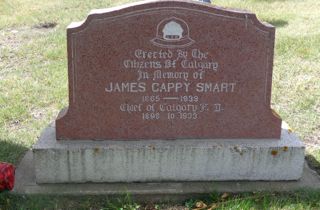
CAPPYFirst up is JAMES ‘CAPPY’ SMITH, a Scot who arrived in Calgary on October 19th, 1883 to a city of ‘nothing but a village of tents’. He worked in a sawmill before signing up with Calgary’s young fire department. He was appointed chief in 1898 and remained in that position until 1933. He was a blunt spoken man who led by example and should the crowds get too close to a fire and refuse to listen to his orders to get back, he would simply turn that fire hose on them! He led the Stampede Parade for many years, owned 3 bears, an alligator, a monkey and a parrot!

DENNYNext is SIR CECIL EDWARD DENNY. Born in England, Denny emigrated to the US when he was nineteen, before moving north to Canada. He joined the North West Mounted Police for the famous March West in 1874, traveling north from Fort Macleod in the fall of 1875 to build Fort Calgary. He was one of the signatories at Treaty Number 7 but forced to resign from the NWMP when he had an affair with a colleague’s wife. Denny then became an Indian Agent and archivist and can truly be called one of Calgary’s founding fathers.

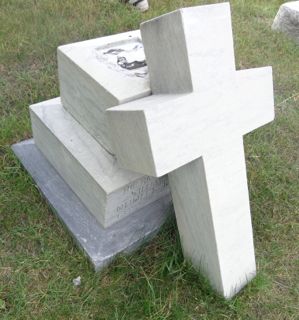
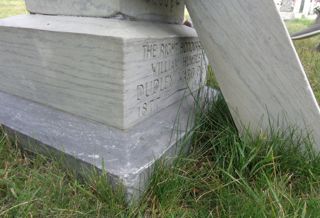
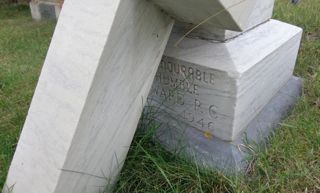
Now comes my personal favourite. WILLIAM DUDLEY WARD. If you’re a Downton Abbey fan and watched the 2013 Christmas Special, or if you know anything of the goings-on of the Prince of Wales at the beginning of the 20th century, you should recognize the name, because his wife Freda Dudley-Ward was the long-time mistress of Edward Prince of Wales before Wallis Simpson came into the picture.

WARD1    WARD2

WARD3 I have to admit, finding his grave raised more questions than answers. Why did a man, born into great wealth and privilege, educated at Eton and Cambridge, a possible spy and British MP who divorced his wife in 1931, end up in Calgary where he died at aged 69 following an operation? Hmmmm.  I’m going to be down at the library this week checking that out!

BETNLEYBut perhaps one of the most moving memorials in the cemetery is that of the Bentley family. An ordinary young couple, it is a sobering reminder that life is fragile and to be treasured. On May 7, 1918, Orlie Bentley gave birth to a daughter, Helena. Four days later, the infant died of exhaustion due to an inability to ‘latch on’ and feed. Within three weeks, Orlie herself was dead from ‘childbed fever’, all-too-common amongst women before the mid-20th century. Tragically, only six months later, James died from the Spanish flu which struck Calgary in October 1918.  He was only twenty-eight.

I’ll continue with more stories from Union Cemetery in my Wednesday post.


The Virgin’s Promise – Kim Hudson – Part One

For those of us who’ve been around the writing block for any length of time and read books on the craft, it’s very exciting when you discover a book that takes a completely fresh approach and makes you look at ‘story’ in a whole new way.

imagesWhich is exactly what Kim Hudson does in her book The Virgin’s Promise. Deciding that the twelve steps of The Hero’s Journey didn’t quite work for her, she spent five years researching and watching movies before completing The Virgin’s Promise.

There are three main sections to her book: The difference between Myths and Fairytales; The Twelve Archetypes; The Thirteen Stages of the Virgin’s Journey.

In essence, myths are about self-sacrifice while fairy tales are about self-fulfillment. Myths follow the 12 steps of The Hero’s Journey while fairytales follow the 13 steps of the Virgin’s Journey. But don’t start thinking that one is purely male and the other female. Rocky, that iconic movie of the 70s, follows the virgin’s path, rather than that of the hero.

FAIRYTALES: (The Virgin’s Journey)
Centered on self-worth and self-hood.
They answer the protagonist’s questions: Who do I know myself to be? What do I want to do in the world, separate from what everyone else wants of me?
They can be casual, every day events that take place in the domestic realm.
They are a journey towards psychological independence.
It is a PULL towards a joy that drives the character’s transformation.
They are a journey to SELF-FULLFILMENT

MYTHS: (The Hero’s Journey)
Centre around obligation.
They answer the hero’s question: Could I survive in the greater world or am I to forever cling to the nurturing world of my mother for fear or death.
They are a journey of physical independence.
The hero usually leaves his community or ‘kingdom’
The hero is transformed by a need to conquer fear
They are tales of SELF-SACRIFICE.

THE VIRGIN: (The Virgin’s Journey/fairytale)
Knows her dream.
She brings her dream to life while surrounded by the influences of her ‘Kingdom’.
The obstacle for the virgin is her community.
The virgin is about BEING.
The supporting characters in the virgin’s story are out of balance and grow with her.
The virgin has friends.

THE HERO: (The Hero’s Journey/myth)
Faces mortal danger by leaving his ‘village’ and proving he can exist in the larger world.
The obstacle for the hero is the evil threatening his village/kingdom.
The Hero is about DOING.
The hero has allies and their goal is of mutual interest.

Please click on this LINK to her website. (If it says the link has been taken down, click on the X and – abracadabra – the site will appear!!)


Walking the Labyrinth – Calgary

A labyrinth? Here in Calgary?

Who knew!

I had always assumed (incorrectly, as it turns out) that labyrinth was just another word for a maze – a maze offers you choices, while a labyrinth has only one track leading in and out – and was intrigued to discover there are several to be found here in Calgary.

Labyrinths have been around for thousands of years, featuring in ancient tales and legends as well as being a spiritual tool used in many religions.

When it comes to stories, perhaps the most famous labyrinth was that in Crete where Theseus killed the Minotaur. Briefly, every nine years, King Minos of Crete demanded that the city of Athens send seven young boys and seven young maidens to Crete to be devoured by the Minotaur – a half man, half bull creature – in recompense for a previous war. The third time this happened, Theseus volunteered to take the place of one of the youths and vowed to kill the Minotaur. (If something about this tale sounds familiar, I found an interview with Suzanne Collins, the author of the highly successful Hunger Games trilogy, where she acknowledges the Minotaur myth as one of the inspirations for her book.)

Perhaps the most famous religious labyrinth is to be found in Chartres Cathedral in France. Apparently, about one thousand years ago, when it became to unsafe for Christians to make a pilgrimage to Jerusalem, pilgrims began visiting the big cathedrals in Europe; Chartres, Canterbury and Santiago de Compostello. Somewhere between 1200-1240 a labyrinth was laid in the floor of Chartres which became known as The Road to Jerusalem. Not a maze, but a single track, it provided an opportunity for the faithful to replicate a pilgrimage to the Holy Land by following the path on their knees while praying.

But what has this to do with Calgary?

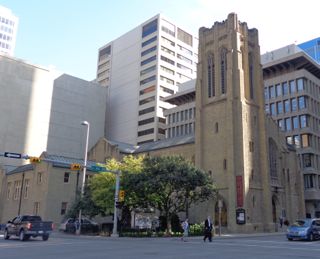
CHURCHONE

Knox United Church, Calgary

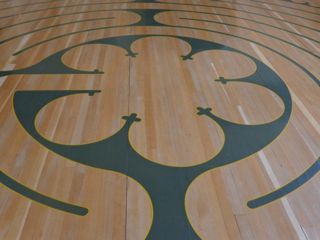
The labyrinth in Knox United Church, in the heart of Calgary’s downtown, is open to all – Christian or not – from Monday-Friday, 9am-7pm, and is based on the Chartres labyrinth.

When I visited the labyrinth yesterday, I walked it twice. The first time was from sheer curiosity: Was there really only one way in and out?  Did I cover every section of the intricate design?


LAB

The Labyrinth, Knox United Church, Calgary

The second time I decided to take it a little more seriously. According to the pamphlet provided by the church, the labyrinth is a unique spiritual tool that can be used to:
deepen self-knowledge
relieve stress and clear the mind
empower creativity
calm people in life transitions
awaken the spirit within
bring forth spiritual healing
open a path to action

I’m not religious, but I turned on the CD that is provided and tried to quiet my mind. There is no right or wrong way to walk the labyrinth, but I found that by just taking my time and concentrating, at the end of 20 minutes I returned once more to the entrance of the labyrinth feeling calm and relaxed.

CENTRE

The centre of the labyrinth, Knox United Church, Calgary.

The labyrinth in Knox United Church is not the only one in Calgary; there are several more, including an outdoor one in Sarcee Park. If you’re interested in finding one near you, please check out this worldwide labyrinth locator.