Wartime Rations – Day Three

No food photographs today as breakfast was toast and marmalade, and lunch will be leftovers from yesterday’s evening meal. I’m heading out to ‘the pictures’ with a friend this evening, so will be grabbing something to eat at the mall. Keeping in the wartime spirit, I’m planning to enjoy a fish supper/fish and chips. If fish isn’t available, I’ll make do with chips.
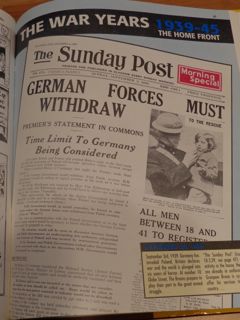
Sunday post 1October 8th 1944 was a Sunday. There was no edition of The Glasgow Herald on Sundays during wartime, so I tried to find examples of other newspapers online, especially The Sunday Post which was a fixture in most Scottish households. I was unsuccessful, but I did find a link to a documentary on the 100th year anniversary of this iconic Scottish paper which also includes accounts of the paper’s experience during both world wars. (Minutes 37.55 – 40.30 for WW2.)

Anne worked for The Daily Record in Glasgow, so I asked her about what Sunday papers were available, and also about her experiences working in a newspaper office.  I also asked:  Given there was no edition on Sunday, I assume they didn’t work on Saturday, but must have had to work on a Sunday to get the Monday edition out.  How did that square the very Presbyterian notion of keeping the Sabbath holy?  Do you remember?

One of the things I love about eye-witness accounts are the details you can’t find in history books, so here are Anne’s memories.

anne2013No memories really of its interfering with church.  I can’t see that anyone would have accepted having to wait till Monday for write-ups about the dozens of football matches on Saturday afternoons.
broons2

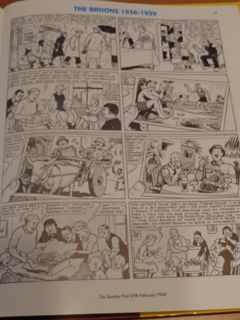
The Broons in The Sunday Post, February 1944

Most households would take The Sunday Post along with one or maybe two others; the Sunday Post was the demand of children for Oor Wullie sitting on his up-turned bucket and, of course, The Broons.

Most newspaper businesses did publish a Sunday paper but under a different name. You could perhaps find out by looking up Outram Press on Internet.  I worked for the rivals: the Kemsley Press in Hope Street.  My first job there was to sit with headphones on, from about 3 in the afternoon till 10 or 11 at night, taking ‘stories’ from correspondents all over Scotland for Kemsley’s morning paper, ‘The Daily Record’ , straight on to the typewriter for local calls and using shorthand for ‘long distance’ or ‘trunk’ calls.  These could be anything from the latest news in a court case to the prices obtained at the latest cattle auction, and had to be taken straight to the chief reporter.   Kemsley also published ‘The Evening News’ and on Sundays ‘The SundayMail’.  I got one day off a week and, not being involved in The Sunday Mail’, had Saturday off as well, so was having a 5-day week when most working people were still working half-day on Saturday.

I loved the feeling of ‘things happening’, was fascinated by the men operating the Linotype machines which pulled down the tiny lead (I think) characters (known as slugs) from the slots which surrounded the operator and was used to form the text; loved to go down to the basement and watch the huge, noisy presses in action as papers poured out, and watching as photographs from distant parts printed themselves oh-so-slowly, dot by dot, line by line, and eventually made a picture – do you remember those pictures? If you looked carefully you could see the individual dots, all varying shades of palest grey to black which resolved themselves into a printable illustration.

There were newsboys (sometimes rather old boys) waiting to get their supply to hawk in the city streets; and other boys loading sheaves of papers into waiting vans for further afield.

The Kemsley building was many stories high but with the war, the upper floors were redundant since paper was scarce and the papers had very few pages.  When war ended a decision was made by someone (Lord/Lady Kemsley?) to fit the empty space with hospital-type beds and offer them as accommodation to Empire servicemen who had been serving in Europe and wished to visit Scotland, sometimes the land of their parents perhaps, during their last leave before returning home.  They were also free to use the canteen.  So I met men from all over the Empire: Canada, Australia, New Zealand and S Africa.  Have to say I liked the New Zealanders best and happily took four of them (safety in numbers!) to the carnival in Kelvin Hall to have a go on the bumping cars etc.  All good fun.


Wartime Rations – Day Two

When Anne reads what I’m about to say, she’ll be rolling her eyes, shaking her head and saying, “No, no, no, no, no.” Having reminded me yesterday of the severe shortages of even rationed foods, I have to confess that I used two – TWO – eggs today. One for lunch and one in tonight’s bread and butter pudding. In fairness, when I’m cooking meals for my husband, I don’t try to feed us off my rations alone, so you could argue that tonight’s egg was ‘his,’ or would have come out of our shared powdered egg ration.

mince tarts

Mince tart, with onion/potato hash browns and mashed carrots.

Only two days in and we’re both finding the main courses really filling. (Perhaps I should have served dinner on a simple white plate as the meal and plate combined is an explosion of colour.) Using leftover mince from last night, I made a mince and potato pastry tart, with onion and potato hash browns and leftover carrots. It tasted really good and, as I managed to make four tarts from the recipe, they’ll make a nice change from a sandwich for tomorrow’s lunch.

bread pudding

Bread and butter pudding.

And here is the bread and butter pudding. To be honest, we’re both so full from the main course that we’re going to have to take a break and maybe come back to it this later in the evening. At the time of posting this, I can’t vouch for its taste… but it smells delicious.

The good thing about tomorrow? I’ll be back to my full 1/2 pint of milk per day until Sunday. Making the bread and butter pudding drained the last of my milk ration for the day!

On to the news.

The Glasgow Herald on Saturday, October 7th, 1944. Normally the paper consisted of 8 pages, but on Saturday it was only 6. (Sunday, no edition was published.)

As always, blackout times for Glasgow are at the very top of the front page:  7.07pm until 7am.

Page One: With no edition on Sundays, the churches advertised their services for the following day. I decided to check out The Cathedral Church of St Mary on Great Western Road as – I believe – this is where my parents were married. On October 8th, the 18th Sunday after Trinity, Holy Communion (sung) would be held at 8,9 and 12.15, with Matins at 11 and Evensong at 6pm. The minister was Rev A.I. Haggart B.A. and (very interesting) all seats free.

Page Two: The Battle of the Rhine is again increasing in violence, and according to the German commentator, Sertorius, the British have now succeeded in establishing a bridgehead across the Lek, which is being secured by further reinforcement. It will be necessary to wait for official confirmation from General Eisenhower before the full scale and scope of this attack can be grasped, but any idea that it is species of revenge for the defeat at Arnhem may be dismissed, Sound strategy aims at victory, not vengeance.

Page Three: Among the treasured souvenirs of the Glasgow Highlandersstay in Belgium during the present campaign, will be a beautifully executed tapestry portrait of King George VI, which was presented to the battalion by the Mayor of the village of Bellingham. It had been kept hidden during the whole period of German occupation, and its presentation to the Scottish troops was a spontaneous gesture which was greatly appreciated.

Page Four: Radio times for Saturday and Sunday.  At 8.30pm on Sunday, listeners could hear the final episode of Dr Jekyll and Mr Hyde.
It was also reported that during 1943-44, 1,124,255 people had visited the Art Gallery and its branch museums in Glasgow.

Page Five: Several new companies were registered in Scotland this week under the Companies Act:
#22946: James Lees and Sons (Ardrossan) Ltd.  (Mineral water.)
#22947: John G Dunn and Sons (Cambuslang) Ltd. (Wood and lumber merchants.)
#22948: Hillocks of Gourdie Farms (Blairgowrie) Ltd.  (Ownership of landed estates.)
#22949: James Johnstone (Glasgow) Ltd. (Grocers and Provisions merchants.)
#22450: Smedley’s Scottish Estates (Blairgowrie)Ltd. (TO purchase the lands and farm of Welton near Blairgowrie.)
#22451 W. Caldwell and Co. (Paisley) Ltd. (Gum and starch manufacturers)
#22452: James Church (Transport) Ltd. (Hauliers and carters.)
#22453: J.B. Bennet (Glasgow) Ltd (Public works contractors.)
#22454: Peter Robertson (Glasgow) Ltd. (Traders or business of auctioneers.)
#22455: The North-West Highland Associated Hotels (Inverness) Ltd. (To acquire hotels and inns.)
#22456: Saracen’s Head Hotel (Leith) Ltd. (To purchase the business of the Saracen’s Head Hotel from Mrs Jessie Wright.)

Page Six: Classifieds. The price of 750 pounds sterling was paid for a first prize five-month filly foal at Lanark. (If you’re interested in figuring out comparative costs for a house or car in 1944, please check out this great website.)


War Time Rations – Day One (again!)

It can get pretty boring looking a food pictures, so I’m not going to take pictures of EVERYTHING I eat over the next month. But as it’s the first day, I thought I’d show examples of what will be my typical weekday morning and lunch.

PorridgeWeekday breakfast will be porridge, a little milk and smattering of sugar for taste. (I’m going to save my egg and bacon as a treat for the weekend.) Because I only get 3 pints of milk a week, I’ve decided to divide that up into Mon/Tues allowing myself 1/4 pint each day and thereafter 1/2 pint daily for the rest of the week.

My weekday lunches will be a variation on The Oslo Meal. Essentially, it’s a sandwich (lettuce and tomato), a piece of cheese, glass of milk and piece of fruit, but given that lettuce and tomato are not in season in October, I’ve modified it to a bowl of homemade vegetable soup with some bread, homemade coleslaw (some days I’ll substitute an apple) and a cup of tea. My family seem to like my veggie soup and it’s really easy, so here’s the recipe.

RATIONSDiana’s Homemade Vegetable Soup:
Pan of water, one stock cube, 1/2 cup of lentils, 1/2 cup of split peas (if desired), one chopped onion, one chopped potato and one chopped carrot. Put everything in the pan, bring to the boil then simmer for at least 1 hour. The longer you simmer it the better.

minceDinner. Having grown up in Glasgow, I’m very fond of ‘mince and tatties’ but I decided to do the potatoes just a little differently tonight.  I mashed them with fried leek, moulded them into hamburger sized patties and then fried them which gave them a great texture.

And then pudding.  Ah, pudding.  I only ever seem to eat a dessert whendessert I’m eating wartime rations – go figure. However, with apples and blackberries as the only fruits available to me for October, I’m going to have to get creative. Tonight I made the old standby; apple and raisin crumble. The crumble is dead easy; rub 2oz of butter into 4oz flour then mix in 2oz sugar. I only used a small amount of the mixture tonight so have stored the rest in the fridge for the evenings I need to pull something together quickly.

Just as well I have to take the dog for a walk tonight as I feel pretty full!

anne2013Anne’s asked me to remind everyone that, “When you’re talking about rationing, don’t forget fuel and soap.  Remember it was a time of coal, electricity and gas, so Britain then didn’t have the benefit of hydropower and nuclear stations, nor did local users have wind farms.  So, electricity often meant blackouts of light as well as heat for cooking (in the middle of making dinner!), and the coal ration was only enough to heat one room, so most families lived in the kitchen, often undressing there and dashing through the cold hall to get to their cold bedrooms.  As for soap, there were no detergents beyond soap in block, flake or powder form and the ration was meagre.  In Glasgow we didn’t feel it badly because we had such nice soft water from Loch Katrine and mother used often to send a soap coupon or two down to relatives in Derby and Nottingham where the tap water was very hard. There was also washing soda but that was extremely harsh on hands and fabrics.”

As for what was being reported in The Glasgow Herald on this day 70 years ago, despite the continued posting of the blackout times for Glasgow – 7.10pm until 7.01am next morning – there appears to be a growing sense that people are looking beyond the end of the war.

Page One: Noel Coward’s Blithe Spirit was playing at The Alhambra.

Page Two: The Army, unleashed after its dogged punishing weeks in the Caen sector, is gathering an amazing momentum.

Page Three: Questions were raised in Parliament on the shortage of teats for babies’ bottles, and, as happens too often, the matter was glossed over with meaningless explanations.

Page Four: Soviet troops were within 10 miles of Belgrade.

Page Five: France. Marshall Petain and 50 former members of his Vichy Government were charged with treason and intelligence with the enemy.

Page Six: After a four-day Court Martial, Private Thomas Montoya (24) of the US Army Air Force was cleared of murdering Joan Long (22) in an air raid shelter in Blackpool but was found guilty of manslaughter. He forfeited all pay and allowances, received a dishonourable discharge and a sentence of 10 years hard labour.

Page Seven: A shortage of round coal was accentuated this week by a number of illegal stoppages in Lanarkshire and by a continued high rate of absenteeism.

Page Eight: Situation Wanted.  Scottish doctor, graduate with varied experience, at present doing war-time locum in busy practice, is anxious to settle in Scotland after the war; age 32; family man; temperate; Presbyterian; he would consider assistantship with view partnership, or buying outright; preference for Highlands and Islands area or small county town, but is interested in any reasonable proposition.

Wartime Rations – The Rules

Earlier this year I spent one month eating World War Two British style food; the basics provided on rations, plus fruit and vegetables in season. My aunt collaborated with me, providing her recollections of her childhood during those six years of war. I had such a great time with the experiment, and learned so much, that I decided it would be a good idea to repeat it four times in the year (April/July/October) using the fruits and vegetables specific to that season.

What was it Robert Burns said?  ‘The best laid schemes o’ mice an’ men gang aft a-gley’. I’m not sure what happened to my good intentions for April and July, but as we’re only ‘just’ into October I’m going to try to get back on track and start again on Monday, October 6th and continue through until Sunday, November 2nd.

Diana’s Wartime Rations Rule Number One:
A little background to rationing in the UK during WW2 for those of you who are unfamiliar with its history.

Even though people received ration cards entitling them to certain essential foods, and those foods were ‘theoretically’ available, it didn’t mean that they always received them. There were constant shortages. If eggs weren’t available one week, you didn’t get two the following week to make up, but I’m going to assume all the foods that were on ration ‘are’ available.

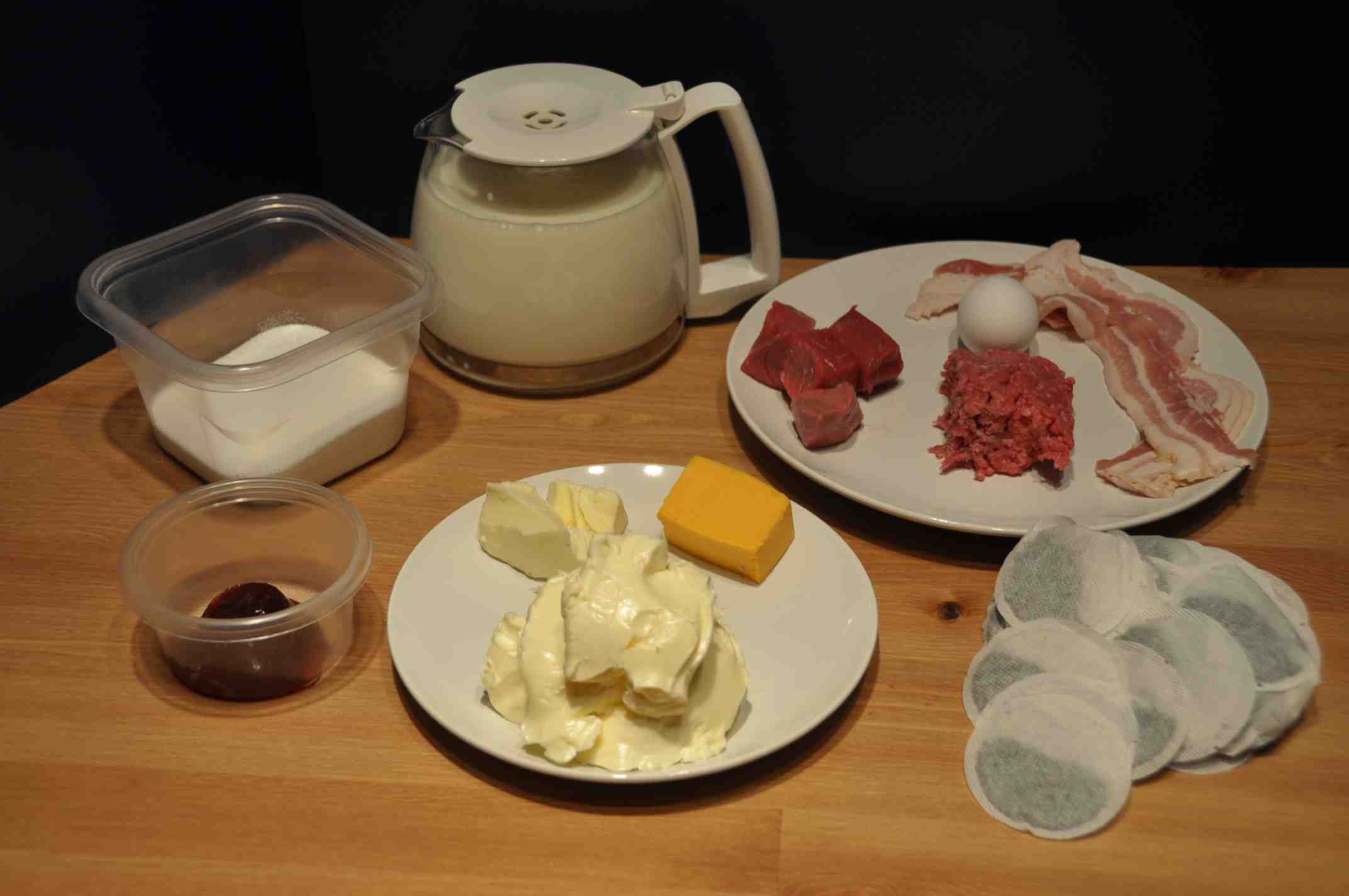
This is what one week’s rations look like.

ratiions

One week’s worth of rations – Britain WW2

Bacon – 4 oz
Meat – 8oz
Sausages – when available
Fats – 8oz (2 oz butter, 4 oz margarine, 2oz lard).  I’m going to substitute that with 8 oz of butter.
Cheese – 2 ozs
Milk  – 3 pints
Sugar – 8oz
Jam – 2oz
Tea – 2oz (15 tea bags)
Eggs – 1 shell and 3 dried.  (I will substitute with 4 shell eggs)
Sweets – 3oz

As for the fruits and vegetables in season, I will be using those suggested on this website. For October that means: Apples, Blackberries, Sweetcorn, Savoy Cabbage, Kale, Red Cabbage, Squash, White Cabbage, Runner Beans, Potatoes, Brussel Sprouts, Spring Cabbage, Carrots, Maron, Spinach, Leeks, Celery, Cauliflower.

Certain other foods weren’t rationed – eg flour, oatmeal – and others were to be found on a points system, eg tinned vegetables.  No-one went into the war with empty cupboards, and I’m sure there were times people swapped – I’ll give you some extra sugar for a tin of peas – so I’m starting tomorrow with the following in my pantry cupboard; flour, raising agents, certain spices, raisins, a small tin of golden syrup and jar of mayonnaise.

Diana’s War Time Rations Rule Number Two:
I call this my ‘Dining at the Savoy’ rule.

Rationing was probably hardest on the housewife who remained in the home and was limited to eating only rationed food – unless she went out for a cup of tea and a bun, or the occasional fish and chips. People who worked in factories were provided with a daily hot meal at the works canteen. And of course, those who could afford it could always eat out, and eat out well –  at places like The Savoy Hotel in London! – thus augmenting their rations.

This month sees Canadian Thanksgiving and a Wedding Anniversary in our family. On those two occasions I’m going to adopt my Dining at the Savoy rule and not inflict my wartime rations on my relations!

I’ve also decided to follow what happened in the newspapers between October 6th 1944 – November 2nd 1944, so will be adding information about that at the end of each post.  And I still have a few questions I’d like to ask Anne who was a child growing up in Glasgow during that time.

(If you have any wartime questions you think Anne might be able to answer, please e-mail them to me at dianacranstoun@gmail.com and I will pass them on.)

Here goes!


Creating an Outline – Linda Shaikh

linda image 2

Artwork: Linda Shaikh

I recently had the great pleasure of attending Calgary artist Linda Shaikh’s exhibition, ‘Finding Voice’.

It was a stunning display. With a mixture of paintings consisting of bold, brash strokes, followed by others which whisper ethereal colours fading into beyond, she draws the eye into the heart of her work.

But as you step closer to examine the images more thoroughly, you discover all is not as it seems.

What you are actually viewing in her paintings are her research, brainstorming, outlines and even chapter synopses for her PhD thesis. Linda is currently exploring ways to give the disadvantaged in our society a voice. As a visual artist, she has found a unique way of transferring words and ideas into art, which she then transforms back into words and fully realized concepts.

Artwork: Linda Shaikh

Take these three images. The first illustrates her initial thoughts and ideas for her thesis. The second, her first outline. In the bottom left hand corner of the third, she’s written down some of the basic concepts of the various philosophers she studied, with questions regarding those ideas radiating outwards.

As I made my way around the exhibition, I thought about the different ways that we, as writers, brainstorm and outline our work: traditional index cards; the use of Powerpoint slides to keep notes and images; visual story boards containing pictures of our main characters and the places they live; long rolls of wall paper which can be rolled out on the floor or stuck on the wall so you can see every scene in one place.

And how many of us create special playlists of music for each project to get us into the mood and settle us in our stories? How many of us go for walks to let our minds wander free and the ideas to flow. I have one writer friend who has discovered she crochets an afghan with each book she writes, the colours subconsciously reflecting scenes, images or emotions in her book.

linda image 3

Artwork: Linda Shaikh

Looking at all these beautiful paintings and their words, it got me wondering if this could be a method some of us might adopt to brainstorm and outline our stories. “Hmmm,” I can hear you say, “but I’m no painter. I couldn’t do that.” And I totally buy that. Something Linda and I discussed at the exhibition was that when asked to draw a bird, most adults will draw a simple double ‘v’ shape, whereas when we were young we painted multicoloured feathers and beaks. We weren’t afraid to take risks.

So here’s an idea. If you’re having trouble with your story or are at the brain storming stage, how about buying a cheap roll of paper and some paints (finger/poster or acrylic – it doesn’t matter), then roll the paper out on the floor or hang it on the wall and start to have some fun.

Look at these two examples of Linda’s chapter outlines. The first shows the details of that particular section. The second shows how the mass of ideas (and colours) develop, the colours taking on a simpler, lighter, calmer feel as the outline develops and reaches its conclusion.

linda image 4

Artwork: Linda Shaikh

linda1

Artwork: Linda Shaikh

To get you started, what about looking at your roll of paper in three-act-structure form? As writers we know that ¾ of the way through the story there needs to be a black moment, so paint in a wide black streak either with a brush, or with your hands. (Very often something tactile releases an idea in your brain.) Half way through is the Point of No Return where you character is not quite who they will be at the end, but something happens here to make them more of who they will be rather than who they were. Maybe you introduce the hint of a new colour here that will grow stronger as you continue towards the end of the story, while colours you used in the beginning start to fade.

In a romance novel, the midpoint is usually a kiss or sex scene, so what about a bold scarlet or gold stripe here?

lindaimage 5

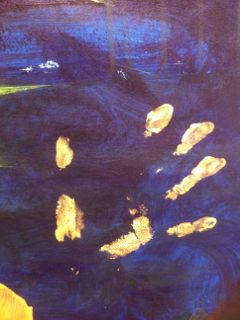
Artwork: Linda Shaikh. Extract from Image #1

What if you have a child in your story? How about including their hand print throughout to remind you of their role?

Once you have the bold strokes of colour of your basic outline and turning points, maybe then is the time to go back and add the detail, whether it is more delicate shadings, writing on the paper, or a collage of notes or images you’ve collected through the brainstorming phase. Once that’s done, you will then start to see the chapters appear.

And when you’re finished, don’t end with a neat line. Let the paper continue to flow and curl as Linda does because, while your story might end, your characters’ lives will continue.

Harold and Emma McGill – A WW1 Love Story

IS picture

Photo – Diana Cranstoun

Harold McGill and Emma Griffis, a doctor and nurse from Calgary, made an unlikely pair – he was shy and reserved while she was outgoing – but when Harold signed up to serve on The Western Front in 1915, he asked Emma to write to him. Emma also joined the Canadian army as a Nursing Sister in 1917 and was stationed in England. The couple married in December 1917, returning to Calgary after the war.

Sadly, Emma’s letters no longer exist, but Harold’s are safe in the archives at the Glenbow Museum in Calgary and can be viewed online. They tell a fascinating story;  aspects of war you rarely find in the history books blended with a tenderly unfolding love story.

Some of Harold’s descriptions of the battlefield – the guns growling, a shower of shells, night as dark as a wolf’s mouth – are chillingly evocative. And when he talks about standing in a trench at midnight on New Year’s Eve 1915 to watch the old year out and witness the blast of artillery fire from all the batteries announcing the birth of 1916… well it makes the hairs on the back of your neck prickle.

He talks about their rotation through the trenches; 6 days in the trenches – where they must sleep in their clothes and only remove their boots to change their socks – followed by 6 days in the brigade reserve, followed by another 6 days in the trenches, then 6 welcome days in divisional reserve billets where they have the opportunity to rest up before the whole process starts over again.

The gas alerts when the wind blows in from the east.

How ‘one smokes a lot at this game’.

A regimental dinner held in a convent.

The daily rum ration when in the trenches.

Having to go for 15 days without changing his clothes followed by the sheer joy of a hot bath and clean bed.

But it’s the love story that is the most touching. He starts off addressing Emma as Dear Miss Griffis and signs off Sincerely yours. Following his proposal of marriage in July 1917, that changes to My dear Emma and ends Yours truly. And after their marriage in December that year, it’s My Dear Wife from Your loving husband.

His concern when he discovers she’s assigned to the ‘lungers‘ ward at Bramshott Military Hospital in England, and his ‘mortal terror of TB which is more deadly than Fritz’s trench mortars’.

He makes an interesting comment about how men approach married life. ‘Usually when a man asks a woman for the privilege of making her everlastingly happy,” he writes, “what he really wants is for her to make him happy and worship him as a tin God.”

Only after they became engaged, when he was on leave in England in July 1917, do they really start learning about each other. He tells her he has an older brother and two younger sisters (one of whom, Margaret, is also serving in France) and that his parents died within 10 days of each other when Margaret was only 15.

There is so much more. I can only offer a sliver of the richness of his letters here and encourage you to click on the link at the top of the page and check them out yourself. As to why her letters didn’t survive… Harold offers the intriguing hint that he would ‘love to keep them’ but it is ‘difficult on active service’ and he must ‘burn them’.


Research

My main area of historical interest is World War Two. I’m fascinated by it – perhaps because there were still air raid shelters around to play in when I was growing up in Glasgow. And I can still clearly remember my Dad pulling on his old army overalls and beret before climbing underneath Mum’s car when it needed fixed.

So when I heard about a two-day symposium on The Great War being offered at the Military Museum here in Calgary, I hummed and hawed before deciding to sign up. It’s not ‘my’ time period.

But I’m glad I did.

Here’s what I learned.

1) Two days and 25 papers later, I probably know more about Alberta in WWI than most of my native-born Albertan/Canadian friends.

2) As a writer, ANYTHING you learn is invaluable. Everything can be adapted to add depth, texture and veracity to your writing.

3) More importantly, if you write anything inaccurate in your novel, someone somewhere will pick up on it. And when they do, it will pull them out of the story. From then on they will question everything else you say. Pull a reader out of your story and you’ve lost them.

No matter what you’re writing about, please – please – make sure your facts are sound.


Calgary Zoo

penguin

Photo by David Smith. The Calgary Zoo.

My husband and I were talking about zoos a while back. When he was young, whenever they went on holiday, his father always took the family to visit the nearest zoo. Whether it was Germany or France or England, it was just one of those things they ‘did’.

Me? Not so much. I’ve visited 4 zoos in my life; Edinburgh, London, Toronto and Calgary. What do I remember most about the first two? Remember, this was a loooong time ago and things have changed greatly in the past few (ahem!) decades, but boy did they smell. And even back then, my young self hated seeing the animals pacing back and forth, trapped in their barred cages.

Because of those memories, I think I only took my own kids to the zoo once or twice when they were growing up. Oh, I’ve been plenty of times since then in the winter to visit Zoolights, but never to go and see the animals.

flood

Calgary Flood 2013. The Calgary Zoo.

So when it was suggested I go to the zoo with my (now all grown-up) kids and granddaughter a few weeks ago, my expectations weren’t too high. Particularly because the Calgary Zoo, situated on an island in the middle of the Bow River, was badly damaged by the flood that hit Calgary in June last year.

My first impression on this visit? Extremely favourable. It didn’t smell at all!!  Probably because the animals are no longer housed in cages but in large indoor/outdoor enclosures where they can move around and socialize. The zoo is divided into different areas, some of which include: Destination Africa, Eurasia, Canadian Wild and the Penguin Plunge. Each area has a concession area and play park, so if your child gets a bit antsy, you can sit and enjoy a cup of coffee while they burn off excess energy on the equipment.

foamingo1

Photo by David Smith. The Calgary Zoo.

How did my granddaughter enjoy it?  She’s not quite three yet, so she was a bit intimidated by the larger animals. What really fascinated her were the birds, especially the flamingoes. She sat and stared at them for ages, completely enthralled.

How did her grandmother enjoy it? I think watching her is what started changing my mind about the concept of zoos. Until now I’ve always been a bit uncomfortable that we cage animals, even in generous enclosures, for our entertainment. Why not leave them in the wild and just watch them on TV?

tiger

Photo by David Smith. The Calgary Zoo.

But maybe it’s only when you get up close to an animal, watch how it behaves, look into its eyes and witness its unique beauty, intelligence, heart and soul, that you can really appreciate it. Really understand how precious animals are to our world and how we must treasure and protect them in the wild.

So if you have kids (or even if you haven’t) and are visiting Calgary, why not add a visit to the zoo to your itinerary.

Calgary Zoo, you’re doing a great job. My granddaughter and I will be back.

Often.


Alberta In The Great War

Although I learned about The First World War in secondary school, I don’t remember much about it beyond the Schlieffen Plan and trench warfare. Somehow it never captured my imagination in the same way as The Second World War.

However, I’ve recently been soaking up all the recent TV programmes and documentaries which have been made to mark the 100th anniversary since the The Great War’s outbreak. And the more I learn, the more I want to learn. So when I discovered the Military Museum here in Calgary was offering a lecture to introduce their temporary exhibition, Albertans in The Great War, I was in there like a dirty shirt.

Here are a few tidbits I learned.

alberta map for blogIn 1914, Alberta, as a province in Canadian Confederation, was only 9 years old with a population of 470,000. (Canada’s total population was 7.9million.) During the war, Alberta sent 49,000 men, between the ages of 18-34, to serve overseas. Only Ontario and Manitoba sent more in sheer numbers, but the proportion of men Alberta sent was the highest in Canada.

The majority of Albertan men served in the infantry on The Western Front, but a few joined the navy or the RFC serving at sea (obviously!) or in Palestine, Siberia and at Gallipoli. Supporting units included Artillery Batteries, Cyclist(!), Tunnelling and Railways companies. Medical, engineering, veterinary, supply, forestry and machine gun personnel. (The aim of the bicycle units had been to get the infantry up to the front fast, but were essentially useless in the chewed up battlefields of The Western Front. They did come into their own at the end of 1918 when the front line moved to areas where the roads remained intact.)

During the war, Alberta became the largest exporter of wheat and timber, the 3rd largest exporter of beef, and sent over ½ million horses overseas. The province also raised $42million ($1 billion in 2014 dollars) to war relief efforts such as The Red Cross, The Canadian Patriotic Fund, The Belgium Relief Fund and the YMCA amongst others.

Sam Steele, a hero of The March West, The Riel Rebellion and The Boer War, volunteered to serve, but was officially too old for the armed forces.  However he received special dispensation to help train the men here in Alberta and accompany them to Britain. Once there, the men received further training under Steele, but Steele then had to relinquish command when the troops were sent to the Western Front. His forage cap is part of the current exhibition.

The lecturer told a great story of pilots in the RFC who, after they had destroyed a target (eg ammunition dump/ train) would then land their planes beside the target, collect a souvenir (eg empty shell casing/letter from the engine) then take off again. Apparently one pilot returned with a sack full of mementoes.

And what do you do if you’re caught in a chlorine gas attack and have no gas mask to hand? Urinate into your handkerchief and hold it against your face.

These are just a fraction of the stories told during the current exhibition. It’s on until December 15th.  If you live in Alberta and have an interest in our province’s role during the conflict, I highly recommend you check it out.


Scottish Referendum – The Morning After

The morning after

Scotland, 19th September 2014

by Christine de Luca

Let none wake despondent: one way
or another we have talked plainly,
tested ourselves, weighed up the sum
of our knowing, ta’en tent o scholars,
checked the balance sheet of risk and
fearlessness, of wisdom and of folly.

Was it about the powers we gain or how
we use them? We aim for more equality;
and for tomorrow to be more peaceful
than today; for fairness, opportunity,
the common weal; a hand stretched out
in ready hospitality.         

It’s those unseen things that bind us,
not flag or battle-weary turf or tartan.
There are dragons to slay whatever happens:
poverty, false pride, snobbery, sectarian
schisms still hovering. But there’s
nothing broken that’s not repairable.

We’re a citizenry of bonnie fighters,
a gathered folk; a culture that imparts,
inspires, demands a rare devotion,
no back-tracking; that each should work
and play our several parts to bring about
the best in Scotland, an open heart.