Story Inspiration

On Monday morning, I’ll be sending my novel – Invincible Summer – out into the world in search of an agent. It’s a story I love and have carried in my heart for many years, so I will be releasing it from my laptop with hope… and not a little trepidation.

Invincible Summer tells the story of Maggie MacDonald, a twenty-one year-old Scottish nurse, who finds herself thrown into the crucible of World War Two when she volunteers for the Queen Alexandra Imperial Military Nursing Service. Despite facing many dangers, Maggie survives the war, but struggles to survive the peace.

I always find it interesting to find out where authors find the inspiration for their stories, so here’s a little background on Invincible Summer.
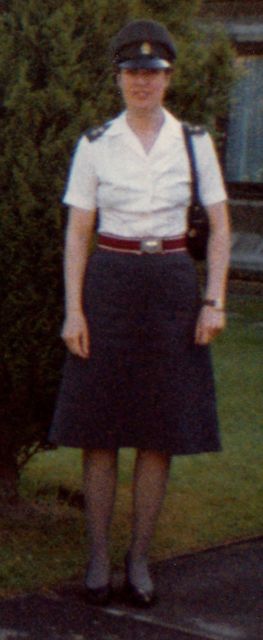
DianaQABack in 19-something or other, I received a commission as a Lieutenant in the Queen Alexandra Royal Army Nursing Corps – Reserve.  (QARANC)  The Reserve part means that I was in the Territorial Army, living my normal daily life, attending training sessions once a week and a minimum of two full training weekends a year. Should Britain have gone to war, I would have been called up to serve with the Military Hospital to which I was attached.

I also had the opportunity to attend a one-week Junior Officers Training Course in Aldershot, and during that time, we were taken to visit the QA Museum. (Now part of the Army Medical Services Museum.) There were all kinds of fascinating items on display, but two objects in particular caught my attention and ultimately inspired Invincible Summer.

The first was a rosary made from tiny bits of tar, looped together with thread taken from the uniform worn by an inmate Roman Catholic priest at Belsen Concentration camp. As I remember it, he gave it to the QA who ‘saved his life’. Until that time I hadn’t realised British army nurses had been amongst the first military personnel into the concentration camps following their liberation in 1945. Accounts of what they experienced are horrific, but those young women cared for their patients with kindness and professionalism.

The second was a QA cape. Inside were sewn army badges from many of the patients its owner had cared for; soldiers from all services in the British Army, Canadians, Australians and more. Remember that most of these QAs were young women in their early 20s, fresh out of nursing training. As commander of the British Army, Field Marshall Montgomery ordered that QAs serve as close to the front line as possible to raise the morale of the fighting soldiers. And whereas nurses in civilian hospitals were expressly forbidden to wear make-up or perfume, a hint of lippy and scent was actively encouraged amongst the QAs – again to raise morale.

QA2That week in Aldershot, I also had the opportunity to meet the inspiring Dame Margot Turner who I have spoken about in a previous blog. (Someone really needs to make a film about her life!) And I also picked up a book where I learned that at the start of World War Two there were six hundred and forty or so serving QAs scattered around what was still the British Empire. However, less than ten months later, 1,300 young QAs found themselves standing shoulder to shoulder with the soldiers of the British Expeditionary Force awaiting rescue from the beaches of Dunkirk. Until then, I had NO idea there were army nurses at Dunkirk.

The road to submitting Invincible Summer has been a long one. Working with my writing partner Margaret Thomson, we drew up a first draft of a novel entitled ‘Promises’ which told the story of 3 young student nurses who meet in Glasgow in 1936 and follows their lives through to 1946. We followed that up with an idea for a TV series, ‘The Scarlet and The Grey’, focusing on 4 QAs in a Field Hospital in World War 2 France.  A major British production company  shopped The Scarlet and The Grey around the TV networks… but sadly it didn’t get picked up.

And now comes Invincible Summer. Please wish it well as it sets out on its journey in search of a publisher.

‘WAS’ is a four-letter word… or is it?

According to Michael Hauge, the job of the filmmaker is to elicit emotion in the audience. That responsibility holds equally true for the fiction writer. Our readers want to share in our characters’ journeys, experiencing in a visceral way their joy and despair, fear and courage, trust and betrayal etc.

As writers, we’re told the most effective way to do this is to ‘show’ our stories rather than ‘tell’ them. A simple technique to ‘show’ is to use active, rather than passive, voice.

Passive voice – telling – holds the reader at arm’s length, and merely informs.

Active voice – showing –  engages the reader, eliciting emotion in both reader and character.

One of the biggest culprits of passive voice?

Was.

It might only be a three letter word, but the writer must treat it with the same respect as its four-letter cousin.  Rely on was too frequently and your writing will lose its power.

The Argument AGAINST ‘was’:

Take this simple phrase:  He was walking.  ‘Was’ plus an —-ing verb is as passive as it gets, and is on the ‘No, no, no, no, no!’ self-editing checklist for many publishing companies.  It’s boring and very rarely elicits emotion in either character or reader.

He walked – is a little better, but it still doesn’t tell the reader much.

Now try these for size. He strode. He strolled. He sauntered. He paced. He plodded. He shuffled. He waddled. He marched. He meandered. He slogged.

As a reader, can’t you now see a picture in your head of how – exactly – the character ‘was walking’? Doesn’t that image suggest the emotion the character is feeling? And now don’t you want to use that other three-letter-word ‘Why?’ to ask why the character is feeling that way?

Get your reader to ask ‘Why?’ and you’ve engaged him. You’ve elicited an emotion – at the very least, one of curiosity. And curiosity is good, because it makes the reader ask, “What happens next?” and turn the page to find out!

The Argument FOR ‘was’:

It’s often suggested that during our final edit, we plug was into our search option and eliminate its every use.  That’s a great idea, but do remember that ‘was’ does – sometimes – have a place in our stories.

Where?

In character dialogue, especially when he or she is passing on information. ” You know, she was telling me the other day…”  “I heard she was going into the army.” “There was a sale at the shops downtown.”

And there is an argument to be made that too much showing can adversely affect the pace of a story. Think about the phrasing or pacing of a song. If the singer sings each word, each phrase, at the same volume and with the same intensity, it’s boring and turns the listener off. You need the quiet moments, the loud moments, the fast and the slow to give variety, interest and hold the listener’s attention. That’s one of the roles of ‘was‘ in your book. Sometimes you just need that moment where you want to slip in a fact or piece of incidental information without making a big deal of it.

Ah, but what about the beginning of A Tale of Two Cities? I hear you ask.  In his famous opening line, It was the best of times, it was the worst of timesDickens uses the word ‘was’ ten times.  That’s right, ten times!

As always, whenever there’s a rule, it can be broken. But it’s not something I suggest you try to emulate. Dickens’ effectiveness has everything to do with the poetic nature of his introduction and the fact that he was a genius. That’s not the case for most of us.

So how many times is it okay to use ‘was‘ in your story. Is there a ‘magic’ number?

Check out the  links below and see how these best-selling authors deal with this simple three letter word.

(Disclaimer:  I’ve taken all these examples from the internet and am assuming they are genuine and error free.)

Hunger Games/Suzanne Collins:

Chap One:      5,187 words           was x22

Twilight/Stephanie Meyer:

Chap One:       6,783words         was x195

Harry Potter/JK Rowling:

Chap One:      4588 words             was x92

Chap Five:      6,579 words            was x92

Chap 13:        3,189  words             was x49

Chap 16:        6,432 words              was x75

Pride and Prejudice/Jane Austen:

Chap One:      847 words                was x8

Chap Two:      796 words                 was x1

Sherlock Holmes/Study in Scarlet/Sir Arthur Conan Doyle:

Chap One:      2,771                          was x28

Carnal Innocence/Nora Roberts:

Prologue:        1,539                         was x31

Chap One:      6,917                          was x118

Searching For…

I’m really excited about the project the writing group I belong to – The Alberta Romance Writers’ Association/ARWA – is currently involved with.  (I know, I know… the prepositions in that sentence are in the wrong places, but it sounded too formal written the ‘proper’ way!)

Back in November, under the stewardship of multi-published author Jessica L. Jackson, ARWA decided to promote a series of books with the theme Searching For…

The cross genre novels are between 40-70,000 words, the link between them being the main character must be Searching For… something.  That ‘something‘ can be a person/place/thing/peace of mind,  so the writer’s imagination is not limited.

This week saw the launch of the first book in the Searching For Series.  Written by Mahrie G. Reid, it’s a mystery entitled, Sheldon Harris Came Home Dead.

Please check it out.  I will be announcing future releases on this blog as they are published.

Mahrie

Writing Sexual Tension – Tammy Lyn Carbol

Tammy Lyn photo

Calgary writer Tammy Lyn Carbol presented a fabulous workshop on Sexual Tension at the Alberta Romance Writers’ Association meeting last week.

Using examples from the movies Zorro and Pride and Prejudice (2005), she reminded us that sexual tension is NOT about the sex act.  It’s about anticipation.  It’s slow, deliberate and can take time.

How to achieve that?

1) Make the attraction each character feels for the other blatantly obvious to the reader.

2) There must be conflict between the couple.  No conflict = No tension.

3) Use internal dialogue. Does the hero have to clench his hands at his side to prevent him reaching out to touch the heroine?

4) Even when they are not together, they should be thinking of the other.

5) Be patient. Take it slow.  Build the anticipation.

6) Then… give them a taste… then pull back.

7) When it looks like their relationship is going to work, pull them apart again. (Perhaps through the external conflict.) Tease the reader.

8) Try not to resolve their relationship until the very end.

Tammy cautioned us to be very aware of the different reactions between a man and a woman in a sexually charged situation.  A man will respond in a sexual manner while the woman’s response will be more emotional. As writers we must remember that if our characters are going to sound ‘real’.

Tammy also recommended that we watch the proposal scene from Pride and Prejudice (2005). It crackles with sexual tension. Watch Darcy and Elizabeth. They can’t take their eyes off each other.  And watch (around 2.37) where they lean in and – just for a moment – we think they might kiss.

Thanks, Tammy Lyn, for a GREAT workshop! And if you would like to check out more of Tammy Lyn’s writing, please visit her website: http://www.tammylyncarbol.com

Did She Go or Did She Stay?

I know Wednesday is supposed to be my travel writing day, but as Shirley Valentine was set in Greece, maybe I can squeak it through.

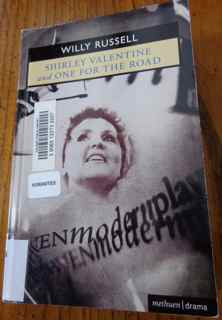
ShrielyI’m trying to write a one-woman play for my nightclass, so I’ve just spent the morning reading through the script (stage version) of Shirley Valentine by Willy Russell, working through the GMOTS that I mentioned in Friday’s writing post, to try and figure out how it’s done by an expert.

Shirley clearly articulates her physical goal (to drink wine in the country where the grape is trod) and emotional goal (to be Shirley Valentine again and ‘jump off the roof’) while being very conscious of the high risks (the loss of her marriage/family/friends) she will face in their pursuit. There’s no messing or tiptoeing around these goals and possible consequences. The stakes are high.

Shirley achieves both those goals, but the ending of the play is ambiguous when it comes to the risk involved.  Does she manage to keep her family… or in finding herself, does she lose them?

Or was the greater stake the even smaller life she would have lived if she hadn’t had the courage to find herself?

WindmillI found a posting on the internet where someone posed the question – Did Shirley Valentine stay in Greece or did she return to England? Apparently the women who responded said she stayed, the men said she went back.

Interesting.

Early in the play Shirley says she remains married because she needs to – she’s terrified at the idea of facing life alone in the world beyond the wall.

But once she does go out into the big wide world perhaps that marriage isn’t as important as her self-actualization.

I don’t know for sure what happens.  I think she stays in Greece for a while and then moves back to England or moves on – with Joe if he’s willing to accept Shirley Valentine, without if he needs her to be St Joan of the Fitted Units. But her life will never be the same again.

What do you think?

And is it important that the ending of a story dots all the ‘i’s’ and crosses all the ‘t’s…or can a little ambiguity sometimes be a good thing?

Caroline Russell-King

A couple of weeks ago I stepped waaaay outside my writing comfort zone and signed up for a playwriting course taught by award-winning Calgary playwright and dramaturg Caroline Russell-King.  Writing for the stage is very different from anything I’ve attempted before, but I believe that anything that challenges the writing brain cells has got to be good for developing one’s craft. Fortunately, Caroline creates a very safe emotional space in which to work, experiment and learn.

The one thing I love about taking writing classes is that although you may ‘hear’ the same lessons over and over again – eg plot structure, character development – sometimes a teacher will use a word, phrase or expression that turns the light bulb on and allows you to reflect on something in a different way.

Using the acronym GMOTS, Caroline Russell-King did just that, forcing me to examine various elements of my plot as a whole rather than individually. Like most people, I’m familiar with Goal, Motivation and Conflict, but I like how Caroline Russell-King breaks it down even further.

G – GOAL – Your protagonist wants something.

M – MOTIVATION- Must be High.

O – OBSTACLES – List the obstacles the protagonist will have to face.

T – TACTICS – What tactics does the protagonist use to overcome the obstacles.

S – STAKES – What are the consequences if the protagonist fails to achieve his/her goal?  These MUST be high.

And the real zinger?

Once you’ve worked all that out for your protagonist, repeat the process for your ANTAGONIST. In doing so, you’ll discover hidden layers of conflict in both your protagonist and antagonist.

And conflict is drama, right?

http://www.carolinerussellking.com

Don’t Write A Book, Write A Poster – Part 2

Back in August, I blogged about a poster I saw at Platform 9 3/4, the Harry Potter shop at King’s Cross Station. I was astounded – and inspired – by the image which contained all 76,944 words of JK Rowling’s first Harry Potter book.

HPPOser

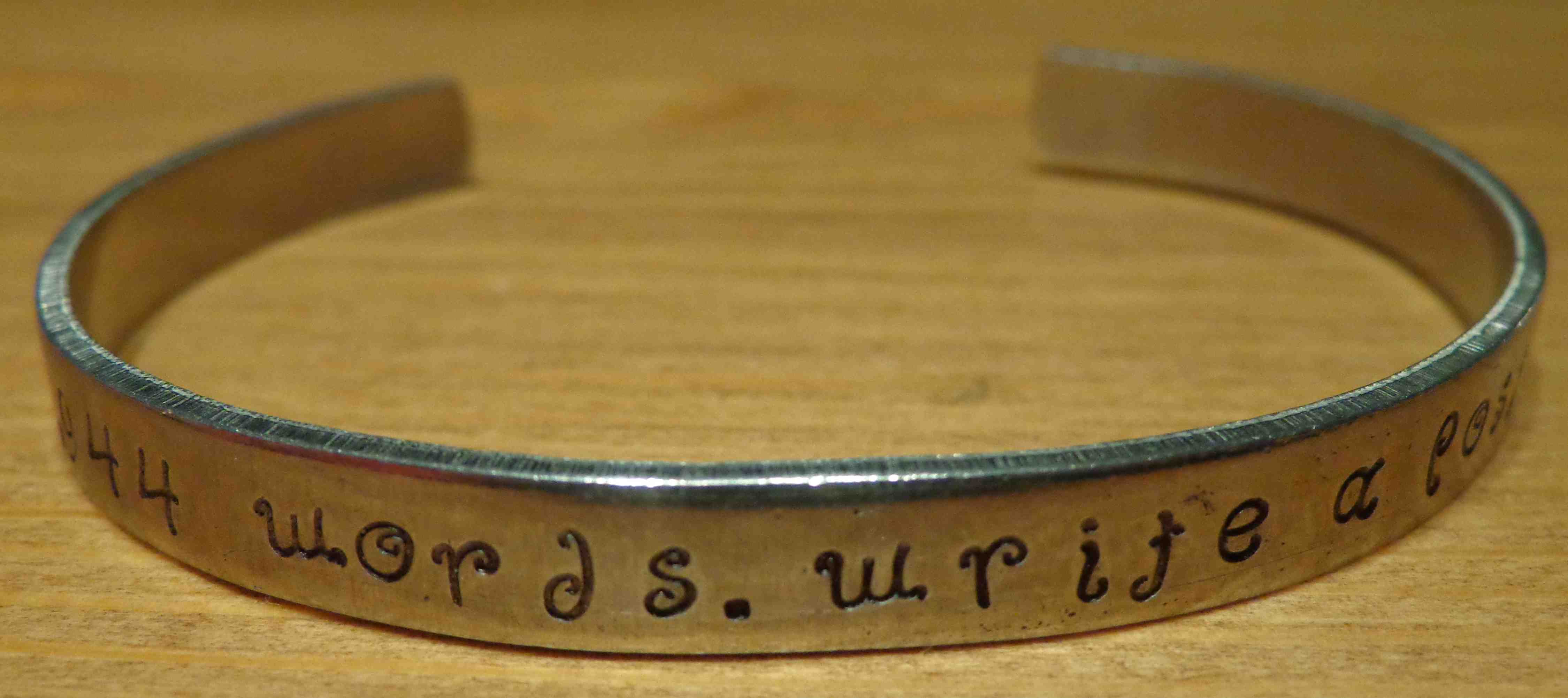
For a writer, facing the challenge of the blank page – or 375 of them for a 75,000 word book – can be daunting, but seeing a whole story on a poster somehow makes that task appear more achievable. So imagine my delight on Christmas Day when a good friend presented me with a bangle on which she’d had the words –  76,944 words. write a poster – inscribed.

bangle

Thank you, L. I’m going wear it every day in 2014 as I work on my writing, using it as inspiration to write my own ‘poster‘.

Doctor Who

As a child growing up in Glasgow, late Saturday afternoon found me in front of the TV watching Doctor Who. I have to admit, I was one of those cliches – the kid hiding behind the sofa, terrified yet enthralled by these strange characters and even stranger worlds.  And don’t get me started on the Daleks.  As far as I’m concerned, they are the most frightening aliens ever invented!

I stopped watching the show around the time Jon Pertwee became the third doctor, but last weekend I plonked myself ON the sofa (rather than behind it) to enjoy the full day of celebrations for Doctor Who’s 50th anniversary.

And I had a blast. The special episode, broadcast live around the world to over 94 countries, was great, but I particularly enjoyed the interviews with cast members, past and present, as well as the drama An Adventure in Space and Time which documented the making of the show back in 1963.  Interesting that the Head Of Drama, who came up with the concept, the producer and director were all ‘outsiders’ –  a Canadian, the first female producer, and first Indian director, employed by the BBC.

Episode One – An Unearthly Child –  was broadcast the day after JFK’s assassination in Dallas. No-one expected the show to last more than one series, but here we are, 50 years later.

(An interesting tidbit for you Outlander fans out there –  Diana Gabaldon has said that Jamie Fraser was inspired by one of the Doctor’s early assistants.)

Watching that very first episode once again took me right back to my childhood.  Then, as now, the music still sends shivers up my spine.

Here are the opening scenes of that very first show.  Enjoy!