Happy Hallowe’en

Growing up in Scotland, Hallowe’en was the most magical of nights. First would come the carving of the turnip; two triangles for its eyes, a twisted slash for a grin, a candle perched inside, and string worked through the sides to create a handle.

turnip

Party pieces perfected, we’d get dressed up in weird and wonderful homemade costumes and go out guisin’, the glow from our turnip lamps lighting our way down streets glittering with frost, to visit friends and neighbours.  (No knocking on strangers doors and definitely no calls of Trick or Treat back then.) Invited inside, we’d then have to perform our poem or song, and if our audience was pleased with the recitation, we’d be rewarded with an apple, orange, peanuts, or best of all, a silver coin… or two!

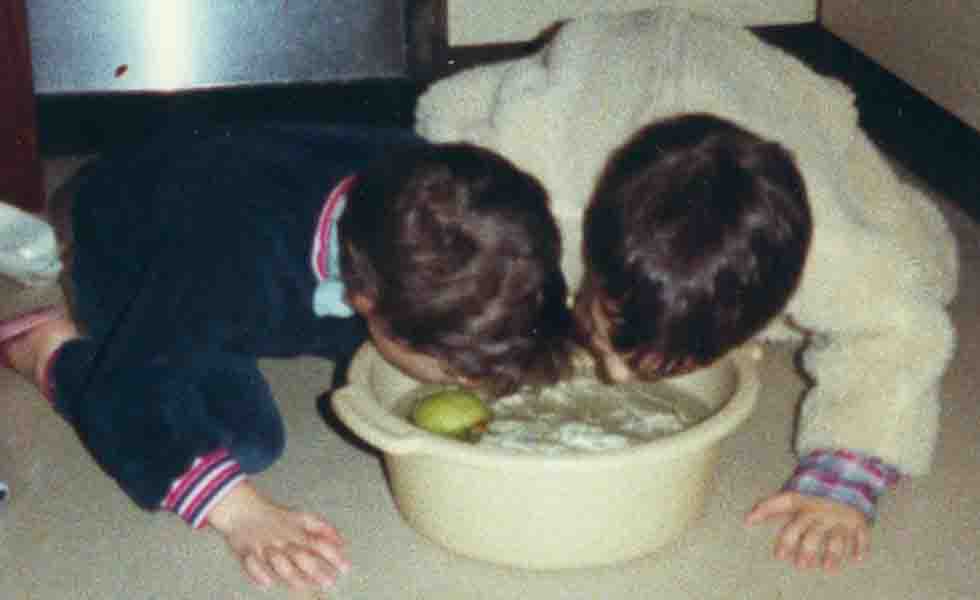
Back home, Mum would have slathered crumpets in treacle and attached them to the pulley in the kitchen.  With our hands behind our backs, the game was to see who could be first to eat them.  That would be followed – fortunately – by dookin’ for apples.  If you didn’t manage to grab an apple with your teeth, at least the treacle was washed from your face.
dookin

According to some historical accounts, it was Scottish and Irish immigrants who brought these traditions to North America. They developed over the years to the Hallowe’en celebrations kids enjoy now.

And talking of the Scots, it turns out that Robert Burns wrote a poem capturing the Hallowe’en rituals of 18th Century Scotland.  No, I’m not talking about Tam O’Shanter, but another entitled, simply, Hallowe’en, which describes the lingering pagan traditions in the Scotland of his time. Even I found myself struggling with the Scots version, so here’s an English translation.

Whatever your traditions, have a Happy Hallowe’en everyone!

Dr. Elsie Inglis

After training at The Royal Infirmary of Edinburgh, newly qualified Staff Nurses usually headed to Simpson’s or The Elsie Inglis to do their midder training. As RIE student nurses, we’d been taken to the room where Sir John Simpson had ‘discovered’ chloroform, the wonder drug which would be used to induce anaesthesia in childbirth.  (Simpson and some of his medical friends experimented with the drug one evening – Simpson was the first to wake up next morning so he got to claim the discovery.)

But what of Elsie Inglis?  What was her story?

Born in India in 1864 to supportive, liberal Scottish parents, Elsie Inglis attended the newly founded Edinburgh School of Medicine for Women, before completing her training at the Glasgow Royal Infirmary.

After working at Elizabeth Garrett Anderson’s ‘New Hospital for Women’ in London, and a maternity hospital in Dublin, she returned to Edinburgh where she opened a medical practice. An active suffragist, she was horrified by the lack of medical care available to women, and opened a maternity hospital and midwifery centre in 1894.

When World War One broke out she approached the British War Office with the idea to set up a Scottish Women’s Hospital to care for the soldiers fighting overseas.  ‘My good woman,’ came the response, ‘go home and sit still!

Undaunted she approached the French who were much more sympathetic. Funded by the Women’s Suffrage Movement, these all female staffed hospitals sent teams to France, Serbia, Salonika, Romania, Malta and Corsica.  Captured in Serbia in 1915, Elsie Inglis was repatriated to the UK where she then created and led a new team to set up a Scottish Women’s Hospital in Russia.

When Elsie Inglis died of cancer in 1917, Winston Churchill said of her, ‘Inglis and her nurses will shine in history‘.

In July 1925, the Elsie Inglis Memorial Maternity Hospital opened in Edinburgh with 20 beds. When it closed in 1988, it had expanded to provide 82 beds.

The Clydesdale Bank honoured Dr Elsie Inglis and her work by putting her likeness on their 50 pound bank note in 2002.

Ida Cook

There’s a great line in the play The History Boys by the character Mrs Lintott. “History,” she says, “is a commentary on the various and continuing incapabilities of men. What is history? History is women following behind with the bucket.”

With Remembrance Day fast approaching, I plan to post articles over the next couple of weeks featuring four remarkable and brave women who supposedly followed behind, but in fact led the way; Ida Cook, Dr Elsie Inglis, Nurse Edith Cavell and Dame Margot Turner.

IDA COOK

Writing under the name Mary BurchellIda Cook (1904-1986) wrote over 125 romance novels for Mills and Boon (Harlequin). She also helped found The Romantic Novelists Association in the UK and served as its president for many years.

An impressive CV in itself, but perhaps the proudest moment of Ida’s life came in 1965 when she and her sister, Mary Louise, were honoured as Righteous Gentiles by the Yad Vashem Martyrs and Heroes Remembrance Authority in Israel.

During the 1930s, funded by money earned from her romance novels, Ida and her sister helped 29 Jews escape the murderous regime of Nazi Germany.

At that time, Jews were forced leave all their wealth and possessions behind if they wished to leave Germany.  Countries around the world, including Britain, refused entry to Jews unless they brought their wealth and possessions with them.  An evil Catch-22.

Under the scrutiny of the Nazi security forces, Ida and Mary Louise sought out Jews in need. Using their love of opera and their connections with famous opera singers of the day, they visited Germany and Austria, supposedly to attend concerts.  In reality, these two modest sisters carried little with them as they entered the country, but left wearing jewellery belonging to Jews desperate to flee the Nazi regime, thus allowing their owners to meet the stringent UK immigration requirements. Ida and her sister put themselves at great risk in their attempt to save as many lives as they could.  Had they been discovered they would certainly have faced imprisonment in one of Hitler’s concentration camps, if not worse.

Ida Cook.  (And Mary Louise.)  Romance writer.  Genuine Heroines.

Safe Passage: The Remarkable True Story of Two Sisters Who Rescued Jews from the Nazis by Ida Cook (Nov 1 2008)

British Pathe

In the ‘olden days’ – not so long ago – when you bought a ticket to the cinema, it didn’t just buy you a few adverts, coming attractions and main feature. Oh no. It provided you with a whole experience; adverts, coming attractions, newsreels, second feature, intermission for ice creams or Kia-Ora orange juice, and then the main feature.  The programme kept going all day, from around 10 in the morning, on a continuous loop, until the National Anthem just before midnight.

I remember going with a friend to see West Side Story at what is now the Glasgow Film Theatre in Rose Street. (I also saw its predecessor Romeo and Juliet there too, but that’s a whole other story.) We walked in during the last half hour, just as Tony (Romeo) intervened in a fight between Barnardo (Tybalt) and Riff (Mercutio) resulting in the latter being killed.

No matter that we now knew the ending, we sat through the adverts, coming attractions, newsreel, second feature and intermission then watched West Side Story from beginning to end.

In those days, the newsreels were provided by British Pathe. I recently discovered, through the BBC History Magazine, that British Pathe has established a website which opens the door to an Ali Baba’s Cave of newsreel treasures.

Out of curiosity, I typed in Forth Road Bridge because I clearly remember watching a newsreel (can’t remember the film I went to see but it was at the ABC in Sauchiehall Street) on its opening.

And there it was.

The internet’s a wonderful thing, isn’t it?

Night Shift

Despite all the dangers of social media – once you post anything on e-mail/Facebook etc it is there for ev-ah even if you think you’ve deleted it – the net truly is one of the wonders of the modern age.

Take last night…

I was on Facebook around 4.30pm Calgary time when my friend R from my Student Nursing days put up a post in Scotland.

What are you doing up at that time of night? I asked.

Unable to sleep.

Minutes later, the third member of our trio, B, also in Scotland, posted – Looks like we’re all working nightshift tonight.

And you know, just for a minute, there we were, the three of us stepping onto the dim, quiet wards of The Royal Infirmary of Edinburgh at the beginning of a night shift.

Eidnburgh royal

There’s something special about working while the rest of the world is asleep. Most nights were quiet – routine obs, turning patients q4h, changing drip bottles – interspersed with both scheduled and fly tea breaks and the occasional moments of panic.

I still remember the terror of my first junior nights when the nurse in charge (a second or third year student nurse) went on her break. Left alone with only an auxilliary to care for up to thirty patients, I tiptoed from bed to bed, shining the tiny beam from my miniature torch onto my patients’ chests to make sure they were still breathing.

Now, all these years and thousands of miles later, those days have taken on a rosy glow and I’ve forgotten the hard times the three of us experienced on those wards: having a child die on Xmas Day; a ward sister hurling a bottle (of something you don’t want to know what it contained); sitting behind the screens with a patient holding their hand so they wouldn’t die alone in the dark.

And yet there were magical moments too – great moments of joy and friendship –  and that’s what I felt last night as we whispered to each other across the silent net.

Thanks, guys!

Fabulous Fashionistas!

This has to be one of the most inspiring documentaries I’ve seen in a long time.

These women are absolutely amazing. If you want to check out the whole documentary, type the above title into Youtube to watch it. (Just be aware you’ll have to plough through a few adverts first!)

My Mum could have been one of those women – as is her sister Anne, my aunt, who has contributed to this blog and is currently helping me edit my novel.

I think we tend to think of our mums as ‘just Mum’, but when I stand back and look at the things my mum did in her life, she, too, was amazing.

Putting aside what she went through in the war – separated from her husband, a child who almost died, experiencing bombing in Glasgow – it’s how she dealt with her later years that is just as inspiring. Mum was in her early sixties when my Dad died. Having given up work when she got married to become a traditional wife and mother, she had little experience of the working world, but after she became a widow she found herself a job in a doctor’s surgery and took in a boarder. When the boarder finally left she figured out what it was that she liked doing – cooking and looking after people – and organised herself some ‘wee jobs’ as a housekeeper in London. I remember driving her to her first interview, decked out in her ocelot fur coat and claiming to be ten years younger than her actual seventy six years.

Of course she aced it.

My siblings and myself weren’t too keen on this sudden show of independence. Maybe we thought it reflected badly on Dad – he’d left her well provided for,  she didn’t have to work – but now I understand.  No, she didn’t HAVE to work, she wanted to.  But on her terms.  One month on for the challenge, and one month off to return to her island home and enjoy her home, friends and village.

Older women rock!!

All change!

I love learning new things, and this was a great weekend to do so.

First off, I watched a BBC documentary – Nelson’s Carribbean Hell-hole: An Eighteenth Century Naval Graveyard Uncovered – and learned the following facts:

1) Faced with a choice of committing all their Royal Navy resources to fighting the Americans in The Revolutionary War or protecting their lucrative West Indies sugar-trade, the British government decided their priority was the latter rather than the former.  (They never taught us THAT at school!)  Had Britain chosen to concentrate on war with the US rather than sugar and rum, history could have turned out very differently. Hmmm.

2) There are no rivers in Antigua therefore all water comes from ‘the sky’ and must be collected in specially designed water-chambers.

3) Although many – many – sailors in the West Indies died from tropical diseases, the majority probably died from lead poisoning from the bottles containing the rum they drank.

But the most important thing I learned this weekend came from an Alberta Romance Writers’ Association workshop. It turns out there’s a whole new genre of fiction out there! Boomer-Lit. Who knew? But it makes absolute sense, doesn’t it?

There are millions of boomers out there and they want to read about themselves.

Check out this Goodreads site for more info – and happy writing!

(And reading!)


Voice

At the two writing conferences I’ve attended this summer, editors have made it very clear that they’re looking for writers who possess a strong narrative voice.

But what IS voice? How do you define it?

Consider the immediately identifiable voices of the following famous actors, radio personality and singer; Kathleen Turner, Alan Rickman, Jian Gomeshi and Frank Sinatra. They might use the same words we all do, but there is a quality to their tone and phrasing that make their voices uniquely theirs. So with our own writing voice. We must write in such a compelling way that no-one else could have written our words.

Some of it, it has to be said, is down to natural talent, but writing is also a craft. Craft can be studied and learned.

Ernest Hemingway’s advice was to Write drunk; edit sober. You’re welcome to accept his advice literally, but I think what he really meant was to write your first draft without any inhibitions. Be free and creative in the knowledge that no-one else is ever going to read that draft, then once it’s completed go back and hone your words so your story sounds as you want to tell it.

A solution we discussed at The Alberta Romance Writers’ Association meeting on Thursday was to compare your first and fourth chapters. Do they sound the same? Chapter Four will probably have a stronger voice than Chapter One? It can take a while to hit our stride writing a novel.  By Chapter Four we’ve usually settled in with our characters and plot and aren’t thinking so hard about the actual writing as the story takes over. It starts to flow more naturally, and as you relax, your natural voice is more likely to shine through. Identify the strengths of your voice in Chapter Four then go back and take a look at Chapter One again and make sure your voice is clear and true from the first page.

Character and Characterization

Years ago I took a Russian class. Our teacher had taught English ‘back home’ in his native Moscow and found the English language very frustrating.  In Russia, it seems, there is an exact word for everything.  You want to describe the placement of a pen situated 2 inches to the left and one inch in front of a book? Apparently there’s a word to describe precisely that position. (I don’t know for sure – I only took the class for 12 weeks – but I’ll take my teacher’s word for it!)

That vagueness is the problem we run into when discussing Character and Characterization. For many people, the words are interchangeable, but they’re not.

When we talk about a character’s ‘character’ – see what I mean about English being imprecise? – we are talking about the internal make-up of the person.  Think of it in Jane Austen terms: He was a man of good character. Character speaks to us of values, ethics and morals, and all of these are internal.

Consider one of Harry Potter’s conversation with Dumbledore. Because both Harry and Voldemort can speak to snakes, Harry is concerned that he might be swayed to following The Dark Lord.  Dumbledore reassures him by responding – We are our choices.  And that is key.  Even from a very young age, Harry’s choices were very different to Tom Riddle’s.

As Robert McKee writes in his book Story: True Character is revealed in the choices a human being makes under pressure – the greater the pressure, the deeper the revelation, the truer the choice to the character’s essential nature.

So what is Characterization? Robert McKee says: Characterization is the sum of all observable qualities of a human being, everything knowable through careful scrutiny 

For me, simply put, character is internal while characterization is the external manifestation of the internal.

For example, if your character’s ‘character’ is petty and mean-spirited, how will that reveal itself externally in your character’s actions? Will he leave a tip for the waiter? If he does, will it be exactly 10%. Will he count the money out in change down to the last penny?

If your character’s ‘character’ is cowardly, will he act to save someone’s life if it means he personally must face personal danger to do so?

Revealing ‘character’ (choices) through characterization (external actions) creates drama and conflict on the page.