D-Day +1 June 7th, 1944

I found Friday’s remembrances of the 70th anniversary of D-Day very moving, but perhaps for many of us the story that stood out was the journey 89 year-old Bernard Jordan took from his care home in Hove to join his colleagues in France.  It’s already been nicknamed The Great Escape, and I’m sure within a few weeks there will be a film in the pipeline.

Quite rightly, the emphasis this weekend was on the veterans and thousands upon thousands of young men who died on those beaches and in the months following the invasion. But it got me to wondering about the news the British people received, listening to the radio or reading the papers to find out what was happening to their loved ones.

Once again, I turned to The Glasgow Herald of June 7th, 1944 for some insights and gathered together a collection of tidbits that appealed to me.

Whereas other papers’ headlines screamed Invasion, with only 8 pages available (because of paper rationing) The Glasgow Herald wasted little space on pictures and remained as understated as ever. On the front page were the usual blackout times (Glasgow 11.57pm until 4.34am) and notifications of births, marriages and deaths. The current entertainment available at the city’s theatres was listed (including the Half-Past Eight Show mentioned in last week’s blog) as well as a programme of musical concerts in city parks.

But the Invasion did make its presence known on the front page with notices from city churches informing the faithful of special prayers and services for ‘our King and County and Allies and for the Forces now invading Europe’. Glasgow Cathedral offered two services at noon and 3pm for ‘those engaged in the Second Front Operation’.

The Late News column referenced a German report which talked of ‘grim fighting’ between Havre and Cherbourg being the ‘bloodiest of the day’ with several hundred Canadian paratroopers wiped out or forced to surrender.

German Overseas Radio denied any fighting in Caen. ‘Mr Churchill’s reference about fighting in Caen is untrue. No enemy troops have penetrated into the city, therefore no fighting has taken place in Caen.’

Page two carried the Colonial Secretary being forced to deny a ‘silly and harmful story’ which had had much circulation, particularly in America, to the effect that America was being charged for every palm tree they destroyed in battles for the recovery of British possessions.

When talking about the history of invasion in Europe, one columnist pointed out that Caen had been the HQ of William The Conqueror before he turned his sights on England in 1066.

Eisenhower apparently carried seven old coins in his pocket – one being an ancient five guinea piece.  He is said to have given these mascots a rub before the Italian invasion and everyone hoped that the mascots would do as good a job again.

Regarding the Invasion of Italy and France, it had been decided by Roosevelt and Churchill at the Casablanca Conference in 1943 that an invasion of the west would be deferred until the Allies had cleared the Mediterranean and knocked out Italy.

Page 3 contained Scottish news with detailed Invasion news starting on page 4.

The Invasion was originally scheduled for Monday June 5th, but postponed for 24 hours because of bad weather.

German Radio admitted the Allies had a foothold 10-15 miles long and nearly a mile deep in France.

Allied landings also took place on Guernsey and Jersey in the Channel Islands.

Hitler was reported to have taken charge of the military response to the invasion.

Between midnight and 8am on June 6th, an estimated 31,000 Allied airmen flew over France. 1,300 Fortresses and Liberators began their attack at 6am ending at 8.30am.

Priority was being given for troops’ mail so that both the men in the front line and their relatives and friends at home should receive regular deliveries of letters.

One hour before they left for the beaches, the troops enjoyed a meal of pork chops and plum duff. Each solder was then given a ‘landing ration’ –  a bag of chocolate and biscuits and cigarettes for ‘consumption while waiting’.

Civilian workmen and villagers who had seen anything of the preparations at an American airfield were detained in the camp by the authorities for 48 hours until news of the landings were released.

125,000,000 maps were used by the US invasion forces.

Eisenhower broadcast a Call to the People of Europe:  The hour of your liberation is approaching. All patriots, men and women, young and old, have a part to play in the achievement of final victory.

General Montgomery wished the troops ‘Good Hunting in Europe’.

And then, on pages 7 and 8 it was back to normal with commodity markets, situations vacant, property, livestock and farms for sale.  A five-room terraced house with kitchen and scullery could be bought for 800 pounds. So much for the biggest invasion force the world had ever seen.

If you ever get the opportunity to watch the film The Longest Day, I highly recommend it. It’s a comprehensive view of the events of June 6th, 1944 from all sides involved.


Ma Wee Gas Mask

Before I start a post, I usually have a clear idea of what I want to write about. However sometimes I can get pulled off track and this evening was one of those occasions. So this is going to be a long post, but if you hang in, there’s a rather sweet Youtube video at the very end!

With the 70th Anniversary of D-Day rapidly approaching on June 6th, I thought it would be interesting to look at The Glasgow Herald from June 2nd, 1944 and see if I could find any hint of the approaching invasion.

As noted in previous blogs, paper rationing meant each issue was comprised of only 8 pages. The Glasgow blackout began at 11.52pm and ended at 4.28am, a far cry from six months earlier when it lasted from 5.25pm until 9.17am the following morning!

As always, the war news was buried in the middle of the paper, so there were all kinds of fascinating articles to read through first.

Films showing in Glasgow included:
Lifeboat – Tallulah Bankhead.
Jack London – Susan Hayward
Madame Curie – Greer Garson
For Whom the Bell Tolls – Gary Cooper
The Cross of Lorraine – Gene Kelly
Life and Death of Colonel Blimp – Deborah Kerr

A list of legacies given to The Western Infirmary – remember this was 4 years before the NHS came in to being.

Mr Herman Anton Andrews, a London banker, bought the Scottish islands of South Uist, Benbecula and Eriskay. Following the purchase, the Scottish National Party sent him a letter detailing their concern that the buying up of large tracts of land by those operating from London and other centres outside the borders was contrary to the interests and people of of Scotland. (Given that Scotland is voting on Independence in September this year, I this particularly apt.)

And then came the war headlines.

Germans ‘getting a licking’ in Italy.

Notification that 47% of US Army troops (3,500,000 men) were stationed overseas.
The US Air Force had 50% of its personnel (2,357,000 men) and more than 50% of their machines stationed overseas.

Allied Gains on the Burma Front.

Three beachhead columns were moving on Rome.

4,000lb bombs were dropped at Roumania’s Iron Gate (where the Danube narrows), reducing German barge traffic and their ability to repair their railways.

Admiral Sir William M James, Chief of Naval Information in London, said the Navy would soon appear again in the public eye. ‘Before long, we shall reach that stage when we begin to launch a great amphibious expedition… We are going to have dramatic moments soon.” So there it was, the hint that something big was in the air.

And then it was back to general news, where one item in particular caught my attention. The Half-Past-Eight Show, starring entertainer Dave Willis was playing at the King’s Theatre.

As a child in the 60s, I remember going with my mother to see The Half-Past-Eight Show starring Dave Willis! I had no idea it had been going for so long. Before the 1930s, it had been the tradition for theatres to close during the summer when the citizens went on holiday. In the early 30s, however, it was decided to produce a high quality summer variety show. It was so successful it became an annual tradition lasting a long – long – time.

I seem to remember one of Dave Willis’s famous songs was about fox-hunting, but I’ve been unable to find any mention it on the internet. If anyone out there has any information, I would love it if you could send it to me.

Another song he sang during the war was Ma Wee Gas Mask.  I was unable to find a video of Dave Willis singing it, but I did find an absolutely charming video.  Enjoy!

In ma wee gas mask
Ah’m working oot a plan
The weans a’ think that Ah’m the bogey man
The girls a’ cry, an’ bring their friends to see
The nicest lookin’ warden in the A.R.P.

When there’s a raid on, ye ought tae hear me cry
‘An aeroplane, an aeroplane awa’ wa up a kye’
They a’ rin helter skelter, bit dinna rin efter me
Ye’ll no get in ma shelter for it’s faur too wee.

Family History

I love history. I love reading books and watching TV programmes about history. I love visiting museums, castles, stately homes, heritage parks, tenement museums. You name it, if a thing or place tells a story about the past – and particularly people who lived then – I’m in.

What is so exciting about history these days is that we’re interested not just in the lives of the ‘rich and famous’, but in those of ‘everyday folk’. Maybe that’s why we’re so drawn to TV programmes like Upstairs, Downstairs and Downton Abbey because, while we may fantasize about the aspirational, we acknowledge the ‘reality’.

And I love the fact that so many people these days are interested in their own family histories. Take last week, for example, when I received a parcel from my sister. On initial inspection, it looked like an ordinary shoebox…

box

… but inside was a veritable treasure trove of four generations of my own family’s history, written and created in their own hand.

My Mum’s 21st birthday cards from March 15th, 1937, including one from her then boyfriend who would become her husband, my Dad. A homemade birthday card her sister Anne – who has contributed her own wartime memories to this website – made for her.

21               anne card lower

Letters I wrote to my Mum describing our early years in Canada, postcards from a great-aunt on Mum’s side of the family, a dress and hat my grandmother (again on my Mum’s side) crocheted for one of my dollies. A Christmas card I made for my parents many – many – years ago.

envelopscard

It’s important we always remember that, like many things, history begins at home!

What family memories, or artifacts, do you treasure?

Visiting Fort William

I spent an afternoon in Fort William a few weeks ago. I’d recently read an article which said the drive from Glasgow to Mallaig ranked amongst the best in the world – just don’t stop in Fort William. Well… that’s a bit harsh. Given that the town clings to the shores of Loch Linnhe, the surrounding scenery is pretty stunning.

A wee bit of history about Fort William. According to Wikipedia a ‘Fort was constructed to control the population after Oliver Cromwell’s invasion during the English Civil War and then to suppress the Jacobite uprisings of the 18th Century’. Nowadays, the town is more famous for being the end point of The West Highland Way, a 96 mile walk from Milngavie (just outside Glasgow) to Fort William.

highlandway

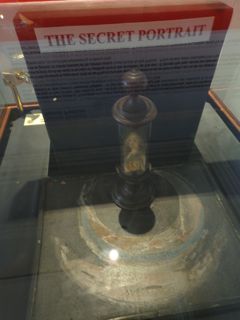
Whilst there, we visited the West Highland Museum. It’s a great wee museum, covering everything from traditional Highland life to the training of commandos during World War Two. But the highlight for me was The Secret Portrait, a fascinating piece of anamorphic art. (I’d never heard of anamorphic art or illusion before. Basically it’s when an image only reveals itself when viewed from a particular angle.)

bonnycharlieAfter the Jacobite defeat and Bonnie Prince Charlie‘s retreat back to France, the English government banned all things Scottish and any reference to a Stuart king. When toasting ‘The King’ – meaning King William – Jacobites would pass their glass over the fingerbowl in a silent toast to ‘the King over the Water’, but the English soon got wise to that and banned fingerbowls from Scottish tables.

But where there’s a will there’s a way. Anamorphic trays were designed with special metal glasses.  When viewed from a particular angle, Bonnie Prince Charlie’s image appeared on the goblet. Should the ‘enemy’ arrive on the doorstep, the goblet was removed, revealing only a messy looking tray.

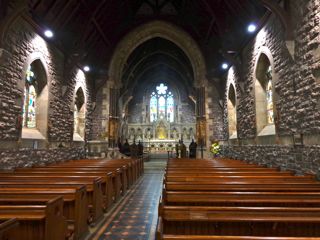
I also popped in to St Andrew’s Episcopal Church on the main street. Silent and peaceful, beautiful and welcoming, it’s definitely worth a visit.

.church1church2

Kiel Church and Cemetery – Morvern

The Morvern Peninsula, on the west coast of Scotland, is an isolated and stunningly beautiful part of the world. Because it is so peaceful and wild, you tend to think that probably not much has happened here in the past 1,000 years. But you couldn’t be more wrong. In the days when travel by water was the only effective method of getting from A to B, the Sound of Mull was a ‘motorway’ for vessels sailing up the west coast of Scotland – all the way back to the Vikings and beyond.

The present Kiel Church, which stands on a hill overlooking the Sound of Mull, is only just over 100 years old, but there has probably been a church on this site since the 6th Century. It’s even possible that St Columba himself, who died on Iona, might have visited here.

soundofmull    church

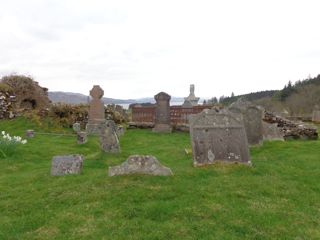
I’m used to cemeteries being flat and ordered. That’s not the case with this graveyard. The ground is rough, the stones – mostly 18th and 19th century – laid out higgledy-piggledy, with many sinking into the ground, leaving only their tips visible.

graveagain    grave1

For such an isolated corner of the country, there’s a lot of interesting history to be found here. A marker has been placed by one monument, commemorating the grave of a soldier who carried a Jacobite banner on Culloden Field.

cullodenTo the side of the church, there is a tiny building which houses the beautiful Carved Stones of Kiel which date from the 14th, 15th and 16th centuries. These too are gravestones, their size and intricate carving indicating the importance of the people whose graves they once belonged to.

stones1    stones2

If you’re ever in this wonderful part of the world, please take the time to visit Kiel Church, its fascinating cemetery and carved Stones.


Famous Scottish Writers

Typing ‘Scottish writers’ into Google brings up pages and pages of names. As I said in Monday’s post, for such a small country, Scotland has produced a disproportionate amount of talent.

Here are just a few of those names.

Thomas Carlyle – I’m embarrassed to admit I’ve never read any of his work, but he was one of the most important philosophers of the 19th Century. Click here to read some of his most famous quotes. The one I found most inspiring: ‘He who has health has hope; and he who has hope has everything’.

Robert Burns – If you’ve ever sung Auld Lang Syne at New Year, you’ve sung this famous poet’s words.

Sir Walter Scott – Ivanhoe, Rob Roy.

J.M. Barrie – Peter Pan.

Robert Louis Stevenson – Treasure Island.

Sir Arthur Conan Doyle – The creator of Sherlock Holmes

A.J. Cronin – not quite so popular now, but a huge name in the 40s with The Citadel and Dr Finlay’s Casebook.

Alistair MacLean – The Guns of Navarone. Where Eagles Dare.

Muriel Spark – The Prime of Miss Jean Brodie

Kenneth Graham – Wind in the Willows. (I have to admit this was a surprise as it has always seemed a very ‘English’ book to me.)

Iain Banks – The Crow Road

Ian Rankin – Rebus Detective Series

Val McDermid – Crime Writer (Tony Hill Series)

For the Scottish Independence Referendum in September this year, the Scottish Government defines a Scot as someone who chooses to make Scotland his or her home. Under those ‘rules’, here are a few other names you might recognise.

Louise Welsh – Crime writer

Julia Donaldson – Children’s writer.  (The Gruffalo)

J.K. Rowling – Harry Potter series.

Not bad for a small country. What names would you add to this list?

All you need to know about Scotland in four items!

GTrayI’m excited to have  Sarah Kades writing on my blog on Wednesday.  She’ll be talking about her visit to Scotland, so I’ve decided to keep with the ‘theme’ and examine a little about the history of Scotland today and some of its great writers on Friday’s post.

Arriving in a Glasgow hotel room, we found the following four items waiting for us; a bottle of Scottish spring water, a bottle of Irn Bru, a Tunnock’s Caramel Wafer and an apple. My husband commented that those four items told you everything you needed to know about Scotland, so although I might be stretching things a little in places, here I go!

waterWATER: As part of an island nation, Scotland is surrounded on three sides by water. The sea has exerted a great influence on the country’s history and culture. It has brought invaders (Romans and Vikings), Christianity and commerce (fishing, sugar and tobacco trade, oil and gas) to its shores.

For an island nation, it also harbours over 790 offshore islands within its total boundary, the main ones being Shetland, Orkney, and the Inner and outer Hebrides, but there are plenty more.  The Isle of Arran, which I’ve written about before, is only 2 hours travel west of Glasgow and known as Scotland in Miniature.

Because of its latitude, Scotland should experience similar winters to Scandinavia, but the presence of the Gulf Stream protecting its shores means that even in winter you can always find palm trees on the west coast.

Don’t forget the water which is essential in whisky making – uisge beatha – literally the water of life, or the rivers and streams famous for their salmon.

And… oh yes, it does rain in Scotland.  Sometimes quite a lot.  But that’s what makes it such a lush, green and beautiful place.

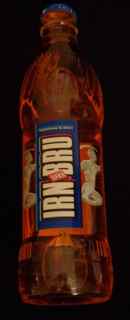
irn burIRN BRU: A local soft drink, produced since 1901, it continues to outsell the giants – Coke and Pepsi – in Scotland. As such, I think it symbolizes the uniqueness of Scotland and its people who posses a real warmth and friendliness – but also a bloody-mindedness.

Over the past few hundred years, Scotland’s influence on the world has been way out of proportion for its size of population. Although many factors are involved, some credit is often given to John Knox, an influential Presbyterian minister, who insisted that every single child in Scotland (rich or poor ) learn to read the Bible. An educated population gave Scotland a huge advantage during the Enlightenment and Industrial Revolution.

According to Wikipedia, 75% of US presidents can claim some Scottish Ancestry, and the first permanent settlement in America – Jamestown – was named after a Scot.  (King James VI of Scotland/I of England.)

Scots make up the 3rd largest ethnic group in Canada and the first prime-minister of the Dominion was Scots-born Sir John A. MacDonald.

caramelTUNNOCK’S CARAMEL WAFERS: Like Irn Bru, Tunnock’s is a successful Scottish company, created in the 19th Century and still going strong. (It’s also one of the few food companies who continue to refuse to make ‘own’ label products for supermarkets.)

Much has changed in the Scottish economy since I was a child. At one time, Glasgow was known as the Second City of the Empire because of its strong industrial base and I still remember the fading days of shipbuilding, steel, coal mining, car manufacturing, sewing machine manufacture and railway engine building in the Central Belt.

That has all gone now.  Modern industries include Oil and Gas, Banking and Finance, Computing and Pharmaceuticals while the traditional agriculture, forestry, fishing – and let’s not forget whisky! – continue to flourish.

appleAPPLE: Hmmm.  Scotland’s diet is not the healthiest in the world – remember that this is the country that gave the world the ‘Deep Fried Mars Bar’!  Even a Scottish government report admits that the Scots’ poor diet is the second major cause (after smoking) of poor health.

But… Scottish food is amazing.  Here’s just a ‘taste’ of what’s on offer.  Haggis, Cullen Skink, Finnan Haddie, Smoked Salmon, Black Pudding, Mince and Tatties, Square sausage, Stovies, Blaeberries, Lanark Blue Cheese, Cranachan, Marmalade, Oatcakes, Butteries, Tablet, Tattie scones, Shortbread, Heather Honey.

So there you go, a brief  look at Scotland through four items found in my hotel room.  But there’s so much more that I haven’t even touched on. The scenery for one thing.  It truly is gorgeous.

I guess there’s only one thing for it – you need to come here and see it all for yourself!

Elinor Glyn – Part One

A screenwriting friend recently drew my attention to an article she found on-line. In contrast to women’s experiences in modern-day Hollywood, did you know that once upon a time, women were the most famous and well-paid screenwriters?

As I scrolled through the list of names, the picture of Elinor Glyn caught my attention. I’d never heard of her until a few years ago when I visited the stately home of Montacute in Southern England where she lived with her lover Lord Curzon – but what a woman! Once again I have to ask, Why hasn’t someone made a film about her life?

Elinor Glyn was born Elinor Sutherland to a Scottish father and Canadian mother on the Channel Island of Jersey in 1864.  Following the death of her father, her mother took Elinor and her sister Lucy (who went on to become the famous dress designer Lucille) back to Guelph, Ontario.  They remained there until Elinor was eight before returning to Jersey on her mother’s remarriage.

Elinor married Clayton Louis Glyn, a barrister, in 1892.  They had two daughters, but due to his recklessness with money, Elinor was forced to begin writing to keep the family financially afloat.  Elinor essentially created the modern romance novel, her most famous work being the ‘scandalous’ (for its time) Three Weeks.

It was an unhappy marriage and Elinor had several affairs which scandalized Edwardian Britain. A famous poem of the time was: Would you like to sin With Elinor Glyn On a tiger skin? Or would you prefer To err with her On some other fur?

Following the death of her husband in 1915 and the end of her relationship with Curzon, Elinor moved to Hollywood in 1920 where she became a very successful screenwriter – but more about that on Friday!

Vera Brittain

It’s never been hard to find books chronicling men’s experiences in war. However, the first account I can remember reading of a woman’s experience during World War One was that of Vera Brittain in her book Testament of Youth.  It’s the harrowing true account of a young woman who loses her fiance, her brother and many of his friends in the killing fields of Europe. Not willing to sit idly by and watch the war from the sidelines, Vera trained as a nurse and served overseas.

Vera Brittain’s story was first told on-screen by the BBC in an adaptation which can be found on Youtube.  Just weeks ago, filming began on a new adaptation of Testament of Youth, a feature-length film, also by the BBC.  It will be released in 2015.

Although I knew Vera Brittain was a novelist, I didn’t realise she’d also written poetry. Here is one of her most famous war poems, The Sisters Buried at Lemnos, written in 1916 after she visited the graves of two Canadian Army Nurses buried on that island.

THE SISTERS BURIED AT LEMNOS

O golden Isle set in the deep blue Ocean,

With purple shadows flitting o-er they crest,

I kneel to thee in reverent devotion

Of some who on thy bosom lie at rest!


Seldom they enter into song or story;

Poets praise the soldier’s might and deeds of War,

But few exalt the Sisters, and the glory

Of women dead beneath a distant star.


No armies threatened in that lonely station,

They fought not fire or steel or ruthless foe,

But heat and hunger, sickness and privation,

And Winter’s deathly chill and blinding snow.


Till mortal frailty could endure no longer

Disease’s ravages and climate’s power,

In body weak, but spirit ever stronger,

Courageously they stayed to meet their hour.


No blazing tribute through the wide world flying,

No rich reward of sacrifice they craved,

The only meed of their victorious dying

Lives in the hearts of humble men they saved.


Who when in light the Final Dawn is breaking,

Still faithful, though the world’s regard may cease,

Will honour, splendid in triumphant waking,

The souls of women, lonely here at peace.


O golden Isle with purple shadows falling

Across thy rocky shore and sapphire sea,

I shall not picture these without recalling

The Sisters sleeping on the heart of thee!


Story Inspiration

On Monday morning, I’ll be sending my novel – Invincible Summer – out into the world in search of an agent. It’s a story I love and have carried in my heart for many years, so I will be releasing it from my laptop with hope… and not a little trepidation.

Invincible Summer tells the story of Maggie MacDonald, a twenty-one year-old Scottish nurse, who finds herself thrown into the crucible of World War Two when she volunteers for the Queen Alexandra Imperial Military Nursing Service. Despite facing many dangers, Maggie survives the war, but struggles to survive the peace.

I always find it interesting to find out where authors find the inspiration for their stories, so here’s a little background on Invincible Summer.

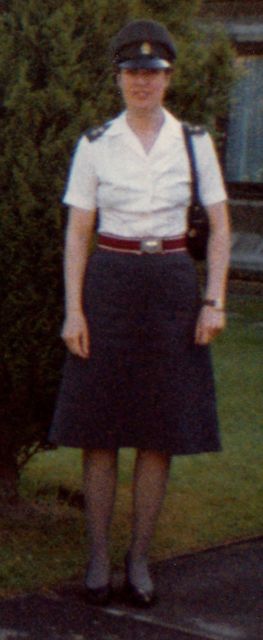
DianaQABack in 19-something or other, I received a commission as a Lieutenant in the Queen Alexandra Royal Army Nursing Corps – Reserve.  (QARANC)  The Reserve part means that I was in the Territorial Army, living my normal daily life, attending training sessions once a week and a minimum of two full training weekends a year. Should Britain have gone to war, I would have been called up to serve with the Military Hospital to which I was attached.

I also had the opportunity to attend a one-week Junior Officers Training Course in Aldershot, and during that time, we were taken to visit the QA Museum. (Now part of the Army Medical Services Museum.) There were all kinds of fascinating items on display, but two objects in particular caught my attention and ultimately inspired Invincible Summer.

The first was a rosary made from tiny bits of tar, looped together with thread taken from the uniform worn by an inmate Roman Catholic priest at Belsen Concentration camp. As I remember it, he gave it to the QA who ‘saved his life’. Until that time I hadn’t realised British army nurses had been amongst the first military personnel into the concentration camps following their liberation in 1945. Accounts of what they experienced are horrific, but those young women cared for their patients with kindness and professionalism.

The second was a QA cape. Inside were sewn army badges from many of the patients its owner had cared for; soldiers from all services in the British Army, Canadians, Australians and more. Remember that most of these QAs were young women in their early 20s, fresh out of nursing training. As commander of the British Army, Field Marshall Montgomery ordered that QAs serve as close to the front line as possible to raise the morale of the fighting soldiers. And whereas nurses in civilian hospitals were expressly forbidden to wear make-up or perfume, a hint of lippy and scent was actively encouraged amongst the QAs – again to raise morale.

QA2That week in Aldershot, I also had the opportunity to meet the inspiring Dame Margot Turner who I have spoken about in a previous blog. (Someone really needs to make a film about her life!) And I also picked up a book where I learned that at the start of World War Two there were six hundred and forty or so serving QAs scattered around what was still the British Empire. However, less than ten months later, 1,300 young QAs found themselves standing shoulder to shoulder with the soldiers of the British Expeditionary Force awaiting rescue from the beaches of Dunkirk. Until then, I had NO idea there were army nurses at Dunkirk.

The road to submitting Invincible Summer has been a long one. Working with my writing partner Margaret Thomson, we drew up a first draft of a novel entitled ‘Promises’ which told the story of 3 young student nurses who meet in Glasgow in 1936 and follows their lives through to 1946. We followed that up with an idea for a TV series, ‘The Scarlet and The Grey’, focusing on 4 QAs in a Field Hospital in World War 2 France.  A major British production company  shopped The Scarlet and The Grey around the TV networks… but sadly it didn’t get picked up.

And now comes Invincible Summer. Please wish it well as it sets out on its journey in search of a publisher.