Wartime Rations – Day Twelve

Life just suddenly seems to have got busy, so I’ve been relying on leftovers and familiar recipes today. Next week I really must get more focused and do a bit more experimenting with my rations.

appleBreakfast and lunch were the usual. Dinner was leftover sausages from last night, and for dessert I made a baked apple. So simple, yet really delicious and just the thing my sweet tooth was craving. (Under non-rationing circumstances it tastes even better with cream or ice cream on the side.)

It’s dead easy and very quick. Clean your apple and core it. Place it on a dish with just enough water to cover the bottom of the dish. Mix some raisins with a teaspoon of syrup/honey or sugar and stuff the apple.  Bake at 180C for 20-30 minutes, and Bob’s your uncle!

On to The Calgary Herald (14 pages) for October 17th, 1944.

There was lots of war news: The Russians had begun their drive into East Prussia with Berlin admitting the Russians were now on ‘sacred soil’;The Japanese had lowered the age of conscription from 19 to 17 years-of-age, and Rommel’s death had been confirmed.

But I have to admit, it’s the news from the Home Front that I find the most fascinating. The war news you can find in the history books, but the news in the papers is pure gold. (At least to the history geek in me!)

The Women’s Minimum Wage in Canada was set at $15 per week for a 30+ hour work week. Currently it was $12.50 – $14 for 48+hours.

Apple juice would be available to civilians this coming winter. During the past few years it had been reserved for the military.

Canadian Wren Mildred Honey found herself having problems. Custom dictated she be called by her last name, which caused puns and a lot of laughter on the base.

Alberta seemed to have a lot of problems with escaping POWs. I mentioned one yesterday, but in today’s paper was the report that: German POW Joseph Haub, 30, who’d escaped from his work at the Madalia Potteries on September 13th, was captured by RCMP and Medicine Hat City Police at 1am this morning in a house occupied by two women. Although it was unclear how long he’d been in the house, the two women were not charged with harbouring him.

And then there was this angry letter to the editor from ‘A Veteran’.
Returning to this country after spending three-and-a-half years overseas with the army, I received my discharge. After reading and hearing so much about the shortage of manpower, I thought it would be a simple matter to get a job, but I certainly found out my mistake when I tried.
At most of the places I was sent to by the Selective Service I was told I was too old. Since when was a man of 40 too old to work? And where is the rehabilitation program we hear so much about, or is the government keeping it for its much-beloved Zombie Army? How is it the business people of Calgary expect men to go to war and fight for them but will not give them work when they return? It was the same thing after the last war. They seem to have no use for an ex-serviceman here.
I suppose they will expect us to invest in the Victory Loan that opens soon. Any country that can afford to keep a Zombie Army of 72,000 men hanging around doing nothing does not need any help at all. (Zombie Army?)

There was a prediction that ‘Within 90 days after the collapse of Germany, the market will be flooded with nylon stockings. They’ll be in colours and designs never before conceived. They will sell at a price range between 79c and $1.25c.’

And finally this great story! Five hundred miles from the nearest land, an exhausted homing pigeon recently alighted on the bridge of HMCS St Lambert in the Atlantic and stayed with the corvette for four weeks, thus becoming one of the most unusual mascots in the history of the Royal Canadian Navy.


Wartime Rations – Day Eleven

When I was looking through Marguerite Patten‘s recipe book We’ll Eat Again yesterday for sandwich fillings, I noted a recipe for Potato Rarebit.

Rarebit

Potato Rarebit. Recipe from We’ll Eat Again by Marguerite Patten.

(Use mashed potatoes as a basis for a rarebit. Beat the potatoes until soft and smooth; add a little milk if too stiff. The potatoes should be like thick cream. Put in as much grated cheese as you can spare, with seasoning to taste. Spread on hot toast and brown under the grill.)

I had some mashed potatoes (with chopped bacon and leek) left over from a couple of days ago, so I thought I’d give it a try. Surprisingly, it was very good, and with some homemade coleslaw on the side, very filling.

steweed

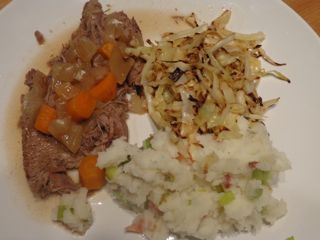
Stewed Sausages with carrots and leek.

For dinner tonight, I had a favourite from when I was growing up – stewed sausages – accompanied by the rest of the leftover mashed potatoes and brussels sprouts. It’s a really easy meal to make. Fry the sausages in a little fat, add leeks and carrots, add some stock (or cider if you’d prefer), cover and simmer until veggies are cooked.

Checking out what was making news in The Calgary Herald for October 16th, 1944, (15 pages today) I found the following:

Field Marshall Edwin Rommel (The Desert Fox) had ‘Died of Wounds’ the German newspapers reported. Hitler had ordered a state funeral for him.  (In fact, we now know the wounds he died of were from his forced suicide. Rommel had been injured on July 17th, 1944 when the RAF strafed his car. However it was his ‘defeatist’ attitude that angered Hitler and he was forced to commit suicide.)

Canadian Veterans were being offered post-war opportunities either in vocational training or educational opportunities. Fees would be paid, and $60 per month given to a single man/woman, or $80 per month to a man with a wife. Additional allowances were available if the couple had children. The programme was available for ‘period of service to a maximum of one year – but can be extended’. Disabled vets received special consideration, their right to training being ‘continuous’.

In New York on Saturday night, Frank Sinatra was hit by an egg as he sang ‘I Don’t Know Why‘ at the Paramount Theatre.

According to Gallup, with the US Presidential election only 3 weeks ago, Roosevelt had 51% of the poll while Dewey had 49% – with an error of 3-4%.

The Personal section was fascinating, operating as a kind of 40s Facebook, with notification of various members of the public returning home from holiday or weekends in Camrose, Banff and Brooks, and of members of the forces coming home on leave. For example: Miss Lucille Allen left this morning for Denver, Colorado, to visit her parents.

An advertisement for Safeway itemised the following foods which people living under rationing Britain could only dream out:
MacKintosh Red apples: 5lbs – 23c: 35lb bag – $1.59
Tomatoes: 19 c per lb
Grapes: 17c per lb
Grapefruit: 21c per 2lbs
Jam: 31c per 2 lb jar
Sirloin steak: 38c per lb
Chickens: 32c per lb

Max Telling, 40, a German POW, escaped from a German POW farm project near Namaka by stealing a truck which was recovered in Calgary. Telling, 5’6″ tall, fair, with wavy hair was wearing a blue/grey suit and blue shirt. He left a thank-you note in the truck thanking the owner for its use. (!!)

An eyewitness account of the gassing and cremation of 4,000 Jewish children in the German concentration camp at Birkenau was given today in a London dispatch. It quoted the letter of a Polish woman imprisoned in the camp for 7 months who was later transferred to a Warsaw prison from which the letter was smuggled out.

Wartime Rations – Day Ten

31LntU63M+L._AA160_It seems I’m doing a lot of ‘Eating At The Savoy’ this week, so dinner is taken care of tonight. That leaves lunch. With cheese being so heavily rationed for my lunchtime sandwich, I’ve turned to Marguerite Patten’s book We’ll Eat Again for some different ideas. What do you think of her suggestions?

1) Shredded cheese and chutney or cooked beetroot.
2) Cooked mashed potato, yeast extract and chopped parsley.
3) Chopped grilled bacon and lettuce.
4) Mashed sardines, pilchards, herring or haddock, mixed with shredded fresh carrot.
5) Minced crisply cooked bacon rinds and toasted oatmeal.
6) Fish paste and chopped parsley.
7) Brawn, shredded swede and chutney.
8) Vegetable or meat extract and mustard and cress.
9) Chopped cold meat and mashed cooked vegetables with seasoning.
10) American sausage meats and watercress.

I’m going to hedge my bets and have a cold sausage sandwich with my soup today.

October 15th, 1944 was a Sunday, so I can’t find any links to any newspapers for that day. Instead, I checked out this great site which has a lot of information on Rationing in Canada during World War Two. Here are some of the main points from the article.

Food was seen as a ‘weapon of war’ so, as in Britain, the Canadian government took control of:

1) Rationing.
2) Promotion of ‘Patriotic Food’.
3) The launch of an unprecedented national nutritional campaign.
4) Controls on the price, production and distribution of everyday foods.

Coupon rationing of sugar in Canada began in April 1942, followed by tea and coffee in August, butter in December, and meat in March 1943. Meat was limited to 2lbs per person per week. (Compare that to the half-pound of meat per person per week in the UK!)

Restaurants offered meatless Tuesday and Friday menus.

Petrol/gasoline was rationed in April 1942.

Alcohol was also rationed – but I couldn’t find a start date or amount for that.

Two hundred cookbooks were published during the war years, and Canadians ate more, and better, than they had for over a decade. (The Great Depression.) Members of the RCAF received approximately 3,900 calories per day.

What were the ‘Patriotic Foods’? Apples and lobster. Lobster! Canadians were encouraged to eat Lobster cocktail, Lobster a la King and Lobster sandwiches.

After the Fall of France in May 1940, Canadian food exports became an essential lifeline to Britain. By the end of the war, Canadian exports accounted for 57% wheat and flour consumption in the UK, 39% of their bacon, 15% eggs, 24% cheese and 11% of their evaporated milk.

Canadian housewives were encouraged to save fat and were reminded that one pound of fat supplied enough glycerine to fire 150 bullets from a Bren Gun. Two pounds supplied a burst of 20 cannon shells from a Spitfire or 10 anti-aircraft shells.

Another great movie set on the Homefront in Canada (Alberta) during World War Two is Bye Bye Blues. Based on the true life experiences of the director’s mother during the war (she found work as a pianist/singer with a dance band to pay the bills when her husband was taken as a POW by the Japanese) it’s extremely hard to find, but well worth it!

Wartime Rations – Day Nine

dinnerBack on track today after the holiday weekend. Porridge for breakfast, homemade soup for lunch, then beef, fried cabbage and mashed potatoes with added fried leeks and bacon for dinner. Rounded off with a blackberry crumble it was a lovely meal to come home to after a long walk around Prince’s Island Park downtown with my daughter. The fall colours are just stunning and we watched a brave soul surfing the mini-rapids on the river created by last year’s flood.

On to the happenings in The Calgary Herald on October 14th, 1914. Being a Saturday, there were 25 pages!

The war was obviously going well for the Allies and you can sense a feeling of optimism. Here are various headlines from the front page alone.

Riga’s Fall Frees Reds for Smash at East Prussia.

Jap Army of 150,000 Believed Cut Off in the Philipines.

British Drive Nearer Reich.

Yanks Press Deeper Into Aachen Rubble.

British Capture Island of Corfu.

For the Germans, however, the future didn’t look quite so promising.

Field Marshall Goering, quoted on German radio, warned the German people they were fighting for their very existence.

Further down there was an article stating that the ‘Nazis No Longer Fight As A Well Trained Army’.

As for what was happening in Canada…

Penicillin was now available in Canada for ‘every civilian needing it’.

A single engine RCAF plane rescued 17 US Fliers, whose plane had been damage in a severe storm in the Hudson Bay, and flew them 4,500 miles to Churchill, Manitoba.

Pilots from all over the world were trained at the Commonwealth Air Training Bases in Manitoba and Alberta during the war.  If you’ve never had the opportunity to see the Canadian film For The Moment, starring Russell Crowe before he became a big star, you might want to check it out. 

Wartime Rations – Days Six, Seven and Eight

It’s been Thanksgiving Weekend here in Canada. I haven’t been quite as regular as usual with my blog over the past few days, but now I’m one week in to the experiment I’m going to take a little time to reflect.

fishcakes

Fishcakes made with white fish, potatoes and leeks, covered with breadcrumbs and fried in a little butter.

What have I missed the most so far?  Cheese! Cheese, cheese, cheese, cheese, CHEESE!  Two ounces a week is a pretty pitiful amount. I love cheese sandwiches (with tomatoes, but they’re ‘out of season’) for lunch, so I had to resort to mixing a little grated cheese and apple together to eke out my ration this week. It  tasted surprisingly good – but I’m looking forward to going back to tomatoes in November! I also ended the week with tea, milk, butter and sugar left over. (I’m saving up my sugar to make toffee apples for Hallowe’en.)

breakfast

Bacon, scrambled egg and homemade hash browns of shredded potato and leek fried in leftover bacon fat.

I’ve also been saving my bacon fat to use for frying potatoes and cabbage – something I remember my mum doing when I was young. It makes anything you fry extra tasty. Also, instead of using a stock cube, you can use one rasher of bacon to add flavour to soups.

sausages

Sausages, baked potato, fried apple slices and white cabbage.

Treating myself to a proper cooked breakfast at the weekend – and puddings at most evening meals – means that I don’t feel deprived. But once again, I’m not fooling myself that this experiment in wartime eating is anything like the real thing. Anne made an observation that when she saw the first Americans in the UK in 1942/43, what struck her the most was that they all had a layer of fat under the skin of their faces that you didn’t see in British people who’d been living with 2-3 years of rationing.

As I said above, it’s been Thanksgiving Weekend here in Calgary, so as a Scottish-Canadian (or Canadian-Scot) I’m going to change tack a little and look at what was being reported in The Calgary Herald this week instead of its Glasgow counterpart.

First impressions? Like the healthy looking Americans my aunt commented on, this Calgary paper comes in at 20 pages compared to the Glasgow Heralds 6 or 8. While there are few photos or picture adverts in the Glasgow paper, the Calgary one is filled with them. There is even one page devoted to cartoons, crosswords and, yes, more adverts! No paper – or goods – shortage here! Very different to the European experience.

Also no blackout times on the front page, although there is a notice informing the readers that: the sun will be above the horizon tomorrow for 10 hours and 53 minutes. Rises at 7.55. Sets at 6.48. Temperature forecast for 3pm. 67F (19C).

The biggest difference is that the main war news is on the front page: Canadian and US gains in Holland; British have landed in Greece; Russian troops have reached Riga (Latvia); Hungary ready to quit the war.

A German POW escaped from Lethbridge POW camp, but was recaptured 50 miles away.

And then this little gem from the UK: Villagers Drive Stake Into Grave of Witch to Peg Impish Spirit. Apparently, during the construction of a military road in Scrapfaggot Green in Essex, a bulldozer pushed aside a boulder which had been used to mark the last resting place of a woman burned at the stake and buried two centuries earlier for being a witch. Thereafter ‘queer things’ started happening in the village; bells ringing, clocks going wrong, chickens and ducks disappearing, things being moved. The villagers took matters into their own hands, consulted an ‘expert’ for advice, measured the grave, drove a stake into it and then rolled the boulder back into place. That night, they ‘had the first quiet night’s sleep in many a day’.

Holland: Retribution is rapidly closing around the men and women in the areas of Holland already liberated who played the Germans’ game during the occupation. About 2,000 alleged quisling have already been arrested.

Buster, an eight-year-old Tiger cat, had been left $100,000 (reduced to $40,000 by court order) and three fans for his comfort by his late master.

Edmonton council considered application from a Japanese-Canadian girl to be allowed to reside in Edmonton while attending the University of Alberta. Her application was accepted, but notice given that other girls of Japanese origin may not reside in Edmonton unless natives of Alberta.

Bundles for Britain. An appeal was made to send clothing to the UK where it ‘is needed more than ever because people are being left homeless by the robot bombs.  (V1 rockets.)

Air Force Casualty Lists: These included those Killed on Active Service, Missing on Active Service, Previously Missing but now Officially Presumed Dead or taken POW. Also those Dangerously Injured on active service.

Antics on downtown streets of High School girls undergoing initiation into Calgary sororities was causing some concern. Attitudes differed between the schools – 3 girls were suspended from Central High School for wearing ‘outlandish costumes’ to class, whilst at Western Canada High School, girls were allowed to wear such clothing for the few days of initiation. (My daughter, who attended Western Canada High School not that long ago, says there are no longer sororities or fraternities at that school.)

British divorce boom worries Anglican Clergy. Pre-WW1, the average divorce rate was 500 per annum. In 1943 that rose to 2,250, and by the beginning of 1944, 3,396 cases were waiting to be heard.

Eighty-one cases of polio had been reported in Alberta in 1943 with the latest victim a 12 year-old girl.

A four bedroom house in Hillhurst in Calgary was on sale for $4,200. (Current prices for a four bedroom house in the same area range from $900,000 to $1.5million!)


Wartime Rations – Day Four

fishI decided on fish tonight. Although fish wasn’t a rationed food in WW2, it wasn’t always available. Fishermen had to put to sea in dangerous waters to haul in their catches, so often weren’t able to go far from shore. Also, which I didn’t realise, there are also distinct seasons for fish with cod being in season (in the UK) from October to January.  Who knew?

I rarely eat fish – I like it but my husband doesn’t – so I don’t have too many fish recipes to hand. But I do remember, from working in NHS hospitals years ago, that they used to serve up cod in a mustard sauce, which I decided to replicate. (Bake cod in oven at 180C for about 15 minutes. Make a white sauce, add mustard powder to taste, then pour over the fish.) It was delicious, and to add some colour and veggies I threw in some roasted Brussels sprouts which cooked in the oven at the same time as the fish.

berryPudding – because I am enjoying eating pudding every night – was apple and blackberry crumble using some of the leftover crumble mix from the other night. Also, saving energy, the pudding baked in the oven at the same time as the fish and veggies – although it needed a little more time.

The Glasgow Herald – Monday, October 9th, 1944

Only six pages again today, and I’m starting to find myself more interested with the ‘local’ news than the actual ‘war’ news.

Blackout times for Glasgow: 7.02pm until 7.07am- so nights are starting to creep in.

Page One: The writing is a bit blurred on this advert, but from what I can make out, the price at Rowans of 70 Buchanan Street for Officers’ uniforms were as follows:
Air Force Tunic: £9-6-6d
Trousers: £3-10-0d
Greatcoat: $14 – 4 -6d.

For comparison of what money bought back then, please check out this site for wartime prices.

Page Two: Scottish War Plant Closed. A war factory at Mossend, Lanarkshire, closed down on Saturday. When the factory was in full production over 500 men were employed, but recently only part of the plant was in operation. Members of the staff have received their notices. One hundred and twenty men are affected.

The above post is interesting when compared with the following one.

Page Three: Need for Private Enterprise. Mr Anthony Eden on Saturday urged that private enterprise should not be stifled after the war. He told Bristol Conservative and Unionist Association that the issue which would confront Britain when Germany and Japan were laid low was whether British industry would be able not only to re-establish itself, but markedly to raise pre-war levels.

Page Four: Food Facts.  Vitamin Foods. In view of the approaching winter, please see that every child under five gets cod liver oil and orange juice every day.

Page Five: Going My Way. Bing Crosby, after travelling so many roads to different places that all turned out to be the same, has deserted his fellow-voyagers, Hope and Lamour, and has gone up a rather odd side-turning to make ‘Going My Way’ (Paramount). In this he plays a young Roman Catholic priest who is sent to renovate a New York parish going downhill; he reforms the local Dead End Kids and sets them to singing Ave Marias, saves young girls from the streets, and raises money for the debt-laden church by composing and selling a sermon in song, a sort of Crooners’ Creed.

Certainly this sounds like the most dreadful slush, but, oddly enough, it is not. This is largely thanks to the acting – Mr Crosby’s diffident charm remains as strong as ever in a clerical suit, and Barry FItzgerald’s playing of an old priest, dry and eccentric, is as good a character sketch as any the screen has given us for some time.

… Altogether, we are still inclined to go Mr Crosby’s way, whether he is heading for Mandalay or the New Jerusalem.

Page Six: Peebles Auction Market. Owing to foot-and-mouth disease restrictions, the sale advertised for Friday, 13th October, has been meantime postponed.

A terraced house for sale at in Bellevue Road, Ayr, comprising 3 public rooms, 7 bedrooms, a kitchen  and servants’ accommodation was being offered for £2,250. I checked on modern-day prices for the same property. The building has now been divided into flats, with one recently priced at £197,844 and the other at £228,500!

Wartime Rations – Day Three

No food photographs today as breakfast was toast and marmalade, and lunch will be leftovers from yesterday’s evening meal. I’m heading out to ‘the pictures’ with a friend this evening, so will be grabbing something to eat at the mall. Keeping in the wartime spirit, I’m planning to enjoy a fish supper/fish and chips. If fish isn’t available, I’ll make do with chips.

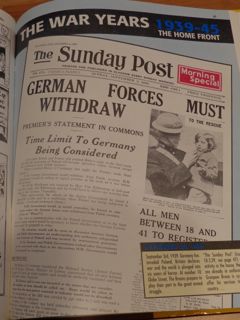
Sunday post 1October 8th 1944 was a Sunday. There was no edition of The Glasgow Herald on Sundays during wartime, so I tried to find examples of other newspapers online, especially The Sunday Post which was a fixture in most Scottish households. I was unsuccessful, but I did find a link to a documentary on the 100th year anniversary of this iconic Scottish paper which also includes accounts of the paper’s experience during both world wars. (Minutes 37.55 – 40.30 for WW2.)

Anne worked for The Daily Record in Glasgow, so I asked her about what Sunday papers were available, and also about her experiences working in a newspaper office.  I also asked:  Given there was no edition on Sunday, I assume they didn’t work on Saturday, but must have had to work on a Sunday to get the Monday edition out.  How did that square the very Presbyterian notion of keeping the Sabbath holy?  Do you remember?

One of the things I love about eye-witness accounts are the details you can’t find in history books, so here are Anne’s memories.

anne2013No memories really of its interfering with church.  I can’t see that anyone would have accepted having to wait till Monday for write-ups about the dozens of football matches on Saturday afternoons.

broons2

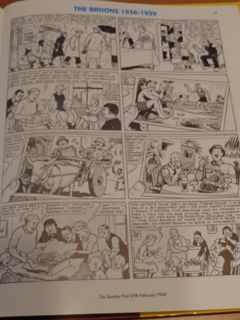
The Broons in The Sunday Post, February 1944

Most households would take The Sunday Post along with one or maybe two others; the Sunday Post was the demand of children for Oor Wullie sitting on his up-turned bucket and, of course, The Broons.

Most newspaper businesses did publish a Sunday paper but under a different name. You could perhaps find out by looking up Outram Press on Internet.  I worked for the rivals: the Kemsley Press in Hope Street.  My first job there was to sit with headphones on, from about 3 in the afternoon till 10 or 11 at night, taking ‘stories’ from correspondents all over Scotland for Kemsley’s morning paper, ‘The Daily Record’ , straight on to the typewriter for local calls and using shorthand for ‘long distance’ or ‘trunk’ calls.  These could be anything from the latest news in a court case to the prices obtained at the latest cattle auction, and had to be taken straight to the chief reporter.   Kemsley also published ‘The Evening News’ and on Sundays ‘The SundayMail’.  I got one day off a week and, not being involved in The Sunday Mail’, had Saturday off as well, so was having a 5-day week when most working people were still working half-day on Saturday.

I loved the feeling of ‘things happening’, was fascinated by the men operating the Linotype machines which pulled down the tiny lead (I think) characters (known as slugs) from the slots which surrounded the operator and was used to form the text; loved to go down to the basement and watch the huge, noisy presses in action as papers poured out, and watching as photographs from distant parts printed themselves oh-so-slowly, dot by dot, line by line, and eventually made a picture – do you remember those pictures? If you looked carefully you could see the individual dots, all varying shades of palest grey to black which resolved themselves into a printable illustration.

There were newsboys (sometimes rather old boys) waiting to get their supply to hawk in the city streets; and other boys loading sheaves of papers into waiting vans for further afield.

The Kemsley building was many stories high but with the war, the upper floors were redundant since paper was scarce and the papers had very few pages.  When war ended a decision was made by someone (Lord/Lady Kemsley?) to fit the empty space with hospital-type beds and offer them as accommodation to Empire servicemen who had been serving in Europe and wished to visit Scotland, sometimes the land of their parents perhaps, during their last leave before returning home.  They were also free to use the canteen.  So I met men from all over the Empire: Canada, Australia, New Zealand and S Africa.  Have to say I liked the New Zealanders best and happily took four of them (safety in numbers!) to the carnival in Kelvin Hall to have a go on the bumping cars etc.  All good fun.


Ma Wee Gas Mask

Before I start a post, I usually have a clear idea of what I want to write about. However sometimes I can get pulled off track and this evening was one of those occasions. So this is going to be a long post, but if you hang in, there’s a rather sweet Youtube video at the very end!

With the 70th Anniversary of D-Day rapidly approaching on June 6th, I thought it would be interesting to look at The Glasgow Herald from June 2nd, 1944 and see if I could find any hint of the approaching invasion.

As noted in previous blogs, paper rationing meant each issue was comprised of only 8 pages. The Glasgow blackout began at 11.52pm and ended at 4.28am, a far cry from six months earlier when it lasted from 5.25pm until 9.17am the following morning!

As always, the war news was buried in the middle of the paper, so there were all kinds of fascinating articles to read through first.

Films showing in Glasgow included:
Lifeboat – Tallulah Bankhead.
Jack London – Susan Hayward
Madame Curie – Greer Garson
For Whom the Bell Tolls – Gary Cooper
The Cross of Lorraine – Gene Kelly
Life and Death of Colonel Blimp – Deborah Kerr

A list of legacies given to The Western Infirmary – remember this was 4 years before the NHS came in to being.

Mr Herman Anton Andrews, a London banker, bought the Scottish islands of South Uist, Benbecula and Eriskay. Following the purchase, the Scottish National Party sent him a letter detailing their concern that the buying up of large tracts of land by those operating from London and other centres outside the borders was contrary to the interests and people of of Scotland. (Given that Scotland is voting on Independence in September this year, I this particularly apt.)

And then came the war headlines.

Germans ‘getting a licking’ in Italy.

Notification that 47% of US Army troops (3,500,000 men) were stationed overseas.
The US Air Force had 50% of its personnel (2,357,000 men) and more than 50% of their machines stationed overseas.

Allied Gains on the Burma Front.

Three beachhead columns were moving on Rome.

4,000lb bombs were dropped at Roumania’s Iron Gate (where the Danube narrows), reducing German barge traffic and their ability to repair their railways.

Admiral Sir William M James, Chief of Naval Information in London, said the Navy would soon appear again in the public eye. ‘Before long, we shall reach that stage when we begin to launch a great amphibious expedition… We are going to have dramatic moments soon.” So there it was, the hint that something big was in the air.

And then it was back to general news, where one item in particular caught my attention. The Half-Past-Eight Show, starring entertainer Dave Willis was playing at the King’s Theatre.

As a child in the 60s, I remember going with my mother to see The Half-Past-Eight Show starring Dave Willis! I had no idea it had been going for so long. Before the 1930s, it had been the tradition for theatres to close during the summer when the citizens went on holiday. In the early 30s, however, it was decided to produce a high quality summer variety show. It was so successful it became an annual tradition lasting a long – long – time.

I seem to remember one of Dave Willis’s famous songs was about fox-hunting, but I’ve been unable to find any mention it on the internet. If anyone out there has any information, I would love it if you could send it to me.

Another song he sang during the war was Ma Wee Gas Mask.  I was unable to find a video of Dave Willis singing it, but I did find an absolutely charming video.  Enjoy!

In ma wee gas mask
Ah’m working oot a plan
The weans a’ think that Ah’m the bogey man
The girls a’ cry, an’ bring their friends to see
The nicest lookin’ warden in the A.R.P.

When there’s a raid on, ye ought tae hear me cry
‘An aeroplane, an aeroplane awa’ wa up a kye’
They a’ rin helter skelter, bit dinna rin efter me
Ye’ll no get in ma shelter for it’s faur too wee.

The Glasgow Herald – Wartime

There might have been a war going on, but as some excerpts from articles in The Glasgow Herald on January 23rd, 1942 show, in amongst the war related news, real life carried on as usual.

Copeland and Lye’s shop on Sauchiehall Street advertised their cafe as a ‘Cheery Meeting Place’ where John McArthur’s Orchestra played daily from 12.30-2pm and then again from 3-5.15pm. (Obviously no muzak in those days.)

Two RAF planes collided mid-air killing seven in Prince Edward Island, Canada.

It was illegal for shopkeepers to offer to wrap customers’ goods in paper unless it was food or the goods were to be delivered.

No sun was recorded in Glasgow for the week ending January 3rd,1942. The rainfall was 1.06 inches, the mean maximum temperature was 43.9F (6.6C) and the mean minimum temperature was 34.3F (1.2C)

Moon over miami

In the three weeks since January 1st, 19 people were killed (by traffic) on Glasgow streets with 239 injured. This was an improvement on the same time period in 1941 when 29 people were killed and 360 injured.

British film star Jessie Matthews, then living and working in New York, was reported out of danger following a serious illness.  She was diagnosed as suffering from nervous exhaustion caused by rehearsing for her new show while continuing with her war-work. Recuperation was expected to last several months.

A teacher of French to Leaving Certificate standard was wanted immediately for a school evacuated to Upper Deeside. Classes were small, the post was resident, there would be no house duty and weekends were free. A retired or married teacher might accept the post as war work.

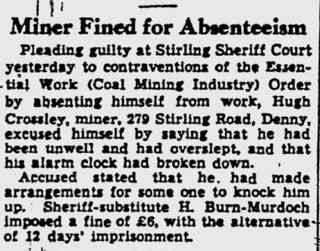
Miner jpeg

Alexander J McKenzie was presented with a Diploma from the Royal Humane Society. An explosion at the docks threw a man into the River Clyde. Mr McKenzie, at great risk to himself, dived in and brought the man to safety.

Two fifteen year-old girls were killed instantaneously at a factory in Lincolnshire.

Court News from Buckingham Palace.  Lady Katharine Seymour succeeded Lady Delia Peel as Lady-in-Waiting to the Queen.

The ration for margarine was reduced from 5ozs per person weekly to 4ozs.  Butter remained at 2 ozs per person.

One British Pound was worth $4.43Cdn and $4.021US.

Wartime Rations – Day Twenty-Eight

The final day of my four-week experiment. I invited the family around for lunch – just something casual to use up the remains of my rations: vegetable soup, rolls with a variety of fillings (bacon/cheese/egg mayonnaise), potato scones and apple/pear crumble to finish. The only thing no-one touched was the red cabbage coleslaw. (They don’t know what they were missing.)

I would like to say a huge thank you to Anne for sharing so many of her memories as a child growing up during the war years. Recipes can always be found in books, but personal memories are priceless.

So, in closing, here are Anne’s thoughts of how the war directly affected her life.

anne2013The change to living in a quiet village after the hustle of Glasgow and its varied populations from slums to patrician ‘big houses’ made a big impression. The change from a house where there was nowhere outside to play and I wasn’t encouraged to invite friends home, to the freedom of the fields and moors and woods: all this made me determined always to live in the country if possible.

When I was desperately looking for a home (in the early 60s), I was so glad when the cottage was offered; I knew we were going to be miserably poor for a while and in a village all ‘classes’ live cheek by jowl and rub shoulders, including in the school. The only alternative was a miserable flat in Nottingham.

Minor impressions: my father cursing Hitler when he was trying to make my gas-mask fit properly – the searchlights on the Clydebank nights – the utter impossibility of finding nice things for birthday etc presents – the joy of the young, enthusiastic teachers at Balfron instead of the elderly disillusioned ladies at Hillhead.

Worst memory: sitting in a cinema a few months after VE Day, just finished watching a Hollywood musical when Belsen flashed on to the screen – top story in the News report. That will never leave my memory – sickening shock. Could a whole nation be capable of such inhumanity? Of course not, but they let it happen, and it happened.

What do you remember of VE Day? Of VJ Day? Not a lot – it was a holiday of course, the bells rang, the streetlights came on (great cheering) and the papers were full of photographs of Churchill, the royal family and the heads of the armed services and masses of others. I know there were street parties and dancing, but the euphoria wore off after a couple of weeks. VJ was celebrated too, but a little bit less so.

What about the nuclear bomb? Everyone was stunned; it was so hard to believe. After a while people accepted the facts and that it had saved countless lives and years of war. Maybe such a weapon would bring wars to an end? Fat chance – it seemed no time till it broke out in Korea and the rest is history.