Wartime Rations – Day Four

fishI decided on fish tonight. Although fish wasn’t a rationed food in WW2, it wasn’t always available. Fishermen had to put to sea in dangerous waters to haul in their catches, so often weren’t able to go far from shore. Also, which I didn’t realise, there are also distinct seasons for fish with cod being in season (in the UK) from October to January.  Who knew?

I rarely eat fish – I like it but my husband doesn’t – so I don’t have too many fish recipes to hand. But I do remember, from working in NHS hospitals years ago, that they used to serve up cod in a mustard sauce, which I decided to replicate. (Bake cod in oven at 180C for about 15 minutes. Make a white sauce, add mustard powder to taste, then pour over the fish.) It was delicious, and to add some colour and veggies I threw in some roasted Brussels sprouts which cooked in the oven at the same time as the fish.
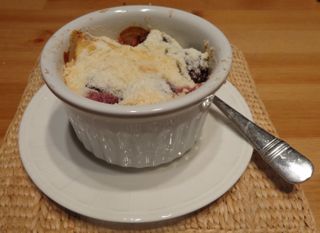
berryPudding – because I am enjoying eating pudding every night – was apple and blackberry crumble using some of the leftover crumble mix from the other night. Also, saving energy, the pudding baked in the oven at the same time as the fish and veggies – although it needed a little more time.

The Glasgow Herald – Monday, October 9th, 1944

Only six pages again today, and I’m starting to find myself more interested with the ‘local’ news than the actual ‘war’ news.

Blackout times for Glasgow: 7.02pm until 7.07am- so nights are starting to creep in.

Page One: The writing is a bit blurred on this advert, but from what I can make out, the price at Rowans of 70 Buchanan Street for Officers’ uniforms were as follows:
Air Force Tunic: £9-6-6d
Trousers: £3-10-0d
Greatcoat: $14 – 4 -6d.

For comparison of what money bought back then, please check out this site for wartime prices.

Page Two: Scottish War Plant Closed. A war factory at Mossend, Lanarkshire, closed down on Saturday. When the factory was in full production over 500 men were employed, but recently only part of the plant was in operation. Members of the staff have received their notices. One hundred and twenty men are affected.

The above post is interesting when compared with the following one.

Page Three: Need for Private Enterprise. Mr Anthony Eden on Saturday urged that private enterprise should not be stifled after the war. He told Bristol Conservative and Unionist Association that the issue which would confront Britain when Germany and Japan were laid low was whether British industry would be able not only to re-establish itself, but markedly to raise pre-war levels.

Page Four: Food Facts.  Vitamin Foods. In view of the approaching winter, please see that every child under five gets cod liver oil and orange juice every day.

Page Five: Going My Way. Bing Crosby, after travelling so many roads to different places that all turned out to be the same, has deserted his fellow-voyagers, Hope and Lamour, and has gone up a rather odd side-turning to make ‘Going My Way’ (Paramount). In this he plays a young Roman Catholic priest who is sent to renovate a New York parish going downhill; he reforms the local Dead End Kids and sets them to singing Ave Marias, saves young girls from the streets, and raises money for the debt-laden church by composing and selling a sermon in song, a sort of Crooners’ Creed.

Certainly this sounds like the most dreadful slush, but, oddly enough, it is not. This is largely thanks to the acting – Mr Crosby’s diffident charm remains as strong as ever in a clerical suit, and Barry FItzgerald’s playing of an old priest, dry and eccentric, is as good a character sketch as any the screen has given us for some time.

… Altogether, we are still inclined to go Mr Crosby’s way, whether he is heading for Mandalay or the New Jerusalem.

Page Six: Peebles Auction Market. Owing to foot-and-mouth disease restrictions, the sale advertised for Friday, 13th October, has been meantime postponed.

A terraced house for sale at in Bellevue Road, Ayr, comprising 3 public rooms, 7 bedrooms, a kitchen  and servants’ accommodation was being offered for £2,250. I checked on modern-day prices for the same property. The building has now been divided into flats, with one recently priced at £197,844 and the other at £228,500!

Wartime Rations – Day Two

When Anne reads what I’m about to say, she’ll be rolling her eyes, shaking her head and saying, “No, no, no, no, no.” Having reminded me yesterday of the severe shortages of even rationed foods, I have to confess that I used two – TWO – eggs today. One for lunch and one in tonight’s bread and butter pudding. In fairness, when I’m cooking meals for my husband, I don’t try to feed us off my rations alone, so you could argue that tonight’s egg was ‘his,’ or would have come out of our shared powdered egg ration.

mince tarts

Mince tart, with onion/potato hash browns and mashed carrots.

Only two days in and we’re both finding the main courses really filling. (Perhaps I should have served dinner on a simple white plate as the meal and plate combined is an explosion of colour.) Using leftover mince from last night, I made a mince and potato pastry tart, with onion and potato hash browns and leftover carrots. It tasted really good and, as I managed to make four tarts from the recipe, they’ll make a nice change from a sandwich for tomorrow’s lunch.

bread pudding

Bread and butter pudding.

And here is the bread and butter pudding. To be honest, we’re both so full from the main course that we’re going to have to take a break and maybe come back to it this later in the evening. At the time of posting this, I can’t vouch for its taste… but it smells delicious.

The good thing about tomorrow? I’ll be back to my full 1/2 pint of milk per day until Sunday. Making the bread and butter pudding drained the last of my milk ration for the day!

On to the news.

The Glasgow Herald on Saturday, October 7th, 1944. Normally the paper consisted of 8 pages, but on Saturday it was only 6. (Sunday, no edition was published.)

As always, blackout times for Glasgow are at the very top of the front page:  7.07pm until 7am.

Page One: With no edition on Sundays, the churches advertised their services for the following day. I decided to check out The Cathedral Church of St Mary on Great Western Road as – I believe – this is where my parents were married. On October 8th, the 18th Sunday after Trinity, Holy Communion (sung) would be held at 8,9 and 12.15, with Matins at 11 and Evensong at 6pm. The minister was Rev A.I. Haggart B.A. and (very interesting) all seats free.

Page Two: The Battle of the Rhine is again increasing in violence, and according to the German commentator, Sertorius, the British have now succeeded in establishing a bridgehead across the Lek, which is being secured by further reinforcement. It will be necessary to wait for official confirmation from General Eisenhower before the full scale and scope of this attack can be grasped, but any idea that it is species of revenge for the defeat at Arnhem may be dismissed, Sound strategy aims at victory, not vengeance.

Page Three: Among the treasured souvenirs of the Glasgow Highlandersstay in Belgium during the present campaign, will be a beautifully executed tapestry portrait of King George VI, which was presented to the battalion by the Mayor of the village of Bellingham. It had been kept hidden during the whole period of German occupation, and its presentation to the Scottish troops was a spontaneous gesture which was greatly appreciated.

Page Four: Radio times for Saturday and Sunday.  At 8.30pm on Sunday, listeners could hear the final episode of Dr Jekyll and Mr Hyde.
It was also reported that during 1943-44, 1,124,255 people had visited the Art Gallery and its branch museums in Glasgow.

Page Five: Several new companies were registered in Scotland this week under the Companies Act:
#22946: James Lees and Sons (Ardrossan) Ltd.  (Mineral water.)
#22947: John G Dunn and Sons (Cambuslang) Ltd. (Wood and lumber merchants.)
#22948: Hillocks of Gourdie Farms (Blairgowrie) Ltd.  (Ownership of landed estates.)
#22949: James Johnstone (Glasgow) Ltd. (Grocers and Provisions merchants.)
#22450: Smedley’s Scottish Estates (Blairgowrie)Ltd. (TO purchase the lands and farm of Welton near Blairgowrie.)
#22451 W. Caldwell and Co. (Paisley) Ltd. (Gum and starch manufacturers)
#22452: James Church (Transport) Ltd. (Hauliers and carters.)
#22453: J.B. Bennet (Glasgow) Ltd (Public works contractors.)
#22454: Peter Robertson (Glasgow) Ltd. (Traders or business of auctioneers.)
#22455: The North-West Highland Associated Hotels (Inverness) Ltd. (To acquire hotels and inns.)
#22456: Saracen’s Head Hotel (Leith) Ltd. (To purchase the business of the Saracen’s Head Hotel from Mrs Jessie Wright.)

Page Six: Classifieds. The price of 750 pounds sterling was paid for a first prize five-month filly foal at Lanark. (If you’re interested in figuring out comparative costs for a house or car in 1944, please check out this great website.)


War Time Rations – Day One (again!)

It can get pretty boring looking a food pictures, so I’m not going to take pictures of EVERYTHING I eat over the next month. But as it’s the first day, I thought I’d show examples of what will be my typical weekday morning and lunch.

PorridgeWeekday breakfast will be porridge, a little milk and smattering of sugar for taste. (I’m going to save my egg and bacon as a treat for the weekend.) Because I only get 3 pints of milk a week, I’ve decided to divide that up into Mon/Tues allowing myself 1/4 pint each day and thereafter 1/2 pint daily for the rest of the week.

My weekday lunches will be a variation on The Oslo Meal. Essentially, it’s a sandwich (lettuce and tomato), a piece of cheese, glass of milk and piece of fruit, but given that lettuce and tomato are not in season in October, I’ve modified it to a bowl of homemade vegetable soup with some bread, homemade coleslaw (some days I’ll substitute an apple) and a cup of tea. My family seem to like my veggie soup and it’s really easy, so here’s the recipe.

RATIONSDiana’s Homemade Vegetable Soup:
Pan of water, one stock cube, 1/2 cup of lentils, 1/2 cup of split peas (if desired), one chopped onion, one chopped potato and one chopped carrot. Put everything in the pan, bring to the boil then simmer for at least 1 hour. The longer you simmer it the better.

minceDinner. Having grown up in Glasgow, I’m very fond of ‘mince and tatties’ but I decided to do the potatoes just a little differently tonight.  I mashed them with fried leek, moulded them into hamburger sized patties and then fried them which gave them a great texture.

And then pudding.  Ah, pudding.  I only ever seem to eat a dessert whendessert I’m eating wartime rations – go figure. However, with apples and blackberries as the only fruits available to me for October, I’m going to have to get creative. Tonight I made the old standby; apple and raisin crumble. The crumble is dead easy; rub 2oz of butter into 4oz flour then mix in 2oz sugar. I only used a small amount of the mixture tonight so have stored the rest in the fridge for the evenings I need to pull something together quickly.

Just as well I have to take the dog for a walk tonight as I feel pretty full!

anne2013Anne’s asked me to remind everyone that, “When you’re talking about rationing, don’t forget fuel and soap.  Remember it was a time of coal, electricity and gas, so Britain then didn’t have the benefit of hydropower and nuclear stations, nor did local users have wind farms.  So, electricity often meant blackouts of light as well as heat for cooking (in the middle of making dinner!), and the coal ration was only enough to heat one room, so most families lived in the kitchen, often undressing there and dashing through the cold hall to get to their cold bedrooms.  As for soap, there were no detergents beyond soap in block, flake or powder form and the ration was meagre.  In Glasgow we didn’t feel it badly because we had such nice soft water from Loch Katrine and mother used often to send a soap coupon or two down to relatives in Derby and Nottingham where the tap water was very hard. There was also washing soda but that was extremely harsh on hands and fabrics.”

As for what was being reported in The Glasgow Herald on this day 70 years ago, despite the continued posting of the blackout times for Glasgow – 7.10pm until 7.01am next morning – there appears to be a growing sense that people are looking beyond the end of the war.

Page One: Noel Coward’s Blithe Spirit was playing at The Alhambra.

Page Two: The Army, unleashed after its dogged punishing weeks in the Caen sector, is gathering an amazing momentum.

Page Three: Questions were raised in Parliament on the shortage of teats for babies’ bottles, and, as happens too often, the matter was glossed over with meaningless explanations.

Page Four: Soviet troops were within 10 miles of Belgrade.

Page Five: France. Marshall Petain and 50 former members of his Vichy Government were charged with treason and intelligence with the enemy.

Page Six: After a four-day Court Martial, Private Thomas Montoya (24) of the US Army Air Force was cleared of murdering Joan Long (22) in an air raid shelter in Blackpool but was found guilty of manslaughter. He forfeited all pay and allowances, received a dishonourable discharge and a sentence of 10 years hard labour.

Page Seven: A shortage of round coal was accentuated this week by a number of illegal stoppages in Lanarkshire and by a continued high rate of absenteeism.

Page Eight: Situation Wanted.  Scottish doctor, graduate with varied experience, at present doing war-time locum in busy practice, is anxious to settle in Scotland after the war; age 32; family man; temperate; Presbyterian; he would consider assistantship with view partnership, or buying outright; preference for Highlands and Islands area or small county town, but is interested in any reasonable proposition.

D-Day +1 June 7th, 1944

I found Friday’s remembrances of the 70th anniversary of D-Day very moving, but perhaps for many of us the story that stood out was the journey 89 year-old Bernard Jordan took from his care home in Hove to join his colleagues in France.  It’s already been nicknamed The Great Escape, and I’m sure within a few weeks there will be a film in the pipeline.

Quite rightly, the emphasis this weekend was on the veterans and thousands upon thousands of young men who died on those beaches and in the months following the invasion. But it got me to wondering about the news the British people received, listening to the radio or reading the papers to find out what was happening to their loved ones.

Once again, I turned to The Glasgow Herald of June 7th, 1944 for some insights and gathered together a collection of tidbits that appealed to me.

Whereas other papers’ headlines screamed Invasion, with only 8 pages available (because of paper rationing) The Glasgow Herald wasted little space on pictures and remained as understated as ever. On the front page were the usual blackout times (Glasgow 11.57pm until 4.34am) and notifications of births, marriages and deaths. The current entertainment available at the city’s theatres was listed (including the Half-Past Eight Show mentioned in last week’s blog) as well as a programme of musical concerts in city parks.

But the Invasion did make its presence known on the front page with notices from city churches informing the faithful of special prayers and services for ‘our King and County and Allies and for the Forces now invading Europe’. Glasgow Cathedral offered two services at noon and 3pm for ‘those engaged in the Second Front Operation’.

The Late News column referenced a German report which talked of ‘grim fighting’ between Havre and Cherbourg being the ‘bloodiest of the day’ with several hundred Canadian paratroopers wiped out or forced to surrender.

German Overseas Radio denied any fighting in Caen. ‘Mr Churchill’s reference about fighting in Caen is untrue. No enemy troops have penetrated into the city, therefore no fighting has taken place in Caen.’

Page two carried the Colonial Secretary being forced to deny a ‘silly and harmful story’ which had had much circulation, particularly in America, to the effect that America was being charged for every palm tree they destroyed in battles for the recovery of British possessions.

When talking about the history of invasion in Europe, one columnist pointed out that Caen had been the HQ of William The Conqueror before he turned his sights on England in 1066.

Eisenhower apparently carried seven old coins in his pocket – one being an ancient five guinea piece.  He is said to have given these mascots a rub before the Italian invasion and everyone hoped that the mascots would do as good a job again.

Regarding the Invasion of Italy and France, it had been decided by Roosevelt and Churchill at the Casablanca Conference in 1943 that an invasion of the west would be deferred until the Allies had cleared the Mediterranean and knocked out Italy.

Page 3 contained Scottish news with detailed Invasion news starting on page 4.

The Invasion was originally scheduled for Monday June 5th, but postponed for 24 hours because of bad weather.

German Radio admitted the Allies had a foothold 10-15 miles long and nearly a mile deep in France.

Allied landings also took place on Guernsey and Jersey in the Channel Islands.

Hitler was reported to have taken charge of the military response to the invasion.

Between midnight and 8am on June 6th, an estimated 31,000 Allied airmen flew over France. 1,300 Fortresses and Liberators began their attack at 6am ending at 8.30am.

Priority was being given for troops’ mail so that both the men in the front line and their relatives and friends at home should receive regular deliveries of letters.

One hour before they left for the beaches, the troops enjoyed a meal of pork chops and plum duff. Each solder was then given a ‘landing ration’ –  a bag of chocolate and biscuits and cigarettes for ‘consumption while waiting’.

Civilian workmen and villagers who had seen anything of the preparations at an American airfield were detained in the camp by the authorities for 48 hours until news of the landings were released.

125,000,000 maps were used by the US invasion forces.

Eisenhower broadcast a Call to the People of Europe:  The hour of your liberation is approaching. All patriots, men and women, young and old, have a part to play in the achievement of final victory.

General Montgomery wished the troops ‘Good Hunting in Europe’.

And then, on pages 7 and 8 it was back to normal with commodity markets, situations vacant, property, livestock and farms for sale.  A five-room terraced house with kitchen and scullery could be bought for 800 pounds. So much for the biggest invasion force the world had ever seen.

If you ever get the opportunity to watch the film The Longest Day, I highly recommend it. It’s a comprehensive view of the events of June 6th, 1944 from all sides involved.


Ma Wee Gas Mask

Before I start a post, I usually have a clear idea of what I want to write about. However sometimes I can get pulled off track and this evening was one of those occasions. So this is going to be a long post, but if you hang in, there’s a rather sweet Youtube video at the very end!

With the 70th Anniversary of D-Day rapidly approaching on June 6th, I thought it would be interesting to look at The Glasgow Herald from June 2nd, 1944 and see if I could find any hint of the approaching invasion.

As noted in previous blogs, paper rationing meant each issue was comprised of only 8 pages. The Glasgow blackout began at 11.52pm and ended at 4.28am, a far cry from six months earlier when it lasted from 5.25pm until 9.17am the following morning!

As always, the war news was buried in the middle of the paper, so there were all kinds of fascinating articles to read through first.

Films showing in Glasgow included:
Lifeboat – Tallulah Bankhead.
Jack London – Susan Hayward
Madame Curie – Greer Garson
For Whom the Bell Tolls – Gary Cooper
The Cross of Lorraine – Gene Kelly
Life and Death of Colonel Blimp – Deborah Kerr

A list of legacies given to The Western Infirmary – remember this was 4 years before the NHS came in to being.

Mr Herman Anton Andrews, a London banker, bought the Scottish islands of South Uist, Benbecula and Eriskay. Following the purchase, the Scottish National Party sent him a letter detailing their concern that the buying up of large tracts of land by those operating from London and other centres outside the borders was contrary to the interests and people of of Scotland. (Given that Scotland is voting on Independence in September this year, I this particularly apt.)

And then came the war headlines.

Germans ‘getting a licking’ in Italy.

Notification that 47% of US Army troops (3,500,000 men) were stationed overseas.
The US Air Force had 50% of its personnel (2,357,000 men) and more than 50% of their machines stationed overseas.

Allied Gains on the Burma Front.

Three beachhead columns were moving on Rome.

4,000lb bombs were dropped at Roumania’s Iron Gate (where the Danube narrows), reducing German barge traffic and their ability to repair their railways.

Admiral Sir William M James, Chief of Naval Information in London, said the Navy would soon appear again in the public eye. ‘Before long, we shall reach that stage when we begin to launch a great amphibious expedition… We are going to have dramatic moments soon.” So there it was, the hint that something big was in the air.

And then it was back to general news, where one item in particular caught my attention. The Half-Past-Eight Show, starring entertainer Dave Willis was playing at the King’s Theatre.

As a child in the 60s, I remember going with my mother to see The Half-Past-Eight Show starring Dave Willis! I had no idea it had been going for so long. Before the 1930s, it had been the tradition for theatres to close during the summer when the citizens went on holiday. In the early 30s, however, it was decided to produce a high quality summer variety show. It was so successful it became an annual tradition lasting a long – long – time.

I seem to remember one of Dave Willis’s famous songs was about fox-hunting, but I’ve been unable to find any mention it on the internet. If anyone out there has any information, I would love it if you could send it to me.

Another song he sang during the war was Ma Wee Gas Mask.  I was unable to find a video of Dave Willis singing it, but I did find an absolutely charming video.  Enjoy!

In ma wee gas mask
Ah’m working oot a plan
The weans a’ think that Ah’m the bogey man
The girls a’ cry, an’ bring their friends to see
The nicest lookin’ warden in the A.R.P.

When there’s a raid on, ye ought tae hear me cry
‘An aeroplane, an aeroplane awa’ wa up a kye’
They a’ rin helter skelter, bit dinna rin efter me
Ye’ll no get in ma shelter for it’s faur too wee.

Wartime Rations – Day 2

It might only be my second day of rations but I couldn’t quite face porridge for breakfast again. After the recent excesses of the holiday season, my mindset saw it as shades of Oliver Twist in the workhouse begging for more gruel.  Give me a couple more days and I’ll be back in the swing of it. Instead, I enjoyed some toast with a meagre scraping of butter and precious jam with my morning cuppa.

For lunch I finished off the homemade soup and leftovers from last night’s dinner, so I’m not going to bore you with those repeated photos.

We’re probably going to have to eat at least one – maybe two – meatless evening meals per week, so I tried to ease ourselves gradually into it this evening with baked potatoes, with a bacon and cheese topping, and carrots on the side. For pudding, I made individual apple crumbles, using one (large) apple and half the crumble mix.  I was still left with 1/2 apple and plenty of topping, so guess what we’re having for pudding tomorrow!

Potatocrumble

Because I’m such a modern day TV addict,  I wondered what radio programmes – and the actual radio set itself – were like during wartime.  Also, I’d heard the newsreaders were supposed identify themselves – something to do with ensuring accurate news during an invasion, I think. I asked Anne, and here’s her reply.

anne2013Radio?  No. no – WIRELESS SET.  It sat on top of the coal bunker, was about 16″ across, 10-12″ high and 9-10″ deep.  Yes, it took a while for the valves to warm up, so you switched THE WIRELESS on a little before your programme was due to start.
Don’t know what it was made of – it wasn’t wood, though many wireless sets were.  It looked like a mottled brown plastic case but of course it couldn’t have been.  The speaker was behind a gold piece of cloth, and there were two knobs:  one for volume and one which changed the station, arrayed in a narrow arc at the bottom.  The foreign station names fascinated me and I used to switch from one to another whenever I could, to listen to the strange languages.  It arrived about 1937 as a gift from Alex to Mum, but of course everyone had use of it, and woe betide anyone who wanted to use it – or made any noise – if Dad was glued to it for a cricket match or a special football match.  It was treated by Mother as if it were sentient – no-one could talk if the wireless was on.  It was as rude as interrupting a person talking, Mum said.   Don’t remember a smell. 

Mary had a wireless in Kippen, but there was no power there and it needed two batteries to work, a solid one about 10x5x3″ deep, and a liquid one in a heavy glass container with a handle so you could carry it to a petrol station or other place to get it re-charged. Which reminds me that we lived by the light of oil lamps. 

The wireless was on most of the day – except during the frequent power cuts. Yes the newsreaders gave their names John Snagge, Bruce Belfridge, Alvar Liddell etc . Lots of b-i-g dance bands with half-hour programmes: Henry Hall, Geraldo, Jack Jackson (my favourite) et al. The biggest ones of around 25-30 instruments called themselves dance orchestras – but it still wasn’t as loud as today’s pop. One of Mother’s favourite wireless programmes was Sandy McPherson on a cinema organ.

Anne mentioning my Uncle Alex above made me decided to check out The Glasgow Herald to see what other programmes were on the WIRELESS on January 7th, 1942.  (Uncle Alex was a reporter with the newspaper before he joined the RAF.)  Here’s a selection.

7.30am: Exercises. 8.15: The Kitchen Front. 10.30: Music While You Work. 2.30: Billy Cotton and his Band. 9.20pm: Tamburlaine, a play by Christopher Marlowe.

What else was in the paper that day?

The blackout in Glasgow started at 5.32pm in the afternoon and ended at 9.15pm next morning.

The New Year Sales were coming to an end.  You could buy a pair of ladies’ shoes for 30 shillings, a nightdress for 8/11,  or a ‘Hampster’ fur coat  (Really?? I hope I read that wrong!) for 19 Guineas.  Even though you could afford the purchase, I think the points system was operating by this time, so I’d love to know how many points you needed for a fur coat.

It was still pantomime season in Glasgow, with Aladdin playing at the Pavilion Theatre and Dick Whittington at the Alhambra.The afore-mentioned Geraldo and his Orchestra were performing at the Glasgow Empire.

An enraged letter to the editor discussed a particular Glasgwegian’s fury at the proposal to plough up golf courses for agriculture while so much untilled land was still available in the countryside.

Women born in 1921, whether married or single, were to register for war-work on Saturday morning at their local Labour Exchange.

In the Situations Vacant, there was a call for a butcher – weekly wage of 6 pounds .  Also a hairdresser – wage not mentioned. And there was another advertisement inviting women – not liable for National Service – to apply for clerical positions in engineering works in the Glasgow Area.

A worker in Paisley was charged with failing to participate in his works fire duties and was fined 4 pounds – to be paid within 8 weeks – or face 6 weeks imprisonment.  His excuse was that he’d gone to a dance and ‘forgotten about the matter’.

But there was some tragic news in there, too. On January 6th, 6 miners were killed in a gas explosion in Lancashire. But that wasn’t the only catastrophic accident in the first week of the New Year. On New Year’s Day, there was an explosion at the Sneyd Colliery near Stoke-on-Trent where 57 miners lost their lives.

mine screen shot


Research

I still haven’t managed to make too much progress on finding out more information on the Canadian Native soldier who apparently died in Glasgow in 1916/17.  However, while researching information about him and his unit, I’ve discovered some great tidbits from The Glasgow Herald newspaper’s archive.

These were all taken from the paper’s December 7-10th, 1916 editions.  When it comes to ideas for stories, they’re an absolute gift for historical fiction writers.

Penpals wanted for Irish POWs imprisoned in Germany.

1,000 maids wanted in Canada.  Travel and personal costs all paid for. (Why did Canada need 1,000 maids in the middle of a war??)

An ex-soldier, who married at the beginning of the war in 1914, was discharged a year later for medical reasons.  His wife then ‘refused to take up house’ with him, so he ‘married’ another woman.  He was found guilty of bigamy and jailed for 2 months and the woman he ‘married’ jailed for 30 days!

A psychic, who told a woman her husband would die in France, was jailed for causing emotional distress and lowering morale.

An angry letter from a woman whose husband was a POW. She was required to donate over 2 pounds sterling a month to insure he received care parcels while only receiving 3/4 of that per month to house, feed and clothe her family. Imagine the physical and mental hardships she must have suffered caring for her family while worrying about her husband.