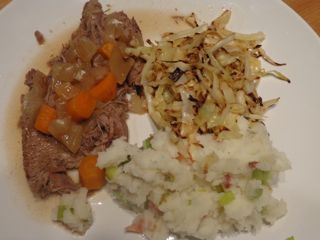
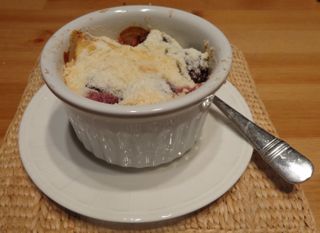
Wartime Rations – Day 17

It’s somehow very telling that when you look through various WW2 recipe books in search of meals to do with turkey or chicken that you find nothing. Nada. Unless you bred your own, was it possible to purchase chicken or turkey during the war?
turkey hashGiven that I had turkey left over from ‘Canadian Thanksgiving’, it meant I had to use my imagination to use up my leftover turkey tonight. I ended up adapting a recipe for Corned Beef Hash to Turkey. (Fry chopped onion, chopped cooked potato and cooked turkey, cover and cook for 15 minutes.) To my meal I added leftover mashed carrots and fresh red cabbage and carrot coleslaw.

October 22nd, 1944 was a Sunday, so no newspapers on that day. (At least, none I can access through the archive.) Instead, Anne has written a great article for this post. I asked her about what she found were the worst (and best) things she could remember about rationing. Obviously food rationing was an issue, but there was so much more to rationing and wartime deprivation, and she paints a fascinating portrait of everyday life on the home front.

anne2013I remember being hungry at times, though that was probably because I had just turned 11 when the war started – rationing started at the end of 1939 – and so was entering my teenage years, the hungry years and rationing went on till about 1954.  Hunger didn’t stop me from selling my sweet coupons apart from reserving a few for an occasional bar of chocolate; I preferred the cash, to buy a sausage roll or scotch pie.  I also contributed to black market goings-on by selling clothing coupons as well – but all my ‘dealings’ were within the family.  There was one occasion when the fighting had ended and a police sergeant friend of the family came visiting when Mother was ironing on the kitchen table and he laid a couple of things on the table, saying These are for you. I think it was a packet of tea and a bag of sugar – rationed stuff, anyway.  Mother was silent, and I could see the thoughts that were rushing through her head: What was this?  A policeman on the black market?  Was he testing her to see if she would accept?  If she did would he arrest her?
Seeing her hesitation and doubting eye, he explained that they had just arrested some big-dealing Black Marketeers and the food would officially be destroyed. (I think my memory is right; the incident left a strong impression.)
My top things would certainly be: the tastelessness of much of the food and the bread in particular – and the meagre scrape of butter didn’t help; the monotony of the meals because there was little importing of fruit, spices etc;  no ‘branding’, everything in the melting pot and ‘National’;  fish was scarce and there was little choice and it seemed we always had to queue for it, not knowing what would still be there when we got to the end – but if we were unlucky we might get fried something from the chippy;  queueing itself would be on my list, it became a part of everyone’s life – imagine rushing to join a queue to get a box of matches when word got round that ‘So&So’s had a supply. In my list I’d include power cuts which affected so much of everyday life: not just going off when you were cooking, but also electricity for ironing so we had to unearth a pair of old flat-irons and heat them on a gas ring – so ironing had to be done in a particular order, eg linens and cottons while the iron was newly heated down to wool when it had cooled off – there were a few disasters.  Public transport was hard pressed: trains could be cancelled at the last minute because of the movement of servicemen; fewer trams and buses and all of them packed to the gills and nearly all in the hands of women conductors since men had disappeared into the Services; often the driver would have to come round and help the poor woman with some drunk and disorderlies, or when would-be travellers were insisting on boarding in numbers way beyond the legal limit.  And of course the winter journeys on street and rails when the only light was a glimmer of blue, certainly not enough to read by.
But of course, we put up with it, and cheerfully.  There was a war on, wasn’t there, and to stay cheerful was part of doing ‘our bit’.  And I was young and able to take it in my stride.

 
On the good side were Mother’s ingenuity in somehow producing nice, if rather monotonous, meals and all her jam-making and fruit bottling in summer (though storage jars were a problem and treated like Ming vases).  Dad’s constant supply of veg: one thing I really loved were boiled turnip tops which had a lovely flavour similar to spinach but tastier.  Recently I mentioned to someone that I couldn’t think why they weren’t sold on veg counters and was told they were banned because they contained something vaguely narcotic – don’t know if that’s true or not.  And there was always the canteen at work to fill up on stodge.


Wartime Rations – Day 16

After my ‘lapse’ over the weekend, I’m trying to get back on track. One of the things I’m finding hard is not having toast with marmalade in the morning, but with only 2oz of jam/marmalade a week, I’m trying to save it for special occasions. So, in looking through Marguerite Patten’s cookery book ‘We’ll Eat Again I came across this recipe for Carrot Jam in the ‘Making Do’ section.

carrot jam

Wartime Carrot and Apple Jam

Method: Cook 8 oz peeled carrots in a little water until a smooth pulp. Cook 1lb sliced cooking apples (weight when peeled) in 1/4 pint water until a smooth pulp. Mix the carrot and apple pulps together. Measure this and to each 1 pint allow 1lb sugar. Tip back into the saucepan, stir until the sugar has dissolved, then boil until stiffened. This never becomes as firm as real fruit jam. (I used eating rather than cooking apples, so I would suggest you dial back on the sugar a little.)

After a week exploring what was going on in Canada 70 years ago, it’s back to Scotland and The Glasgow Herald for October 21st, 1944. Once again, it’s 6 pages of close type, minimal photos and blackout times.  (6.32pm until 7.32am.)

Two adverts on the front page caught my attention.

The Dog’s Bazaar. A bazaar was to be held in aid of The Scottish Society for the Prevention of Vivisection. There was to be a special stall in aid of the Scottish National Institute for Blinded Sailors and Soldiers. Admission was one shilling and those attending were asked to remember to bring their clothing coupons with them and that no loose coupons would be accepted.

Nowadays, people frequently complain that Christmas gets ‘earlier and earlier’ each year, but maybe it was always thus. On October 21st, 1944, Copland’s Stationery Department in Sauchiehall Street advertised  ‘a good selection of Christmas cards and calendars. As supplies somewhat limited, we would suggest the advisability of an early visit’. I wonder if Christmas advertising has always started early, or was this to make sure cards would arrive in time for Christmas for the troops stationed overseas. 

Keeping with the Christmas theme, I found this in the Letters to the Editor:  Sir. We have been told of extra rations to be distributed for Christmas. Can we conscientiously accept them when we think of the starving people in France and other European countries. We suggest that these extra luxuries should be sent to the children of France as a gesture of good will from the people of Britain.

In war news:
Allies enter Cesena. (Italy)
Landing operations in Philippines.
Red Army liberates Belgrade
Aachen fall to the Americans.
Canadians gain ground near Antwerp.

The Cost of Fighting: The average daily expenditure for the three months ending June 30 was a little over £13,250.000 per day.

Although we now know that Rommel was forced to commit suicide, the Allies believed the German reports that he had ‘died from wounds’ after his car was strafed near the village of Dozule east of Caen on the afternoon of July 17th. Wing Commander Baldwin, one of the pilots involved in the attack said, “We saw two despatch riders, one biggish armoured car, another motor transport, a staff car and a smaller armoured car. This indicated somebody of importance and I gave the usual order for the section to peel off one by one and strafe the vehicles. We skimmed along the road at tree top height and let the vehicles have about 300 cannon shells. One of the despatch riders got away as there was plenty of cover beneath the hedges and trees. The other was killed on the spot, and, as we cut off back home we saw the cars either smoking or in flames.”

Far East ‘Snaps’ Wanted: The Admiralty invited the public to submit any photographs they may possess of scenes or subjects taken in Far Eastern areas.

A ship’s steward on a merchant vessel was fined £50 or three months imprisonment when he was charged with smuggling 252 pairs of artificial silk stockings and 10 lbs of sugar.

Wanted: Repatriated officer wishes to replace lost silver cigarette case, gold cuff links and reliable wrist watch; price must be reasonable.

Wartime Rations – Days 13/14/15

In celebrating Canadian Thanksgiving a week late, I always knew this would be a hard weekend food/ration wise. And yes, I slipped – badly – even though Canadians already received way more in rations than the Brits. But, in getting back on track today, it got me thinking a lot about food.

turkey

On the left hand side of the picture you can see my (British) wartime ration of 8 ozs of turkey meat to carry me through the week. On the right, in the brown bowl, the turkey leftovers my dog will be eating over the next few days in 2014.  It makes me remember my parents’ (who lived through the war) frustration when I wouldn’t finish my meals as a child – Don’t you know there are people starving in other parts of the world? – and guilt at what I’m ‘wasting’ on an animal, even though she’s much beloved.

Hmmmm. I really don’t think that we, in the west, who have the wherewithal, sometimes remember just how fortunate we are.

* * *

Given that we had turkey left over from our Thanksgiving meal, I’ve decided to use that as the basis for my meat ration this week even though I’m not sure how common turkey meat would have been in Britain during the war.

My experiment for tonight was full of good ideas, but didn’t quite make it in the execution: baked potato with a turkey, cauliflower, raisin curried white sauce, with fried apples on the side.

curryIt tasted ‘okay’, but I think that either a ‘regular’ curry sauce or one made with mayonnaise and curry powder might have tasted better.

Canadian Thanksgiving in 1944 was celebrated on Monday, October 9th, 1944. The Calgary Herald was not issued that day, but here is the editorial from two days earlier.

Happy (belated!) Canadian Thanksgiving to you all.

Thanksgiving


Wartime Rations – Day Twelve

Life just suddenly seems to have got busy, so I’ve been relying on leftovers and familiar recipes today. Next week I really must get more focused and do a bit more experimenting with my rations.

appleBreakfast and lunch were the usual. Dinner was leftover sausages from last night, and for dessert I made a baked apple. So simple, yet really delicious and just the thing my sweet tooth was craving. (Under non-rationing circumstances it tastes even better with cream or ice cream on the side.)

It’s dead easy and very quick. Clean your apple and core it. Place it on a dish with just enough water to cover the bottom of the dish. Mix some raisins with a teaspoon of syrup/honey or sugar and stuff the apple.  Bake at 180C for 20-30 minutes, and Bob’s your uncle!

On to The Calgary Herald (14 pages) for October 17th, 1944.

There was lots of war news: The Russians had begun their drive into East Prussia with Berlin admitting the Russians were now on ‘sacred soil’;The Japanese had lowered the age of conscription from 19 to 17 years-of-age, and Rommel’s death had been confirmed.

But I have to admit, it’s the news from the Home Front that I find the most fascinating. The war news you can find in the history books, but the news in the papers is pure gold. (At least to the history geek in me!)

The Women’s Minimum Wage in Canada was set at $15 per week for a 30+ hour work week. Currently it was $12.50 – $14 for 48+hours.

Apple juice would be available to civilians this coming winter. During the past few years it had been reserved for the military.

Canadian Wren Mildred Honey found herself having problems. Custom dictated she be called by her last name, which caused puns and a lot of laughter on the base.

Alberta seemed to have a lot of problems with escaping POWs. I mentioned one yesterday, but in today’s paper was the report that: German POW Joseph Haub, 30, who’d escaped from his work at the Madalia Potteries on September 13th, was captured by RCMP and Medicine Hat City Police at 1am this morning in a house occupied by two women. Although it was unclear how long he’d been in the house, the two women were not charged with harbouring him.

And then there was this angry letter to the editor from ‘A Veteran’.
Returning to this country after spending three-and-a-half years overseas with the army, I received my discharge. After reading and hearing so much about the shortage of manpower, I thought it would be a simple matter to get a job, but I certainly found out my mistake when I tried.
At most of the places I was sent to by the Selective Service I was told I was too old. Since when was a man of 40 too old to work? And where is the rehabilitation program we hear so much about, or is the government keeping it for its much-beloved Zombie Army? How is it the business people of Calgary expect men to go to war and fight for them but will not give them work when they return? It was the same thing after the last war. They seem to have no use for an ex-serviceman here.
I suppose they will expect us to invest in the Victory Loan that opens soon. Any country that can afford to keep a Zombie Army of 72,000 men hanging around doing nothing does not need any help at all. (Zombie Army?)

There was a prediction that ‘Within 90 days after the collapse of Germany, the market will be flooded with nylon stockings. They’ll be in colours and designs never before conceived. They will sell at a price range between 79c and $1.25c.’

And finally this great story! Five hundred miles from the nearest land, an exhausted homing pigeon recently alighted on the bridge of HMCS St Lambert in the Atlantic and stayed with the corvette for four weeks, thus becoming one of the most unusual mascots in the history of the Royal Canadian Navy.


Wartime Rations – Day Eleven

When I was looking through Marguerite Patten‘s recipe book We’ll Eat Again yesterday for sandwich fillings, I noted a recipe for Potato Rarebit.

Rarebit

Potato Rarebit. Recipe from We’ll Eat Again by Marguerite Patten.

(Use mashed potatoes as a basis for a rarebit. Beat the potatoes until soft and smooth; add a little milk if too stiff. The potatoes should be like thick cream. Put in as much grated cheese as you can spare, with seasoning to taste. Spread on hot toast and brown under the grill.)

I had some mashed potatoes (with chopped bacon and leek) left over from a couple of days ago, so I thought I’d give it a try. Surprisingly, it was very good, and with some homemade coleslaw on the side, very filling.

steweed

Stewed Sausages with carrots and leek.

For dinner tonight, I had a favourite from when I was growing up – stewed sausages – accompanied by the rest of the leftover mashed potatoes and brussels sprouts. It’s a really easy meal to make. Fry the sausages in a little fat, add leeks and carrots, add some stock (or cider if you’d prefer), cover and simmer until veggies are cooked.

Checking out what was making news in The Calgary Herald for October 16th, 1944, (15 pages today) I found the following:

Field Marshall Edwin Rommel (The Desert Fox) had ‘Died of Wounds’ the German newspapers reported. Hitler had ordered a state funeral for him.  (In fact, we now know the wounds he died of were from his forced suicide. Rommel had been injured on July 17th, 1944 when the RAF strafed his car. However it was his ‘defeatist’ attitude that angered Hitler and he was forced to commit suicide.)

Canadian Veterans were being offered post-war opportunities either in vocational training or educational opportunities. Fees would be paid, and $60 per month given to a single man/woman, or $80 per month to a man with a wife. Additional allowances were available if the couple had children. The programme was available for ‘period of service to a maximum of one year – but can be extended’. Disabled vets received special consideration, their right to training being ‘continuous’.

In New York on Saturday night, Frank Sinatra was hit by an egg as he sang ‘I Don’t Know Why‘ at the Paramount Theatre.

According to Gallup, with the US Presidential election only 3 weeks ago, Roosevelt had 51% of the poll while Dewey had 49% – with an error of 3-4%.

The Personal section was fascinating, operating as a kind of 40s Facebook, with notification of various members of the public returning home from holiday or weekends in Camrose, Banff and Brooks, and of members of the forces coming home on leave. For example: Miss Lucille Allen left this morning for Denver, Colorado, to visit her parents.

An advertisement for Safeway itemised the following foods which people living under rationing Britain could only dream out:
MacKintosh Red apples: 5lbs – 23c: 35lb bag – $1.59
Tomatoes: 19 c per lb
Grapes: 17c per lb
Grapefruit: 21c per 2lbs
Jam: 31c per 2 lb jar
Sirloin steak: 38c per lb
Chickens: 32c per lb

Max Telling, 40, a German POW, escaped from a German POW farm project near Namaka by stealing a truck which was recovered in Calgary. Telling, 5’6″ tall, fair, with wavy hair was wearing a blue/grey suit and blue shirt. He left a thank-you note in the truck thanking the owner for its use. (!!)

An eyewitness account of the gassing and cremation of 4,000 Jewish children in the German concentration camp at Birkenau was given today in a London dispatch. It quoted the letter of a Polish woman imprisoned in the camp for 7 months who was later transferred to a Warsaw prison from which the letter was smuggled out.

Wartime Rations – Day Ten

31LntU63M+L._AA160_It seems I’m doing a lot of ‘Eating At The Savoy’ this week, so dinner is taken care of tonight. That leaves lunch. With cheese being so heavily rationed for my lunchtime sandwich, I’ve turned to Marguerite Patten’s book We’ll Eat Again for some different ideas. What do you think of her suggestions?

1) Shredded cheese and chutney or cooked beetroot.
2) Cooked mashed potato, yeast extract and chopped parsley.
3) Chopped grilled bacon and lettuce.
4) Mashed sardines, pilchards, herring or haddock, mixed with shredded fresh carrot.
5) Minced crisply cooked bacon rinds and toasted oatmeal.
6) Fish paste and chopped parsley.
7) Brawn, shredded swede and chutney.
8) Vegetable or meat extract and mustard and cress.
9) Chopped cold meat and mashed cooked vegetables with seasoning.
10) American sausage meats and watercress.

I’m going to hedge my bets and have a cold sausage sandwich with my soup today.

October 15th, 1944 was a Sunday, so I can’t find any links to any newspapers for that day. Instead, I checked out this great site which has a lot of information on Rationing in Canada during World War Two. Here are some of the main points from the article.

Food was seen as a ‘weapon of war’ so, as in Britain, the Canadian government took control of:

1) Rationing.
2) Promotion of ‘Patriotic Food’.
3) The launch of an unprecedented national nutritional campaign.
4) Controls on the price, production and distribution of everyday foods.

Coupon rationing of sugar in Canada began in April 1942, followed by tea and coffee in August, butter in December, and meat in March 1943. Meat was limited to 2lbs per person per week. (Compare that to the half-pound of meat per person per week in the UK!)

Restaurants offered meatless Tuesday and Friday menus.

Petrol/gasoline was rationed in April 1942.

Alcohol was also rationed – but I couldn’t find a start date or amount for that.

Two hundred cookbooks were published during the war years, and Canadians ate more, and better, than they had for over a decade. (The Great Depression.) Members of the RCAF received approximately 3,900 calories per day.

What were the ‘Patriotic Foods’? Apples and lobster. Lobster! Canadians were encouraged to eat Lobster cocktail, Lobster a la King and Lobster sandwiches.

After the Fall of France in May 1940, Canadian food exports became an essential lifeline to Britain. By the end of the war, Canadian exports accounted for 57% wheat and flour consumption in the UK, 39% of their bacon, 15% eggs, 24% cheese and 11% of their evaporated milk.

Canadian housewives were encouraged to save fat and were reminded that one pound of fat supplied enough glycerine to fire 150 bullets from a Bren Gun. Two pounds supplied a burst of 20 cannon shells from a Spitfire or 10 anti-aircraft shells.

Another great movie set on the Homefront in Canada (Alberta) during World War Two is Bye Bye Blues. Based on the true life experiences of the director’s mother during the war (she found work as a pianist/singer with a dance band to pay the bills when her husband was taken as a POW by the Japanese) it’s extremely hard to find, but well worth it!

Wartime Rations – Day Nine

dinnerBack on track today after the holiday weekend. Porridge for breakfast, homemade soup for lunch, then beef, fried cabbage and mashed potatoes with added fried leeks and bacon for dinner. Rounded off with a blackberry crumble it was a lovely meal to come home to after a long walk around Prince’s Island Park downtown with my daughter. The fall colours are just stunning and we watched a brave soul surfing the mini-rapids on the river created by last year’s flood.

On to the happenings in The Calgary Herald on October 14th, 1914. Being a Saturday, there were 25 pages!

The war was obviously going well for the Allies and you can sense a feeling of optimism. Here are various headlines from the front page alone.

Riga’s Fall Frees Reds for Smash at East Prussia.

Jap Army of 150,000 Believed Cut Off in the Philipines.

British Drive Nearer Reich.

Yanks Press Deeper Into Aachen Rubble.

British Capture Island of Corfu.

For the Germans, however, the future didn’t look quite so promising.

Field Marshall Goering, quoted on German radio, warned the German people they were fighting for their very existence.

Further down there was an article stating that the ‘Nazis No Longer Fight As A Well Trained Army’.

As for what was happening in Canada…

Penicillin was now available in Canada for ‘every civilian needing it’.

A single engine RCAF plane rescued 17 US Fliers, whose plane had been damage in a severe storm in the Hudson Bay, and flew them 4,500 miles to Churchill, Manitoba.

Pilots from all over the world were trained at the Commonwealth Air Training Bases in Manitoba and Alberta during the war.  If you’ve never had the opportunity to see the Canadian film For The Moment, starring Russell Crowe before he became a big star, you might want to check it out. 

Wartime Rations – Days Six, Seven and Eight

It’s been Thanksgiving Weekend here in Canada. I haven’t been quite as regular as usual with my blog over the past few days, but now I’m one week in to the experiment I’m going to take a little time to reflect.

fishcakes

Fishcakes made with white fish, potatoes and leeks, covered with breadcrumbs and fried in a little butter.

What have I missed the most so far?  Cheese! Cheese, cheese, cheese, cheese, CHEESE!  Two ounces a week is a pretty pitiful amount. I love cheese sandwiches (with tomatoes, but they’re ‘out of season’) for lunch, so I had to resort to mixing a little grated cheese and apple together to eke out my ration this week. It  tasted surprisingly good – but I’m looking forward to going back to tomatoes in November! I also ended the week with tea, milk, butter and sugar left over. (I’m saving up my sugar to make toffee apples for Hallowe’en.)

breakfast

Bacon, scrambled egg and homemade hash browns of shredded potato and leek fried in leftover bacon fat.

I’ve also been saving my bacon fat to use for frying potatoes and cabbage – something I remember my mum doing when I was young. It makes anything you fry extra tasty. Also, instead of using a stock cube, you can use one rasher of bacon to add flavour to soups.

sausages

Sausages, baked potato, fried apple slices and white cabbage.

Treating myself to a proper cooked breakfast at the weekend – and puddings at most evening meals – means that I don’t feel deprived. But once again, I’m not fooling myself that this experiment in wartime eating is anything like the real thing. Anne made an observation that when she saw the first Americans in the UK in 1942/43, what struck her the most was that they all had a layer of fat under the skin of their faces that you didn’t see in British people who’d been living with 2-3 years of rationing.

As I said above, it’s been Thanksgiving Weekend here in Calgary, so as a Scottish-Canadian (or Canadian-Scot) I’m going to change tack a little and look at what was being reported in The Calgary Herald this week instead of its Glasgow counterpart.

First impressions? Like the healthy looking Americans my aunt commented on, this Calgary paper comes in at 20 pages compared to the Glasgow Heralds 6 or 8. While there are few photos or picture adverts in the Glasgow paper, the Calgary one is filled with them. There is even one page devoted to cartoons, crosswords and, yes, more adverts! No paper – or goods – shortage here! Very different to the European experience.

Also no blackout times on the front page, although there is a notice informing the readers that: the sun will be above the horizon tomorrow for 10 hours and 53 minutes. Rises at 7.55. Sets at 6.48. Temperature forecast for 3pm. 67F (19C).

The biggest difference is that the main war news is on the front page: Canadian and US gains in Holland; British have landed in Greece; Russian troops have reached Riga (Latvia); Hungary ready to quit the war.

A German POW escaped from Lethbridge POW camp, but was recaptured 50 miles away.

And then this little gem from the UK: Villagers Drive Stake Into Grave of Witch to Peg Impish Spirit. Apparently, during the construction of a military road in Scrapfaggot Green in Essex, a bulldozer pushed aside a boulder which had been used to mark the last resting place of a woman burned at the stake and buried two centuries earlier for being a witch. Thereafter ‘queer things’ started happening in the village; bells ringing, clocks going wrong, chickens and ducks disappearing, things being moved. The villagers took matters into their own hands, consulted an ‘expert’ for advice, measured the grave, drove a stake into it and then rolled the boulder back into place. That night, they ‘had the first quiet night’s sleep in many a day’.

Holland: Retribution is rapidly closing around the men and women in the areas of Holland already liberated who played the Germans’ game during the occupation. About 2,000 alleged quisling have already been arrested.

Buster, an eight-year-old Tiger cat, had been left $100,000 (reduced to $40,000 by court order) and three fans for his comfort by his late master.

Edmonton council considered application from a Japanese-Canadian girl to be allowed to reside in Edmonton while attending the University of Alberta. Her application was accepted, but notice given that other girls of Japanese origin may not reside in Edmonton unless natives of Alberta.

Bundles for Britain. An appeal was made to send clothing to the UK where it ‘is needed more than ever because people are being left homeless by the robot bombs.  (V1 rockets.)

Air Force Casualty Lists: These included those Killed on Active Service, Missing on Active Service, Previously Missing but now Officially Presumed Dead or taken POW. Also those Dangerously Injured on active service.

Antics on downtown streets of High School girls undergoing initiation into Calgary sororities was causing some concern. Attitudes differed between the schools – 3 girls were suspended from Central High School for wearing ‘outlandish costumes’ to class, whilst at Western Canada High School, girls were allowed to wear such clothing for the few days of initiation. (My daughter, who attended Western Canada High School not that long ago, says there are no longer sororities or fraternities at that school.)

British divorce boom worries Anglican Clergy. Pre-WW1, the average divorce rate was 500 per annum. In 1943 that rose to 2,250, and by the beginning of 1944, 3,396 cases were waiting to be heard.

Eighty-one cases of polio had been reported in Alberta in 1943 with the latest victim a 12 year-old girl.

A four bedroom house in Hillhurst in Calgary was on sale for $4,200. (Current prices for a four bedroom house in the same area range from $900,000 to $1.5million!)



Wartime Rations – Day Five

fishandchipsI seem to be eating out a little more frequently than I had planned when I started this programme. It’s the long weekend here in Canada, so we went out to lunch at Earls. Trying to stay within my rations I had halibut and chips, but the helping was so large that I think it’ll just be soup for me for dinner tonight!

The Glasgow Herald

Once more, only 6 pages. I wonder why? It’s getting closer to the end of the war, but is this when material was in real short supply?

Page One: Blackout times: 7pm – 7.09am

What I’m finding interesting about the front page of the paper is that this isn’t where to find the top news. This page is about announcements and adverts. For example:

Silver Weddings: At the Bath Hotel, Bath Street, Glasgow on 10th October, 1919, but Rev. D Galbraith, assisted by Dr Chisholm M.A., Donald M. Wilson to Agnes C. Sloan. Present address: Morangie, 19 Larch Road, Dumbreck, Glasgow.

Crystal Palace on St George’s Road, Charles Laughton in The Man From Down Under.

Page Two:  10,000th ‘Fortress’ Completed. The American Association of Aircraft Manufacturers announced in Los Angeles yesterday that the 10,000th Flying Fortress had just been built by Boeing Aircraft Company in Seattle.

Page Three: German Positions Taken in Rear. The Landing by Canadian Forces at dawn yesterday in the Scheldt Estuary pocket west of the village of Hoofdplaat was reported last night to be ‘progressing satisfactorily’. The assault in the enemy’s rear was made to ease the pressure on the Canadians holding the Leopold Canal bridgehead, and already (reports Reuter) there are signs that the ferocious German attacks at the canal are weakening.

Page Four: No more ration-free bacon. Cooked belly bacon sold off the ration for the past 6 months was from yesterday issued to retailers for the ration bacon requirements. Coupons will be necessary when buying it.

Page Five: Foot and mouth disease was confirmed yesterday among pigs at Spennymoor, Co Durham. The usual standstill order was made.

Page Six: For Sale. Huntly Gardens, Glasgow. 3 public rooms, 4 bedrooms, 2 dressing rooms, 3 bathrooms, kitchen and servants’ bedroom. Entry can be given as soon as the house is de-requistioned by the War Office. (I checked on recent sales at this address. The house has been turned into flats and one recently sold for £475,000. But what I found really interesting is that had been taken over by the War Office.  From whom? How much had they paid the original owners? What was it used for?)

Wartime Rations – Day Four

fishI decided on fish tonight. Although fish wasn’t a rationed food in WW2, it wasn’t always available. Fishermen had to put to sea in dangerous waters to haul in their catches, so often weren’t able to go far from shore. Also, which I didn’t realise, there are also distinct seasons for fish with cod being in season (in the UK) from October to January.  Who knew?

I rarely eat fish – I like it but my husband doesn’t – so I don’t have too many fish recipes to hand. But I do remember, from working in NHS hospitals years ago, that they used to serve up cod in a mustard sauce, which I decided to replicate. (Bake cod in oven at 180C for about 15 minutes. Make a white sauce, add mustard powder to taste, then pour over the fish.) It was delicious, and to add some colour and veggies I threw in some roasted Brussels sprouts which cooked in the oven at the same time as the fish.

berryPudding – because I am enjoying eating pudding every night – was apple and blackberry crumble using some of the leftover crumble mix from the other night. Also, saving energy, the pudding baked in the oven at the same time as the fish and veggies – although it needed a little more time.

The Glasgow Herald – Monday, October 9th, 1944

Only six pages again today, and I’m starting to find myself more interested with the ‘local’ news than the actual ‘war’ news.

Blackout times for Glasgow: 7.02pm until 7.07am- so nights are starting to creep in.

Page One: The writing is a bit blurred on this advert, but from what I can make out, the price at Rowans of 70 Buchanan Street for Officers’ uniforms were as follows:
Air Force Tunic: £9-6-6d
Trousers: £3-10-0d
Greatcoat: $14 – 4 -6d.

For comparison of what money bought back then, please check out this site for wartime prices.

Page Two: Scottish War Plant Closed. A war factory at Mossend, Lanarkshire, closed down on Saturday. When the factory was in full production over 500 men were employed, but recently only part of the plant was in operation. Members of the staff have received their notices. One hundred and twenty men are affected.

The above post is interesting when compared with the following one.

Page Three: Need for Private Enterprise. Mr Anthony Eden on Saturday urged that private enterprise should not be stifled after the war. He told Bristol Conservative and Unionist Association that the issue which would confront Britain when Germany and Japan were laid low was whether British industry would be able not only to re-establish itself, but markedly to raise pre-war levels.

Page Four: Food Facts.  Vitamin Foods. In view of the approaching winter, please see that every child under five gets cod liver oil and orange juice every day.

Page Five: Going My Way. Bing Crosby, after travelling so many roads to different places that all turned out to be the same, has deserted his fellow-voyagers, Hope and Lamour, and has gone up a rather odd side-turning to make ‘Going My Way’ (Paramount). In this he plays a young Roman Catholic priest who is sent to renovate a New York parish going downhill; he reforms the local Dead End Kids and sets them to singing Ave Marias, saves young girls from the streets, and raises money for the debt-laden church by composing and selling a sermon in song, a sort of Crooners’ Creed.

Certainly this sounds like the most dreadful slush, but, oddly enough, it is not. This is largely thanks to the acting – Mr Crosby’s diffident charm remains as strong as ever in a clerical suit, and Barry FItzgerald’s playing of an old priest, dry and eccentric, is as good a character sketch as any the screen has given us for some time.

… Altogether, we are still inclined to go Mr Crosby’s way, whether he is heading for Mandalay or the New Jerusalem.

Page Six: Peebles Auction Market. Owing to foot-and-mouth disease restrictions, the sale advertised for Friday, 13th October, has been meantime postponed.

A terraced house for sale at in Bellevue Road, Ayr, comprising 3 public rooms, 7 bedrooms, a kitchen  and servants’ accommodation was being offered for £2,250. I checked on modern-day prices for the same property. The building has now been divided into flats, with one recently priced at £197,844 and the other at £228,500!