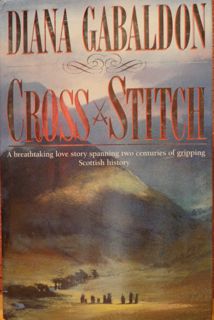
Outlander/Cross Stitch

outlanderI first read Outlander – or Cross Stitch as it was called in the UK – back in 1992. A wonderful mix of romance, adventure and history set in Scotland, I loved it and recommended it to friends and family. I even wrote to Diana Gabaldon asking for an interview for the writers’ group I belong to, The Alberta Romance Writers’ Association, and she was extremely generous with her time and answers.

So when I heard it was finally being adapted as a TV series by Starz, I was both excited and a little anxious. Would they do it justice? We’re now two episodes in, so what are my feelings so far?

Here’s what I like.

1) I’m so happy that a story set in Scotland has actually been filmed in Scotland – unlike some other famous ‘Scottish’ movies I could name. The scenery is stunning and I’ve had a lot of fun figuring out the locations. If you’re planning on visiting Scotland and would like to check out the Outlander sites, even Visit Scotland has got in on the act and created an Outlander map.

2) I think all three main characters, Clare, Jamie and Frank/Jack have been very well cast and are doing a great job. And I’m thrilled to see Gary Lewis, one of my favourite character actors, playing Colum.

3) The fact that they’re sticking to the book. It was interesting to hear the producer say that the series has been made for the book’s fans. Having dabbled in the world of screenwriting myself I understand the huge difference between writing for the page and writing for the screen, so I appreciate that the writers have stuck to the book as closely as they have. But then, they had good source material to start with, didn’t they!

As for the ‘Meh’?

1) The Scottish twee. Admittedly the major audience for this series will be the US and I feel what’s being presented is how they imagine Scotland, and Scottish people, to be. However, as a Scot, there have been places where I have squirmed uncomfortably. There was one scene in the first episode where it felt like Dougal and the Scottish Dwarves… all named Goofy. And as for some of the accents..! And lines. A patient not liking ‘being stuck with a needle’? That’s not an expression I ever heard until I moved to the western side of the pond. But again, the major audience will be American and they might not be familiar with the term ‘injection’ or ‘jag’, so I’m probably just being picky.

2) The nudity. I’m not talking about the sex scenes, but the ones with Clare dressing and Jamie’s sister being attacked in the second episode. I don’t like to think I’m a prude – although maybe I am. This series was advertised as Scotland’s Game of Thrones, and for that reason I know of 3 men in particular who tuned in.  One gave up half way through the first episode, the second at the end of the first hour, and the third has vowed to watch no more having persevered through the second episode. Now, there may be many men who continue to watch and love the series, but my feeling is that the main audience is and will continue to be female. Do women really want to see so much female nudity? Is it necessary to the scene(s) or is it exploiting the actresses? People might argue that I feel this way because, ‘You’re just jealous because you’re older and will never have a body like that again’. Fair enough if that’s what they believe, but because I’m older, and have been around the block a few times, I think I can recognize exploitation when I see it.

But as I said above, I’m being picky.

If you loved the books, there’s waaay more right with the series than is wrong – you can’t please all the people all the time –  so I’ll definitely keep watching. But my advice to anyone would be ‘Read the book first’! Always, read the book.

I’d love to hear your thoughts on Outlander/Cross Stitch and the job of bringing it to the screen.
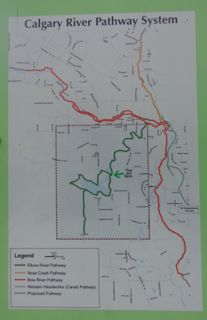


Calgary Pathways – Elbow River Pathway

Staying with the urban parks theme from last week’s posting…with over 900 km of bike/walking paths in Calgary, it’s very easy to get out and enjoy the fresh air and some lovely scenery. Today my daughter and I took an hour to explore just a fraction of the Elbow River Pathway, which is only a mile or so from the city centre. Although it was a warm day, 23C, there was a lot of cloud cover which is unusual in Calgary which is famous for its big blue skies.

Map   view 1

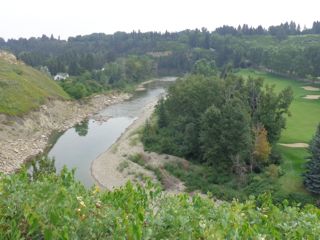
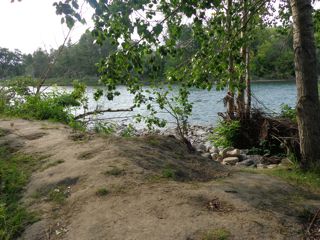
We started from the south end of River Park and headed towards the Glenmore Reservoir. If you’re not familiar with Calgary, you might not know that the city experienced a devastating flood in June 2013. Although this year the river is at a very low-level, if you look towards the left hand side of the photo above, you can get an idea of how much erosion the flooding caused.

woods   take a seat

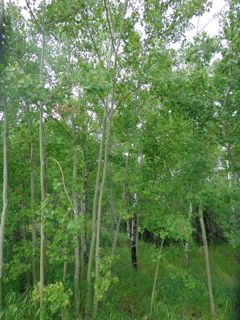
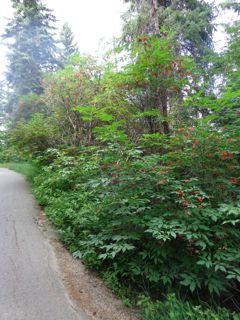
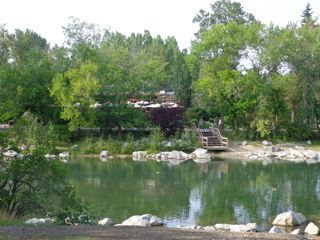
We made our way past woodland to our right and the river valley to our left, stopping for a while for a bite of lunch.

Corrsing the dam dam 2

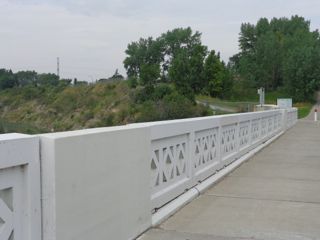
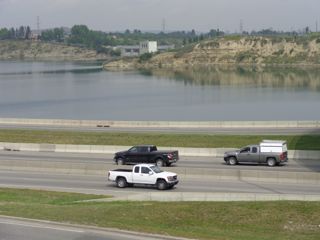
Then it was out across the Glenmore Dam. The first photo is taken from the dam itself. In the second you can see the dam in the distance as we crossed over Glenmore Trail, one of Calgary’s main thoroughfares. Fortunately the roar of the traffic didn’t last long as within minutes we were back in the peace and quiet of the pathway.

rowan path  from rocky

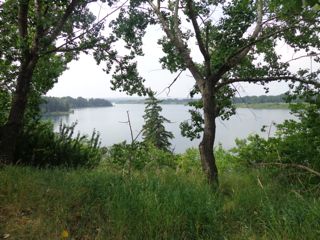
We ended our walk just outside the Rockyview Hospital which has the most wonderful views across the reservoir. (On a clear day you can see the peaks of the Rockies in the distance.) Had we walked a little farther, we could have reached Heritage Park which I’ve talked about in a previous post, but we were short of time, so we headed back towards River Park again.

In total, our walk took us just over an hour  – including stopping for lunch –  and there were times it was hard to believe we were so close to downtown.

If you’re interested in finding out more about Calgary’s pathways, please click on this link. Calgary is a gorgeous city and we’re so fortunate to have so much open green space within the city boundaries. Whether you’re a local or a visitor, consider taking an hour to pull on a pair of walking shoes and explore some of our amazing trails.


Women in World War One

I know a fair bit about my grandfathers’ lives during Word War One. It’s always easy to find out about men’s lives in wartime. In the case of servicemen, every posting is recorded in their service records. For those back home, employed in essential services or too old to fight, there are always work records or census details. But what about the women? What about my grandmothers?

Gran Dad

My paternal grandmother, Mary Hendry, holding my father. 1915

Nannie2

My maternal grandmother, Harriet Davenport

I never met my paternal grandmother – Mary Hendry – but as both she and my maternal grandmother – Harriet Davenport – were young mothers during the 1914/18 conflict, I can only assume they remained at home raising their children while faced with diminishing resources and increasing food shortages. In my paternal grandmother’s case, she raised her family as a single parent under the constant worry that her husband may not return from the front.

But for many single women who found employment it was an exciting time. For the first time in their lives they were earning decent money which allowed them to live independent lives.  I’ve just watched Katie Adie’s Women of World War One which is a fascinating look at how The Great War changed women’s lives and led – eventually – to women finally receiving the vote.  (Women over 30 got the vote in 1918, all women over 21 in 1928.  All men over 21 got the vote in 1918.)

Here’s a clip from Youtube, but please try to catch the whole programme. It’s available on BBC iPlayer until midnight on Tuesday August 19th.

When Words Collide

I spent a great few days last weekend at the When Words Collide conference here in Calgary. Now in its fourth year, it just keeps getting better and better.

Special guests this years included writers, Jack Whyte (check out his website just to listen to his amazing voice!) Brandon Sanderson, Robert J. Sawyer, Jacqueline Guest, Mark Leslie and Shirlee Smith Matheson and editor Adrienne Kerr.

I belong to a wonderful writing group The Alberta Romance Writers’ Association, whose members generously share their knowledge and expertise on both the craft and business of writing, but sometimes you need to get out there and hear from other experts in their field. So much has changed in the publishing world that it’s hard – and sometimes a little intimidating – to keep up, but the focus remains on bringing the best book to the reader whether it is traditionally published or self-published.

The dates and location have already been set up for next year’s WWC – August 14-16th at the Delta Calgary South – and registration is open. At the bargain basement price of $40 it’s a wonderful deal.

See you there!

Prince’s Island Park – Calgary

There are two kinds of emigrants/immigrants; those who are pulled to their new country and those who are pushed from their old. I definitely belonged in the latter category. I was perfectly happy living in Scotland, but then my husband got offered a great job opportunity in Canada so we packed up and moved across the Pond.

It took me a long time to settle here. Getting used to the long – long – winters was a challenge. But over the years Canada, and this city of Calgary where we’ve made our home, have burrowed deep into my heart and now I truly love them both. We are fortunate to live here. When we arrived in Calgary, the population of the city sat at just under half a million. Now it is well over one million, and we’ve seen tremendous changes over those years.

For the next few Wednesdays, I’d like to show you some of my favourite places in this city. Some are well-known while others, like the Reader’s Garden Cafe I spotlighted last week, are unfamiliar to most Calgarians. backendFirst up is Prince’s Island Park. Named after Peter Prince who owned a lumber company nearby, the park is located immediately north of the downtown core on an island donated by the Prince family (according to Wikipedia) to the city in 1947. His original office building remains close by. Now known as the 1886 Cafe, it is a popular restaurant serving breakfast and lunch. Peter Prince’s home can been visited in Heritage Park.

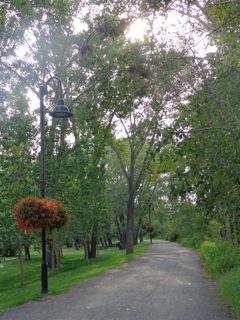
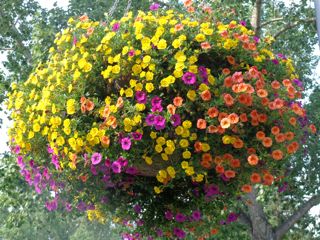
Completely surrounded by the Bow River, Prince’s Island Park boasts all the facilities – and more – you could wish for in an urban park. Each year, it hosts the Calgary Folk Festival, Shakespeare in the Park and the Canada Day Celebrations every July 1st. Or enjoy a meal at the trendy River Cafe with its great food and wonderful location. You’ll find plenty of well laid out trails lined with beautiful hanging baskets for bikers, walkers and runners, but there are also off the beaten tracks where you can get up close to the fast-flowing river.

river2 If you love flowers, there are plenty of displays to enjoy. If you fancy a picnic you can bring your own blanket and spread it out on the grass or use one of the many picnic benches dotted around the park. downtownWhen our kids were young, we used to like to come down on a Sunday morning for a picnic breakfast. After we’d eaten, they’d play for ages at the extensive children’s play park.

Although there are spots in the park where the city can feel a million miles away, there are others where you can see the beautiful glass buildings rising above you, sparkling in the sunlight. It’s a lovely place to visit, whether for a quiet stroll or an ad hoc soccer match or game of frisbee. And if you fancy a coffee, nip in to Eau Claire market on the south side of the park, or stroll across the Peace Bridge and walk along Memorial Drive to Kensington.

flowers

One of the hanging baskets you can find on the lamp posts around the park.

sunflower

Sunflower

River cafe

The River Cafe

bridge

The Peace Bridge linking Prince’s Island Park to Kensington on the north side.


Percy Frederick Huggins

One week into memories of The Great War and it’s the turn of my Grandfather on my Mum’s side. He died when I was about 3 or 4 so I don’t remember much about him. All the memories below are those of his youngest daughter – my aunt Anne who contributed her wartime memories to my wartime rationing blogs at the beginning of this year. I only have only 2 personal memories of Granddad, and they’re of him lying in bed in what, I suppose, was his sick room. He loved canaries and I do remember the sound of them chattering. I also remember that whenever I walked in the door he started singing, ‘Sugar in the morning, Sugar in the evening, Sugar at suppertime…’

gradadcroppedBorn in London, possibly Clapham, around 1878, he was the youngest son in a family of 6 girls and 4 boys. Anne doesn’t know where he got his education and training but presumes it was something to do with glass because when he couldn’t find a job in London, he found one in Glasgow, with Barr and Stroud.  My grandmother stayed in London to await the arrival of her first child, Percy Alexander Huggins, who was born in November 1912. (I think I remember Uncle Alex saying that Granddad wanted him born in England so he could play cricket for England when he grew up – but that might be a false memory.)

Part of Barr and Stroud’s production included  range finders, torpedo depth recorders, periscope range finders and binoculars, so although working in a reserved occupation, my Grandfather’s work was essential to both First and Second World Wars.

According to Anne, he was just over 6′ tall, and thin. His legs seemed to take up most of his height – a real Daddy-longlegs. They were thin too. My brother at 2 years of age always, and off his own bat, grabbed a cushion before he would sit on his Granddad’s boney thighs!

Anne has nice memories of him taking her to Kelvingrove Park in Glasgow to feed the ducks, to another park Dawesholme, which was also a bird sanctuary – he was fond of birds, especially chaffinches, and of accompanying him on fishing trips to Kilmardinny Loch – as long as she promised to keep quiet! He fished for pike (huge, vicious things) sometimes battling for half-an-hour or more. Sometimes they were too big to take home and he would hand them in to a local nursing home – the fish were big enough to feed both staff and patients.

PercyHuggins

Her wartime memories are mostly of his work during World War 2 as she was born long after The Great War ended.  As far as she can remember, during WW2 Barr and Stroud hived off some departments to what were called ‘shadow factories’ – the main building at Anniesland being too obvious a target for bombs. Anne doesn’t know how many shadow places there were, but Granddad was put in to manage one – a very large ex-garage and workshop near Kirklee.  He took her there one Sunday when it was quiet. She was in her early teens and fascinated by the equipment on all the benches and wanted to know what they all did. There were also small cubicles at one end where two people could work on tricky pieces of work.

At the back of the building there was a large area, laid down for wartime as allotments, and he quickly put his name on two of these. At 60/61 he had a garden for the first time – and what a job he made or it. He kept it going for a long time after VE Day too, since food was in short supply (after WW2) until the early 50s.

As always, when reading or listening to Anne’s stories, I wish I’d asked more questions when I was younger. It’s a lesson to us all to ask the questions of our parents and grandparents now!


When Words Collide – The Heroine’s Journey

My second workshop of the When Words Collide Conference this Sunday morning is a discussion on The Heroine’s Journey. Is the Hero’s Journey the same as the Heroine’s?  Do you need to be male to be a hero and female to be a heroine?

My own new personal heroine on this topic is Kim Hudson with her book The Virgin’s Promise.  Please check her out.

If you would like more information on the difference between the male and feminine journeys – and a link to a YouTube interview with Kim Hudson – please click on this LINK.

Happy writing.

When Words Collide – Theme Workshop

I’m really excited to be giving two workshops at this year’s When Words Collide Conference in Calgary, August 8-10th.

The first, on Friday morning, is part of a pre-festival workshop offered by The Alberta Romance Writers’ Association where I will be presenting along with fellow writers Jessica L. Jackson, Mahrie G. Reid and Sarah Kades.

The topic I’m discussing is Theme and its importance in your story. This is a subject I feel passionate about because theme is the heart of your story.

If you would like to check out my handout and read my thoughts on the importance of theme, please CLICK HERE for a link.

I will also be talking about The Heroine’s Journey on Sunday morning at 11am and will be posting a link to that handout on Sunday morning.

Happy Conference, everyone.

When Words Collide – Mark Leslie

Day two of the pre-festival workshops for When Words Collide and yet another great session.

As an author of speculative fiction AND director of self-publishing and author relations at Kobo Writing Life,  Mark Leslie (Lefebvre), offered a unique perspective on the world of Hybrid publishing.

Hybrid publishing? To be honest, I wasn’t familiar with the term until I saw the title on the festival programme, but it appears that many writers are finding success by embracing both traditional AND self-publishing.

From his position at Kobo, Mark was able to offer us some very specific numbers.
In 2013, only 12 authors made more than $100,000 through Kobo Writing Life. (Out of those 12, 11 were romance authors.)
5% made more than $50,000
8% made more than $10,000
20% made more than $5,000
Which leaves a LOT earning between $100 and $5,000

He talked too about The Three P’s of self-publishing.
Practice. Patience. Persistence.

And don’t expect the money to come from having only one book out there. The general wisdom is that you don’t start making money until you have a minimum of 3-4 books published.

A great workshop. I came away with a much better understanding of the realities of the self-publishing industry and a cautious optimism (that phrase again) that this is do-able. Thanks, Mark.

Roll on tomorrow when the conference really gets under way.


When Words Collide – Adrienne Kerr

I’m literally just back in the door after attending my first When Words Collide workshop of the conference. Although WWC ‘proper’ doesn’t kick off until Friday, they’re offering several pre-conference workshops today and Thursday.  I wanted to hear Adrienne Kerr, Acquisitions Editor for Penguin Canada, speak about the Author/Editor Relationship.

Wow! Her workshop was so – very – much more than the title suggested.

First off, Adrienne Kerr was a great speaker; funny, knowledgable, personable, thoughtful, perceptive, informative – my brain is literally buzzing as it processes all I learned today. (And I’m not trying to butter her up just because I’m an aspiring author and she’s an editor.) The hours sped by as she offered fascinating insights into the current state of the publishing industry (not just in Canada but also in the US and UK), the history and trials of its recent past and the challenges it faces in the future.

Other topics included:
The Value and Capital Publishers Bring to the Business – and what they can offer an author.
The Economic Challenges Facing Large Publishers.
An Examination of Contracts from the Publisher and Author’s POV.
The Role of the Agent.
The Author/Editor Relationship.
The Differences Between The US Publishing Industry and The Canadian.

It’s a challenging time to be a writer or a publisher. Publishing is a business and like all businesses, the bottom line rules.

Listening to her description of the industry, my mood swung from despair to excitement, settling down around cautious optimism. And that’s probably the best – and most realistic – place to be.

If you’re attending When Words Collide and haven’t yet decided which panels/workshops to attend, I highly recommend you check out those where Adrienne is speaking.