The Virgin’s Promise – Kim Hudson: Part Three

In this third and final blog installment – The Thirteen Steps of the Virgin’s Promise – taken from Kim Hudson’s book The Virgin’s Promise, I can only offer you a hint – a flavour – of her concepts and ideas.

The thirteen steps Hudson describes are fascinating, all the more so because she compares them with the twelve steps of The Hero’s Journey. And if you read her book (which I highly recommend!) she takes several movies, which follow the Hero’s Journey and others which follow the Virgin’s, and points out each step.

Plus, you know she’s on to something important when Christopher Vogler himself (The Writer’s Journey) says in the forward: This book repeatedly pounds me how much I didn’t know… Many of the terms she uses are compatible with those of the Hero’s Journey and simply emphasize a different shade of meaning in some common signposts. But other elements of her grammar of storytelling are unique, recognizing turning points that don’t have equivalents in the Hero’s Journey language, that are uniquely feminine, or at least reflective of a more inward and emotionally based approach to drama and life.

 THE THIRTEEN STEPS

By Kim Hudson

 ACT ONE:

1) DEPENDENT WORLD: This is often the domestic realm. The people around the virgin are dependent on her or vice-versa. There remains a force within her kingdom – and within her – that keeps her attached to this world.
Material Survival
Social Convention
Protection
Need for Love.

2) PRICE OF CONFORMITY: This is about the suppression of the true self. Even if the virgin knows what she wants, she might not see a way of getting it because she may be:
Sleeping through life.
Living with restrictive boundaries
Living a life of servitude.
Facing psychological danger.

3) OPPORTUNITY TO SHINE: Something happens here that allows the Virgin to reveal her talent, dream or true nature. It can be:
Directed by fate.
Actively pursued.
A wish fulfilled.
A response to someone in need.
The result of a push from the crone.

4) DRESSES THE PART: This can be a fun moment for the audience or reader, but it is NOT a frivolous moment.
She becomes beautiful.
Receives a physical object she begins to use.
Participates in a fashion show and knows her potential.
Undresses (not necessarily physically) to reveal her full potential.

ACT TWO:

5) SECRET WORLD: Once the virgin has had a taste of living her dream and made it a tangible reality, she creates a Secret World in which to experiment and practice in her journey to realize that dream.
Creates her world: This can be a physical place or a state of mind.
Fear of Discovery: What if she’s found out?

6) NO LONGER FITS HER WORLD: She starts to see her dream as a possible reality but it becomes clear she can’t keep juggling the two worlds forever. At this point she may become:
Reckless.
Attract attention.
Declare her task too hard.

7) CAUGHT SHINING: Her two worlds collide and the consequences she feared come to pass.
She grows too big.
Circumstances change.
She is recognized by the dependent world while she’s in her secret world.
Betrayed.

8) GIVES UP WHAT KEPT HER STUCK: This is a MAJOR turning point. As Hudson says so beautifully: ‘Just as a butterfly sheds a drop of blood as it emerges from it cocoon and experiences a period of vulnerability, the virgin must sacrifice some of her past to move into her future.”  

In her Price of Conformity, she had an experience that developed into a complex, burying her pain and creating a belief or pattern of behaviour that keeps her from taking action and claiming her life.

In this major turning point, she brings that belief or behavior to a conscious level and challenges it. She has lost her dream life and must take the steps necessary to make it reality. This begins with letting something go or of allowing it to die. The usual reasons to remain in the dependent world are:
Fear of Being Hurt.
Fear of Loss of Love.

ACT THREE:

9) KINGDOM IN CHAOS:
The world becomes uncomfortable.
The Kingdom uses its power to bring the virgin back into line.

10) WANDERS IN THE WILDERNESS: It was easy to follow her dream when the dependent world still existed as a fallback position, but it’s a different matter following the dream no matter what the consequences. She finds herself faced with:
Test of Conviction.
Moment of Doubt.

11) CHOOSES HER LIGHT: She trusts herself and pursues her dream whatever happens.
Last stage of transformation.
Introduces her true form to the kingdom.

12) RE-ORDERING/RESCUE: This is when her shadow side is truly banished.
She – and others – see her value.
Reconnects with her kingdom.
The false rescue. (In a false rescue, the Hero will fight for the virgin but only to prove he is brave or to assert his will over another.)
The Test: When the hero fails to value her true nature, the virgin must reject him.
Multiple rescues. There can be multiple rescues, each one testing the virgin.

(In writing a compelling romance, the rescue provides the CRUCIAL obstacle to love. The hero fails to value the virgin in her authentic form due to his:
Immaturity – Ever After
Fear of Commitment – Pretty Woman
Fear of Embarrassment – About a Boy)

13) THE KINGDOM IS BRIGHTER: The virgin has challenged the kingdom and thrown it into chaos. They have accepted her back and made adjustments to accommodate her AUTHENTIC nature or dream and realize the Kingdom is better off for having gone through this experience as it needed change.
Evil has been uncovered and removed.
New life has been injected into the kingdom.
Unconditional love binds the kingdom.

So there you have it – The Virgin’s Promise in thirteen steps. But as I said above, this is just a taste of Kim Hudson’s book. Please check it out, examine the films she talks about and you will see the important differences between the journey of the Hero and that of the Virgin. You won’t be disappointed.

The Virgin’s Promise – Kim Hudson: Part Two

If you read my blog last Friday, you probably got the idea just how much I LOVE Kim Hudson’s book, The Virgin’s Promise. Three of the major ideas she puts forward really struck a chord with me.  1) Difference between Myths and Fairytales. 2) Archetypes. 3) The Thirteen Steps of the Virgin’s Journey. Last week I looked at Myths and Fairytales and next Friday I’ll be looking at The Thirteen Steps. Today it’s the turn of Archetypes. Her description of twelve archetypes really helped me see characters in a new light.  Please – PLEASE – pick up her book for yourself. All I can give you below is a taste.

ARCHETYPES
Read different books on archetypes and they might list six, fourteen, twenty-four, or even thirty-nine possible archetypes.

What I love about Kim Hudson’s take on archetypes in her book The Virgin’s Promise, is that she boils it down to twelve (six male, six female) to represent the beginning, middle and end of human life. Each stage of life archetype has its shadow side.

The shadow side may be where the character begins his journey before he transforms. (eg Scrooge the Miser transforms into a Mentor. The Hero initially ‘Refuses the Call’.) The Shadow side is where the character will end up if he/she doesn’t transform. The shadow side can also be portrayed by another character in the story as a warning of what is at stake emotionally if the character fails to transform. Think Marty’s father in Back to the Future at the beginning and then end of the film. He transforms. Biff doesn’t.

THE VIRGIN’S PROMISE / FAIRYTALE THE HERO’S JOURNEY / MYTH
VIRGIN – WHORE
MOTHER /GODDESS – FEMME FATALE
CRONE – HAG
HERO – COWARD
LOVER / KING – TYRANT
MENTOR – MISER

THE VIRGIN’S PROMISE/ FAIRYTALE

VIRGIN: (Not necessarily female. Think Rocky.)
Hers is a journey of self-fulfilment.
Knows what she wants.
Brings her dream to life while surrounded by the influences of her ‘kingdom’.
She is about ‘being’.
Her obstacle is her community.
The Virgin has Friends.

WHORE: (Shadow side)
She is caught in a life that services the needs, values, power and directions of others to her own detriment and neglect.
She sells her soul to conform to the expectations of others.

MOTHER/GODDESS
Enters into a relationship. (Man/woman/parent/child/community.) That union leads to her wholeness.
Knows her power and uses her talents to nurture and inspire.

FEMME FATALE: (Shadow side)
To maintain an imbalance of power, the Femme Fatale will use emotional manipulation. (Think Cersei in Game of Thrones.)
This leads to emasculation, dehumanization and mistrust.

CRONE:
The crone releases her power to leave a positive impact on another.
She often puts the protagonist in a difficult situation where they are challenged to grow and transform.

HAG: (Shadow side)
Diverts the Lover/King from his true destiny into a hopeless union with her. She robs the next generation of its future and spreads dooms.
She cripples people with fear and interferes with their lives. (Think Glenn Close in Dangerous Liasons.)

THE HERO’S JOURNEY/MYTH

HERO: (not necessarily male. Think Katniss in The Hunger Games.)
Faces mortal danger by leaving his ‘village’ and proving he can live in a larger world.
His is a journey of self-sacrifice.
He is about ‘doing’.
The obstacle for the hero is evil – usually an evil that threatens his ‘village’.
Hero has allies whose goal is of mutual interest. (Think of the scarecrow, tin man and cowardly lion in The Wizard of Oz.)

COWARD:
He is so fearful of death that his life occupies a small space.
He fails to explore the world beyond his own village.
He has no confidence he can survive on his own.
Avoids anything that could lead to death or hardship.
(Think a bully or Judas.)

LOVER/KING:
Asserts his will over others (even against their will) to bring integrity, justice and security to the community.
He is challenged to surrender his heart to the feminine.
By allowing love to become central to life (not necessarily a woman – can be a child or friend) he gains a form of immortality. (Think Mr Tom in Goodnight Mr Tom.)

TYRANT:
Seeks to use power for personal gain and is unfeeling towards the feminine. (Not necessarily female.)
He asserts his will physically.

MENTOR:
Can be a philanthropist.
Transfers gifts of wisdom and knowledge to worthy recipients. (Think Obi Wan Kenobi)

MISER: (Shadow side)
Hoards his wealth – real or metaphorical – for himself.
Ignores the effect of his neglect on others. (Think Scrooge.)


The Virgin’s Promise – Kim Hudson – Part One

For those of us who’ve been around the writing block for any length of time and read books on the craft, it’s very exciting when you discover a book that takes a completely fresh approach and makes you look at ‘story’ in a whole new way.

imagesWhich is exactly what Kim Hudson does in her book The Virgin’s Promise. Deciding that the twelve steps of The Hero’s Journey didn’t quite work for her, she spent five years researching and watching movies before completing The Virgin’s Promise.

There are three main sections to her book: The difference between Myths and Fairytales; The Twelve Archetypes; The Thirteen Stages of the Virgin’s Journey.

In essence, myths are about self-sacrifice while fairy tales are about self-fulfillment. Myths follow the 12 steps of The Hero’s Journey while fairytales follow the 13 steps of the Virgin’s Journey. But don’t start thinking that one is purely male and the other female. Rocky, that iconic movie of the 70s, follows the virgin’s path, rather than that of the hero.

FAIRYTALES: (The Virgin’s Journey)
Centered on self-worth and self-hood.
They answer the protagonist’s questions: Who do I know myself to be? What do I want to do in the world, separate from what everyone else wants of me?
They can be casual, every day events that take place in the domestic realm.
They are a journey towards psychological independence.
It is a PULL towards a joy that drives the character’s transformation.
They are a journey to SELF-FULLFILMENT

MYTHS: (The Hero’s Journey)
Centre around obligation.
They answer the hero’s question: Could I survive in the greater world or am I to forever cling to the nurturing world of my mother for fear or death.
They are a journey of physical independence.
The hero usually leaves his community or ‘kingdom’
The hero is transformed by a need to conquer fear
They are tales of SELF-SACRIFICE.

THE VIRGIN: (The Virgin’s Journey/fairytale)
Knows her dream.
She brings her dream to life while surrounded by the influences of her ‘Kingdom’.
The obstacle for the virgin is her community.
The virgin is about BEING.
The supporting characters in the virgin’s story are out of balance and grow with her.
The virgin has friends.

THE HERO: (The Hero’s Journey/myth)
Faces mortal danger by leaving his ‘village’ and proving he can exist in the larger world.
The obstacle for the hero is the evil threatening his village/kingdom.
The Hero is about DOING.
The hero has allies and their goal is of mutual interest.

Please click on this LINK to her website. (If it says the link has been taken down, click on the X and – abracadabra – the site will appear!!)


Outlander/Cross Stitch

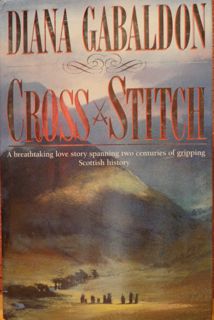
outlanderI first read Outlander – or Cross Stitch as it was called in the UK – back in 1992. A wonderful mix of romance, adventure and history set in Scotland, I loved it and recommended it to friends and family. I even wrote to Diana Gabaldon asking for an interview for the writers’ group I belong to, The Alberta Romance Writers’ Association, and she was extremely generous with her time and answers.

So when I heard it was finally being adapted as a TV series by Starz, I was both excited and a little anxious. Would they do it justice? We’re now two episodes in, so what are my feelings so far?

Here’s what I like.

1) I’m so happy that a story set in Scotland has actually been filmed in Scotland – unlike some other famous ‘Scottish’ movies I could name. The scenery is stunning and I’ve had a lot of fun figuring out the locations. If you’re planning on visiting Scotland and would like to check out the Outlander sites, even Visit Scotland has got in on the act and created an Outlander map.

2) I think all three main characters, Clare, Jamie and Frank/Jack have been very well cast and are doing a great job. And I’m thrilled to see Gary Lewis, one of my favourite character actors, playing Colum.

3) The fact that they’re sticking to the book. It was interesting to hear the producer say that the series has been made for the book’s fans. Having dabbled in the world of screenwriting myself I understand the huge difference between writing for the page and writing for the screen, so I appreciate that the writers have stuck to the book as closely as they have. But then, they had good source material to start with, didn’t they!

As for the ‘Meh’?

1) The Scottish twee. Admittedly the major audience for this series will be the US and I feel what’s being presented is how they imagine Scotland, and Scottish people, to be. However, as a Scot, there have been places where I have squirmed uncomfortably. There was one scene in the first episode where it felt like Dougal and the Scottish Dwarves… all named Goofy. And as for some of the accents..! And lines. A patient not liking ‘being stuck with a needle’? That’s not an expression I ever heard until I moved to the western side of the pond. But again, the major audience will be American and they might not be familiar with the term ‘injection’ or ‘jag’, so I’m probably just being picky.

2) The nudity. I’m not talking about the sex scenes, but the ones with Clare dressing and Jamie’s sister being attacked in the second episode. I don’t like to think I’m a prude – although maybe I am. This series was advertised as Scotland’s Game of Thrones, and for that reason I know of 3 men in particular who tuned in.  One gave up half way through the first episode, the second at the end of the first hour, and the third has vowed to watch no more having persevered through the second episode. Now, there may be many men who continue to watch and love the series, but my feeling is that the main audience is and will continue to be female. Do women really want to see so much female nudity? Is it necessary to the scene(s) or is it exploiting the actresses? People might argue that I feel this way because, ‘You’re just jealous because you’re older and will never have a body like that again’. Fair enough if that’s what they believe, but because I’m older, and have been around the block a few times, I think I can recognize exploitation when I see it.

But as I said above, I’m being picky.

If you loved the books, there’s waaay more right with the series than is wrong – you can’t please all the people all the time –  so I’ll definitely keep watching. But my advice to anyone would be ‘Read the book first’! Always, read the book.

I’d love to hear your thoughts on Outlander/Cross Stitch and the job of bringing it to the screen.


When Words Collide

I spent a great few days last weekend at the When Words Collide conference here in Calgary. Now in its fourth year, it just keeps getting better and better.

Special guests this years included writers, Jack Whyte (check out his website just to listen to his amazing voice!) Brandon Sanderson, Robert J. Sawyer, Jacqueline Guest, Mark Leslie and Shirlee Smith Matheson and editor Adrienne Kerr.

I belong to a wonderful writing group The Alberta Romance Writers’ Association, whose members generously share their knowledge and expertise on both the craft and business of writing, but sometimes you need to get out there and hear from other experts in their field. So much has changed in the publishing world that it’s hard – and sometimes a little intimidating – to keep up, but the focus remains on bringing the best book to the reader whether it is traditionally published or self-published.

The dates and location have already been set up for next year’s WWC – August 14-16th at the Delta Calgary South – and registration is open. At the bargain basement price of $40 it’s a wonderful deal.

See you there!

When Words Collide – The Heroine’s Journey

My second workshop of the When Words Collide Conference this Sunday morning is a discussion on The Heroine’s Journey. Is the Hero’s Journey the same as the Heroine’s?  Do you need to be male to be a hero and female to be a heroine?

My own new personal heroine on this topic is Kim Hudson with her book The Virgin’s Promise.  Please check her out.

If you would like more information on the difference between the male and feminine journeys – and a link to a YouTube interview with Kim Hudson – please click on this LINK.

Happy writing.

When Words Collide – Theme Workshop

I’m really excited to be giving two workshops at this year’s When Words Collide Conference in Calgary, August 8-10th.

The first, on Friday morning, is part of a pre-festival workshop offered by The Alberta Romance Writers’ Association where I will be presenting along with fellow writers Jessica L. Jackson, Mahrie G. Reid and Sarah Kades.

The topic I’m discussing is Theme and its importance in your story. This is a subject I feel passionate about because theme is the heart of your story.

If you would like to check out my handout and read my thoughts on the importance of theme, please CLICK HERE for a link.

I will also be talking about The Heroine’s Journey on Sunday morning at 11am and will be posting a link to that handout on Sunday morning.

Happy Conference, everyone.

When Words Collide – Mark Leslie

Day two of the pre-festival workshops for When Words Collide and yet another great session.

As an author of speculative fiction AND director of self-publishing and author relations at Kobo Writing Life,  Mark Leslie (Lefebvre), offered a unique perspective on the world of Hybrid publishing.

Hybrid publishing? To be honest, I wasn’t familiar with the term until I saw the title on the festival programme, but it appears that many writers are finding success by embracing both traditional AND self-publishing.

From his position at Kobo, Mark was able to offer us some very specific numbers.
In 2013, only 12 authors made more than $100,000 through Kobo Writing Life. (Out of those 12, 11 were romance authors.)
5% made more than $50,000
8% made more than $10,000
20% made more than $5,000
Which leaves a LOT earning between $100 and $5,000

He talked too about The Three P’s of self-publishing.
Practice. Patience. Persistence.

And don’t expect the money to come from having only one book out there. The general wisdom is that you don’t start making money until you have a minimum of 3-4 books published.

A great workshop. I came away with a much better understanding of the realities of the self-publishing industry and a cautious optimism (that phrase again) that this is do-able. Thanks, Mark.

Roll on tomorrow when the conference really gets under way.


When Words Collide – Adrienne Kerr

I’m literally just back in the door after attending my first When Words Collide workshop of the conference. Although WWC ‘proper’ doesn’t kick off until Friday, they’re offering several pre-conference workshops today and Thursday.  I wanted to hear Adrienne Kerr, Acquisitions Editor for Penguin Canada, speak about the Author/Editor Relationship.

Wow! Her workshop was so – very – much more than the title suggested.

First off, Adrienne Kerr was a great speaker; funny, knowledgable, personable, thoughtful, perceptive, informative – my brain is literally buzzing as it processes all I learned today. (And I’m not trying to butter her up just because I’m an aspiring author and she’s an editor.) The hours sped by as she offered fascinating insights into the current state of the publishing industry (not just in Canada but also in the US and UK), the history and trials of its recent past and the challenges it faces in the future.

Other topics included:
The Value and Capital Publishers Bring to the Business – and what they can offer an author.
The Economic Challenges Facing Large Publishers.
An Examination of Contracts from the Publisher and Author’s POV.
The Role of the Agent.
The Author/Editor Relationship.
The Differences Between The US Publishing Industry and The Canadian.

It’s a challenging time to be a writer or a publisher. Publishing is a business and like all businesses, the bottom line rules.

Listening to her description of the industry, my mood swung from despair to excitement, settling down around cautious optimism. And that’s probably the best – and most realistic – place to be.

If you’re attending When Words Collide and haven’t yet decided which panels/workshops to attend, I highly recommend you check out those where Adrienne is speaking.

Eagle In The Sky – Wilbur Smith

Eagle In The Sky was my introduction to Wilbur Smith’s writing.  I read it waaaay back in the day and loved it, finding it to be the perfect mix of romance and adventure. For me it brought the late 60s and early 70s, and a part of the world I didn’t know, vividly to life.

Fast forward 40 years. (Yikes! Am I really that old?)  My husband’s been nagging me that we have to downsize – which we do – and that, ‘You really have to do something about the ridiculous number of books you have, Diana. If you want to read something again, put it on your Kindle.’

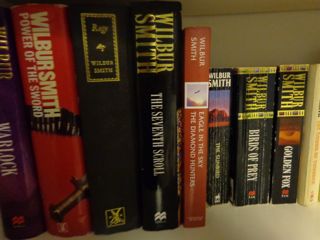
Which is all well and good, but personally I think a house without shelves filled with books has no right to call itself a home.  Still, I get his drift, so I go down to the basement to make a start on clearing out some of the bookcases and come across a shelf full of Wilbur Smith. I haven’t read quite as many as my husband, but we’re both fans.

SHELF

And there it is.

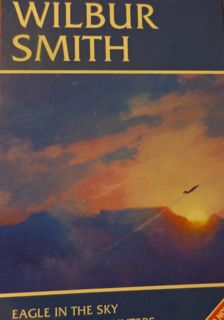
Eagle In The Sky.

Not my original copy – that’s been lost in one of our many moves – but a replacement I must have bought and never read.

I pull it from the shelf and flick through the pages.

Should I risk reading it again?

My memories of the story from all those years ago are so strong – both the characters and plot are clear and much beloved in my head and my heart. If I read it again will I be disappointed?

EAGLE IN THE SKY BOOOK

No.

David and Debra’s love story remained as poignant as it was on first reading. Smith’s deft touch as he takes us from South Africa to Israel and back again is assured and masterful. That last scene…

I love this story.