Walking the Labyrinth – Calgary

A labyrinth? Here in Calgary?

Who knew!

I had always assumed (incorrectly, as it turns out) that labyrinth was just another word for a maze – a maze offers you choices, while a labyrinth has only one track leading in and out – and was intrigued to discover there are several to be found here in Calgary.

Labyrinths have been around for thousands of years, featuring in ancient tales and legends as well as being a spiritual tool used in many religions.

When it comes to stories, perhaps the most famous labyrinth was that in Crete where Theseus killed the Minotaur. Briefly, every nine years, King Minos of Crete demanded that the city of Athens send seven young boys and seven young maidens to Crete to be devoured by the Minotaur – a half man, half bull creature – in recompense for a previous war. The third time this happened, Theseus volunteered to take the place of one of the youths and vowed to kill the Minotaur. (If something about this tale sounds familiar, I found an interview with Suzanne Collins, the author of the highly successful Hunger Games trilogy, where she acknowledges the Minotaur myth as one of the inspirations for her book.)

Perhaps the most famous religious labyrinth is to be found in Chartres Cathedral in France. Apparently, about one thousand years ago, when it became to unsafe for Christians to make a pilgrimage to Jerusalem, pilgrims began visiting the big cathedrals in Europe; Chartres, Canterbury and Santiago de Compostello. Somewhere between 1200-1240 a labyrinth was laid in the floor of Chartres which became known as The Road to Jerusalem. Not a maze, but a single track, it provided an opportunity for the faithful to replicate a pilgrimage to the Holy Land by following the path on their knees while praying.

But what has this to do with Calgary?
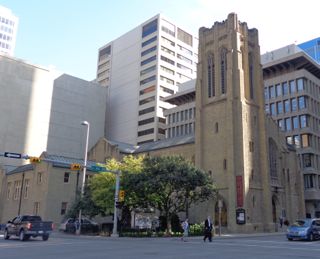
CHURCHONE

Knox United Church, Calgary

The labyrinth in Knox United Church, in the heart of Calgary’s downtown, is open to all – Christian or not – from Monday-Friday, 9am-7pm, and is based on the Chartres labyrinth.

When I visited the labyrinth yesterday, I walked it twice. The first time was from sheer curiosity: Was there really only one way in and out?  Did I cover every section of the intricate design?


LAB

The Labyrinth, Knox United Church, Calgary

The second time I decided to take it a little more seriously. According to the pamphlet provided by the church, the labyrinth is a unique spiritual tool that can be used to:
deepen self-knowledge
relieve stress and clear the mind
empower creativity
calm people in life transitions
awaken the spirit within
bring forth spiritual healing
open a path to action

I’m not religious, but I turned on the CD that is provided and tried to quiet my mind. There is no right or wrong way to walk the labyrinth, but I found that by just taking my time and concentrating, at the end of 20 minutes I returned once more to the entrance of the labyrinth feeling calm and relaxed.
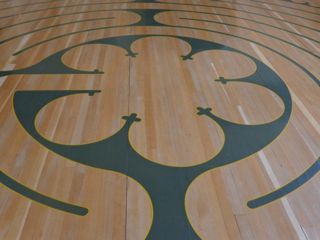
CENTRE

The centre of the labyrinth, Knox United Church, Calgary.

The labyrinth in Knox United Church is not the only one in Calgary; there are several more, including an outdoor one in Sarcee Park. If you’re interested in finding one near you, please check out this worldwide labyrinth locator.
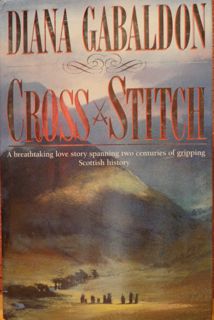
 

Outlander/Cross Stitch

outlanderI first read Outlander – or Cross Stitch as it was called in the UK – back in 1992. A wonderful mix of romance, adventure and history set in Scotland, I loved it and recommended it to friends and family. I even wrote to Diana Gabaldon asking for an interview for the writers’ group I belong to, The Alberta Romance Writers’ Association, and she was extremely generous with her time and answers.

So when I heard it was finally being adapted as a TV series by Starz, I was both excited and a little anxious. Would they do it justice? We’re now two episodes in, so what are my feelings so far?

Here’s what I like.

1) I’m so happy that a story set in Scotland has actually been filmed in Scotland – unlike some other famous ‘Scottish’ movies I could name. The scenery is stunning and I’ve had a lot of fun figuring out the locations. If you’re planning on visiting Scotland and would like to check out the Outlander sites, even Visit Scotland has got in on the act and created an Outlander map.

2) I think all three main characters, Clare, Jamie and Frank/Jack have been very well cast and are doing a great job. And I’m thrilled to see Gary Lewis, one of my favourite character actors, playing Colum.

3) The fact that they’re sticking to the book. It was interesting to hear the producer say that the series has been made for the book’s fans. Having dabbled in the world of screenwriting myself I understand the huge difference between writing for the page and writing for the screen, so I appreciate that the writers have stuck to the book as closely as they have. But then, they had good source material to start with, didn’t they!

As for the ‘Meh’?

1) The Scottish twee. Admittedly the major audience for this series will be the US and I feel what’s being presented is how they imagine Scotland, and Scottish people, to be. However, as a Scot, there have been places where I have squirmed uncomfortably. There was one scene in the first episode where it felt like Dougal and the Scottish Dwarves… all named Goofy. And as for some of the accents..! And lines. A patient not liking ‘being stuck with a needle’? That’s not an expression I ever heard until I moved to the western side of the pond. But again, the major audience will be American and they might not be familiar with the term ‘injection’ or ‘jag’, so I’m probably just being picky.

2) The nudity. I’m not talking about the sex scenes, but the ones with Clare dressing and Jamie’s sister being attacked in the second episode. I don’t like to think I’m a prude – although maybe I am. This series was advertised as Scotland’s Game of Thrones, and for that reason I know of 3 men in particular who tuned in.  One gave up half way through the first episode, the second at the end of the first hour, and the third has vowed to watch no more having persevered through the second episode. Now, there may be many men who continue to watch and love the series, but my feeling is that the main audience is and will continue to be female. Do women really want to see so much female nudity? Is it necessary to the scene(s) or is it exploiting the actresses? People might argue that I feel this way because, ‘You’re just jealous because you’re older and will never have a body like that again’. Fair enough if that’s what they believe, but because I’m older, and have been around the block a few times, I think I can recognize exploitation when I see it.

But as I said above, I’m being picky.

If you loved the books, there’s waaay more right with the series than is wrong – you can’t please all the people all the time –  so I’ll definitely keep watching. But my advice to anyone would be ‘Read the book first’! Always, read the book.

I’d love to hear your thoughts on Outlander/Cross Stitch and the job of bringing it to the screen.


Women in World War One

I know a fair bit about my grandfathers’ lives during Word War One. It’s always easy to find out about men’s lives in wartime. In the case of servicemen, every posting is recorded in their service records. For those back home, employed in essential services or too old to fight, there are always work records or census details. But what about the women? What about my grandmothers?

Gran Dad

My paternal grandmother, Mary Hendry, holding my father. 1915

Nannie2

My maternal grandmother, Harriet Davenport

I never met my paternal grandmother – Mary Hendry – but as both she and my maternal grandmother – Harriet Davenport – were young mothers during the 1914/18 conflict, I can only assume they remained at home raising their children while faced with diminishing resources and increasing food shortages. In my paternal grandmother’s case, she raised her family as a single parent under the constant worry that her husband may not return from the front.

But for many single women who found employment it was an exciting time. For the first time in their lives they were earning decent money which allowed them to live independent lives.  I’ve just watched Katie Adie’s Women of World War One which is a fascinating look at how The Great War changed women’s lives and led – eventually – to women finally receiving the vote.  (Women over 30 got the vote in 1918, all women over 21 in 1928.  All men over 21 got the vote in 1918.)

Here’s a clip from Youtube, but please try to catch the whole programme. It’s available on BBC iPlayer until midnight on Tuesday August 19th.

Percy Frederick Huggins

One week into memories of The Great War and it’s the turn of my Grandfather on my Mum’s side. He died when I was about 3 or 4 so I don’t remember much about him. All the memories below are those of his youngest daughter – my aunt Anne who contributed her wartime memories to my wartime rationing blogs at the beginning of this year. I only have only 2 personal memories of Granddad, and they’re of him lying in bed in what, I suppose, was his sick room. He loved canaries and I do remember the sound of them chattering. I also remember that whenever I walked in the door he started singing, ‘Sugar in the morning, Sugar in the evening, Sugar at suppertime…’

gradadcroppedBorn in London, possibly Clapham, around 1878, he was the youngest son in a family of 6 girls and 4 boys. Anne doesn’t know where he got his education and training but presumes it was something to do with glass because when he couldn’t find a job in London, he found one in Glasgow, with Barr and Stroud.  My grandmother stayed in London to await the arrival of her first child, Percy Alexander Huggins, who was born in November 1912. (I think I remember Uncle Alex saying that Granddad wanted him born in England so he could play cricket for England when he grew up – but that might be a false memory.)

Part of Barr and Stroud’s production included  range finders, torpedo depth recorders, periscope range finders and binoculars, so although working in a reserved occupation, my Grandfather’s work was essential to both First and Second World Wars.

According to Anne, he was just over 6′ tall, and thin. His legs seemed to take up most of his height – a real Daddy-longlegs. They were thin too. My brother at 2 years of age always, and off his own bat, grabbed a cushion before he would sit on his Granddad’s boney thighs!

Anne has nice memories of him taking her to Kelvingrove Park in Glasgow to feed the ducks, to another park Dawesholme, which was also a bird sanctuary – he was fond of birds, especially chaffinches, and of accompanying him on fishing trips to Kilmardinny Loch – as long as she promised to keep quiet! He fished for pike (huge, vicious things) sometimes battling for half-an-hour or more. Sometimes they were too big to take home and he would hand them in to a local nursing home – the fish were big enough to feed both staff and patients.

PercyHuggins

Her wartime memories are mostly of his work during World War 2 as she was born long after The Great War ended.  As far as she can remember, during WW2 Barr and Stroud hived off some departments to what were called ‘shadow factories’ – the main building at Anniesland being too obvious a target for bombs. Anne doesn’t know how many shadow places there were, but Granddad was put in to manage one – a very large ex-garage and workshop near Kirklee.  He took her there one Sunday when it was quiet. She was in her early teens and fascinated by the equipment on all the benches and wanted to know what they all did. There were also small cubicles at one end where two people could work on tricky pieces of work.

At the back of the building there was a large area, laid down for wartime as allotments, and he quickly put his name on two of these. At 60/61 he had a garden for the first time – and what a job he made or it. He kept it going for a long time after VE Day too, since food was in short supply (after WW2) until the early 50s.

As always, when reading or listening to Anne’s stories, I wish I’d asked more questions when I was younger. It’s a lesson to us all to ask the questions of our parents and grandparents now!


Reader’s Rock Garden Cafe – Calgary

A few weeks ago, my daughter took me to the Reader’s Rock Garden Cafe for my birthday lunch. It’s one of Calgary’s little secrets – most native Calgarians have no idea it’s there – tucked off Macleod Trail on 25th Ave. The setting is glorious and the food first class.  (Check out their menu here.)

exterior3  interior

On the day we visited, I had the lamb – Albertan, of course – which was cooked to perfection. I followed that with an Eton Mess – one of my favourite desserts – which tasted every bit as wonderful as it looked. Prices are very reasonable considering the excellent quality, and the setting couldn’t be more perfect.

food1    food2

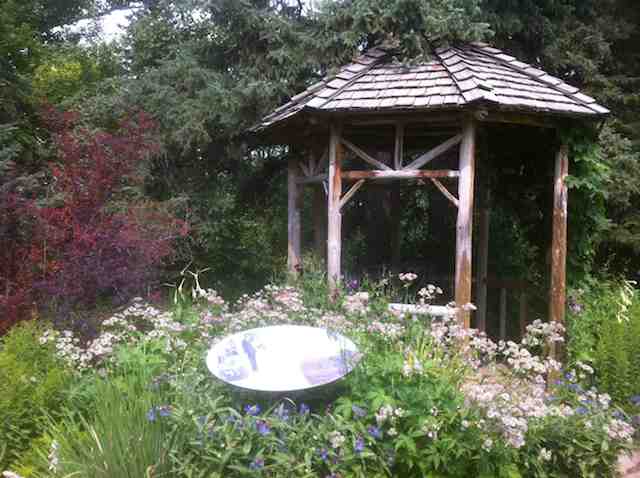
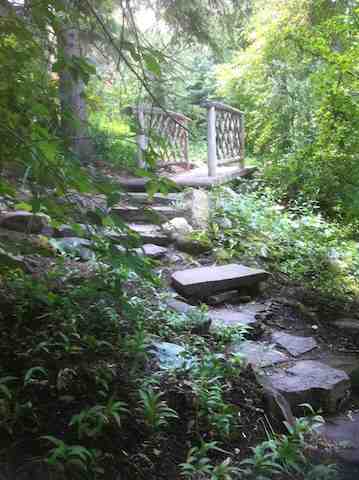
The cafe is surrounded by the most beautiful garden which is a testament to one man’s passion for horticulture. William Roland Reader was Superintendent for the City of Calgary Parks from 1913-42. During that time he transformed what was a bare hillside into an internationally acclaimed garden.

exterior1

Over a period of 30 years, he trialled over 4,000 different plant species. The result is a tranquil, exquisite and secret paradise barely metres from one of Calgary’s busiest thoroughfares.

exterior2

Check it out.  You won’t be disappointed.


David Tweedie Cranstoun

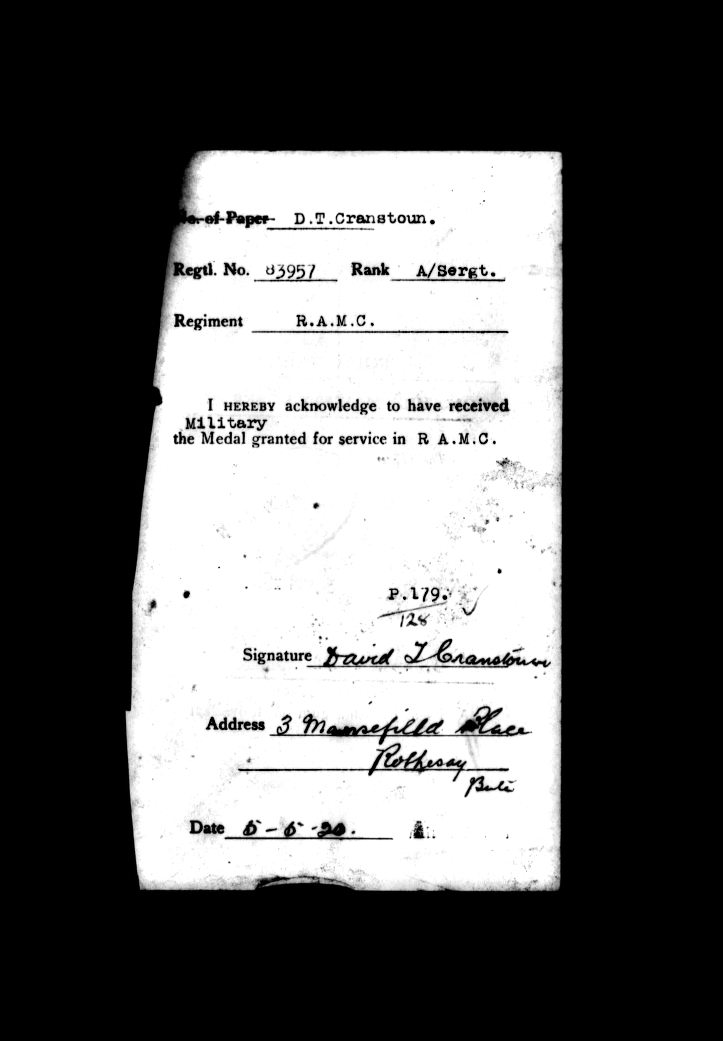
Granddad - I think copyAugust 4th, 2014 marks the 100th anniversary of the outbreak of what became known as World War One.  I never met my grandfather on my dad’s side, David Tweedie Cranstoun; he died ten years before I was born. A trained ‘dispenser’ working in a pharmacy shop in Rothesay, he joined the Royal Army Medical Corps (RAMC) in 1916, ultimately winning the Military Medal for ‘Bravery In The Field’ in 1918.

How do I know this? Not from learning stories about him when I was a child. It never occurred to me to ask questions about his life. By the time I did, all the family members who’d known him personally were dead.

But it’s easy to find out about an ex-soldier’s military record, I can hear you say. When you know their service number you can access their service records online.  What could be simpler?

And that’s true – except my grandfather’s service records were among those damaged or destroyed by the Luftwaffe in World War Two. But some fragments remain, burn marks evident around the sides.

So this is what I’ve found out about the grandfather I never knew.  He was born on May 2nd, 1887, the illegitimate son of Jane Tweedie, a domestic servant.

Birth certificate copy

The fact that he was illegitimate came as a surprise. Growing up in Glasgow in the 60s, ‘that kind of thing’ didn’t happen in families like ours. And you know, I’m not sure my dad ever knew, because somewhere between 1900 an 1910, Enlistbefore he married and became a father, David Tweedie changed his name to David Tweedie Cranstoun. As far as my siblings and cousins were aware, our Cranstoun great-aunts and uncles were truly our grandfather’s flesh and blood. They were always present for family celebrations and there was never a hint of ‘scandal’ about the man who – in reality – was their half-brother.
Married with three children, David joined the army in 1916, serving, as I mentioned before, in the Royal Army Medical Corps.

MMnotification copyI know very little about his war. It must have been bloody and he must have seen some horrific sights. According to surviving records, he contacted measles at the front and was a patient in an isolation hospital in Glasgow for some time. And he must have done something very brave to win the Military Medal in 1918.

I also know that after he was demobbed from the army in 1920 he couldn’t settle. According to my father, my grandfather found it hard to adjust to everyday civilian life and signed up to fight for the ‘White Russians’ following the Bolshevik Revolution in 1921.

Today, 100 years on from the beginning of that bloody First World War, I can’t help thinking of David Tweedie Cranstoun and all the sons, brothers, fathers, sisters, daughters and mothers who served in that conflict at enormous emotional and physical cost to themselves and their families.

We owe them all so much.

Thank you, Granddad.

In My Father’s Footsteps

So, I’ve actually gone and done it.

I’ve been toying with the idea of self-publishing for some time, but yesterday I took the plunge and uploaded a short memoir of my pilgrimage to the beaches of Dunkirk in 2009 to Amazon.

DOGTAGSMy dad was one of 340,000 soldiers evacuated from the beaches of Dunkirk in May 1940 following the German invasion of Belgium, Holland and France. Dad died when I was in my early twenties. He never really talked about his experiences, but in 2009 I visited France with my friend Anna. Not only did we walk the full length of the beach from De Panne in Belgium to Dunkirk in France in his memory, but we also had the honour of meeting a real Dunkirk veteran and talking to him about his time on the beach 69 years earlier.

And then… I met an elderly man who had known my father all those years ago; who had lived in the house next door to where Dad was billeted for six months.

If you’re interested in reading the story, please click here to purchase a copy.  I’ve also included several photos from my journey on the In My Father’s Footsteps link at the top of this page.

Enjoy.

Calgary Stampede

cowboy hatThe annual Calgary Stampede – The Greatest Outdoor Show on Earth – kicked off last Friday morning with a three-hour parade through downtown. This year’s parade marshall was Captain Kirk himself, William Shatner, but in the past it’s been led by actors such as Bing Crosby, Bob Hope, Christopher Reeve and Jack Palance, politicians, sports stars and other dignitaries such as Chris Hadfield, Prince Charles, Ken Taylor, Rick Hansen and Walt Disney.

The first stampede – although not called that – was organised in 1912 by Guy Weadick, an American cowboy and veteran of travelling Wild West Shows. Back then, Calgary was a relatively young city; the North West Mounted Police had arrived in 1875 and founded a fort by the Bow and Elbow rivers. In 1884, Calgary, with a population of only 500 people, was incorporated as town.

CHUCKS

Photo: girltrieslife.com

In 1912, with financial backing provided by four very successful cattlemen – Pat Burns, George Lane, AE Cross and AJ MacLean – Guy Weadick produced what was called the Frontier Days and Cowboy Championship. It was supposed to be a one-off and while there was a suggestion it should be repeated in 1913, money wasn’t forthcoming. After World War One, the idea was resurrected and in 1919 The Victory Stampede was held.  Since then, it’s gone from strength to strength.

GROUNDS

Photo: girltrieslife.com

Beginning on the 1st Friday in July and continuing for ten days until the following Sunday, it’s a time when the city comes alive with the spirit of the Old West.  Down at the Stampede grounds you’ll find an afternoon rodeo, evening chuck wagon races and show, a midway, agricultural and craft exhibition, market, native village and nighttime firework display.


Western ShirtsDuring the ten days of Stampede, the city itself is festooned with banners,  rodeo scenes are painted onto the windows of shops and office buildings, and you can find plenty of pancake breakfasts and stampede parties to suit everyone’s taste. Banks are transformed into Wild West corrals, and young and old deck themselves out in jeans, cowboy shirt, hat and boots.

Come visit us!

Donaldina Cameron

On a recent visit to San Francisco, I took an Alley tour of Chinatown where our guides told us the story of Donaldina Cameron (July 26, 1869 – January 4, 1968). Born in New Zealand to Scottish parents, Donaldina Cameron moved to California with her family when she was two years of age.

Initially joining The Presbyterian Home (a mission home caring for Asian women) in San Fransisco as a young sewing teacher, Donaldina became its superintendent at the young age of twenty-five. Situated on the edge of Chinatown, the home was a place of refuge for young Chinese girls smuggled illegally into the US to work in the sex trade or as indentured servants.

Fearing an influx of Asian immigration to the US, the government had enacted the Chinese Exclusion Act in 1882. This prohibited the immigration of (primarily) Chinese labourers, but it especially banned the immigration of Chinese women unless they were already married to a US citizen. Needless to say, this skewed ratio of men to women and set the stage for a massive illegal sex trade. (The act was only repealed in 1943, with a Californian law prohibiting Asians from marrying whites not repealed until 1948. In other states, similar laws were repealed only in 1967.)

Depending on which side you were on, Donaldina was known as the Angry Angel of Chinatown, the Jesus Woman or the White Devil. With the help of the police – and a sledgehammer or two – she broke down the doors of places she knew women were being held, rescuing as many as she could and gaining guardianship so they could not be returned to their slave owners. Estimates are she saved 3,000 such women, but only 600 were actually recorded on her books. Still, 600 is a not insubstantial number.

Once the women were freed they resided at the Presbyterian Home where they converted to Christianity and were taught English and western housekeeping skills. While some women accepted this conversion and went on to call Donaldina ‘Lo Mo’ (Foster Mother), others weren’t so happy about the loss of their culture. The girls left the home only to marry Christian men

The original home was destroyed by the 1906 earthquake. The women fled the building only for Donaldina to realise their guardianship papers were still inside; without those, the girls could be snatched back by their former owners. Donaldina returned to the damaged house to retrieve the papers, getting out just before the building was dynamited to create a firebreak in an attempt to halt the fire raging through the city.

The house was rebuilt in 1907 on Sacramento Street.

The Cloisters – NYC

I have to be honest, when it was suggested we visit The Cloisters during our recent trip to NYC I took a bit of convincing. I’ve visited medieval convents and monasteries in Europe and was very sceptical that such beauty, solitude and atmosphere could be replicated in Manhattan.

Boy, was I wrong!

(Victoria Smith refers to The Cloisters as one of the underrated gems of New York, so please check out her blog for it and other suggestions.)

CLOSITERS8

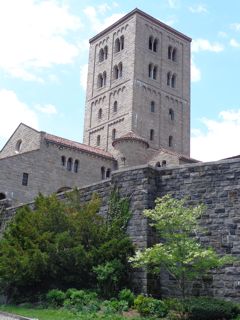
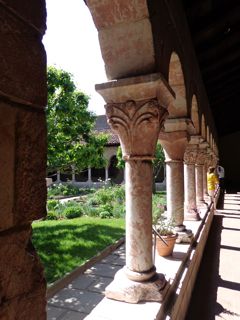
As part of the Metropolitan Museum of Art, The Cloisters is devoted to the art and architecture of Medieval Europe. (Click Here for a link to the official site which includes a 28 minute video.)

CLOSITERS4   CLOSITERS3

A ticket for Metropolitan Museum of Art allows you six days to use that same ticket to visit The Cloisters.

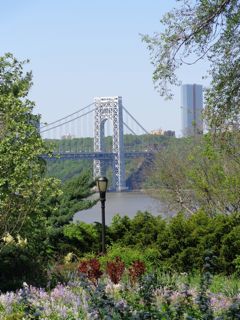
Getting there is simple. Take the A train uptown to 190th.  From there you can either a) hop on the M4 bus for one stop, b) walk along Margaret Corbin Drive, or c) walk through Fort Tyron Park. I recommend the latter as the scenery and views are stunning.

PARK   park2

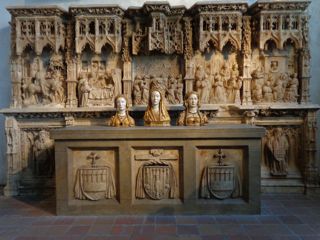
Built from money donated by Rockefeller, the actual fabric of The Cloisters contains elements from original European (mostly French) medieval cloisters.

CLOSITERS1   CLOSITERS2

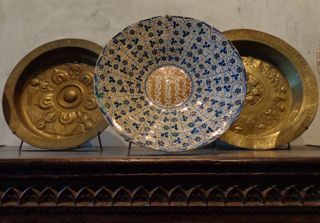
Artifacts include paintings, tapestries (including the Unicorn tapestry), plates, sculptures and religious items.

COSITER6   CLOSIETES7

My favourite was a golden filigree straw, used for drinking the wine (Blood of Christ) from the chalice to ensure none spilled on the ground.

CLOSITER9

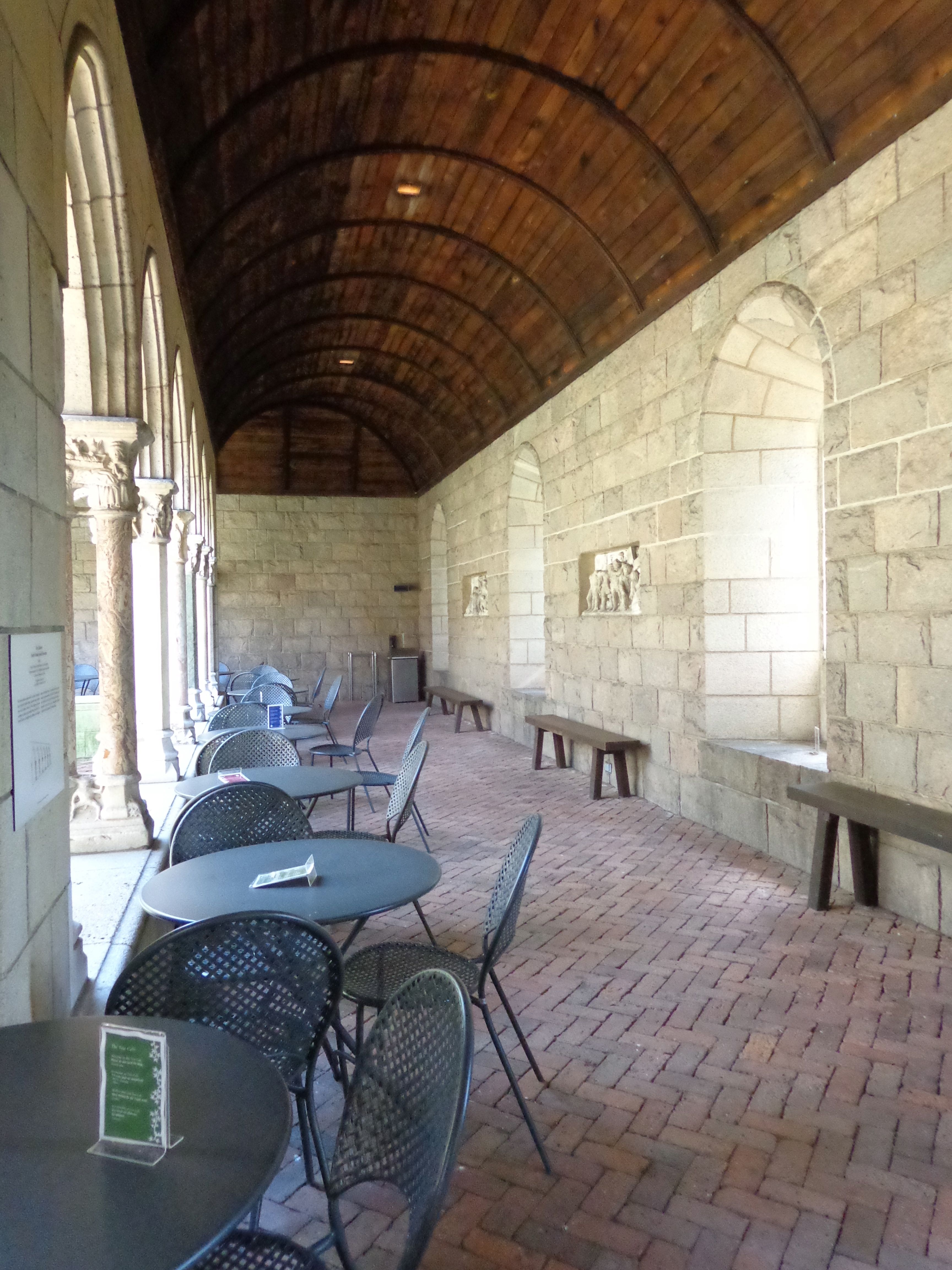
Possessing the most peaceful cafeteria you can imagine, The Cloisters is a wonderful place to while away a few hours and recharge your soul before returning to the hustle and bustle of the rest of Manhattan.

clositersmore

Visit it.  You won’t be disappointed!